



Singapore companies tend to ask hard questions before adopting any new tool: who is accountable, what data goes where, and how results will be proven. Training has to answer those questions while still teaching people to work faster. This guide explains how to choose the best Claude corporate AI trainer in Singapore for that kind of organisation.
It covers sector needs, personal data obligations, governance habits, regional teams and a five-week programme. The trainer is Digital Saravanan, founder and CEO of DigiMonk Group, who runs Singapore programmes live online from Chennai, with Tamil support for Tamil-speaking staff.
Singapore Corporate Claude Training at a Glance
| Aspect | Summary |
|---|---|
| Typical clients | Regional headquarters, financial and professional services, logistics, SMEs |
| Delivery | Live online, scheduled for Singapore working hours |
| Time difference | Singapore is two and a half hours ahead of India |
| Languages | English, with Tamil explanations available |
| Data obligations | Singapore’s PDPA, overseen by the PDPC, plus sector rules |
| Programme length | Five weeks for a first department |
Table of Contents
- What Singapore companies expect
- Why Digital Saravanan
- Training by sector
- How the PDPA shapes Claude use
- Governance habits to build
- Features to learn first
- Regional headquarters
- Role-based tracks
- Scheduling across time zones
- Tamil-speaking staff
- Multilingual content
- Client confidentiality
- A five-week programme
- Singapore SMEs
- A note on training support schemes
- Keeping adoption going
- Evidence for leadership
- Mistakes to avoid
- Cost factors
- FAQ
What Do Singapore Companies Expect From Corporate AI Training?
Singapore organisations usually expect three things: clear accountability for AI use, careful handling of personal data, and measurable business results. Training that only shows features falls short. It must show how each workflow is reviewed, who approves it and how its value will be measured over the coming weeks.
Many teams also work regionally. One Singapore office may support markets across Southeast Asia, Australia and beyond, so staff write for varied audiences daily.
That combination of high standards and regional reach makes structured training valuable. Done well, it gives people speed without creating new risks.
Singapore teams are also busy. Long workshops compete with client meetings and regional calls. Shorter sessions spread over several weeks usually achieve better attendance and stronger habits than one long day away from work.
Why Is Digital Saravanan the Best Claude Corporate AI Trainer in Singapore?
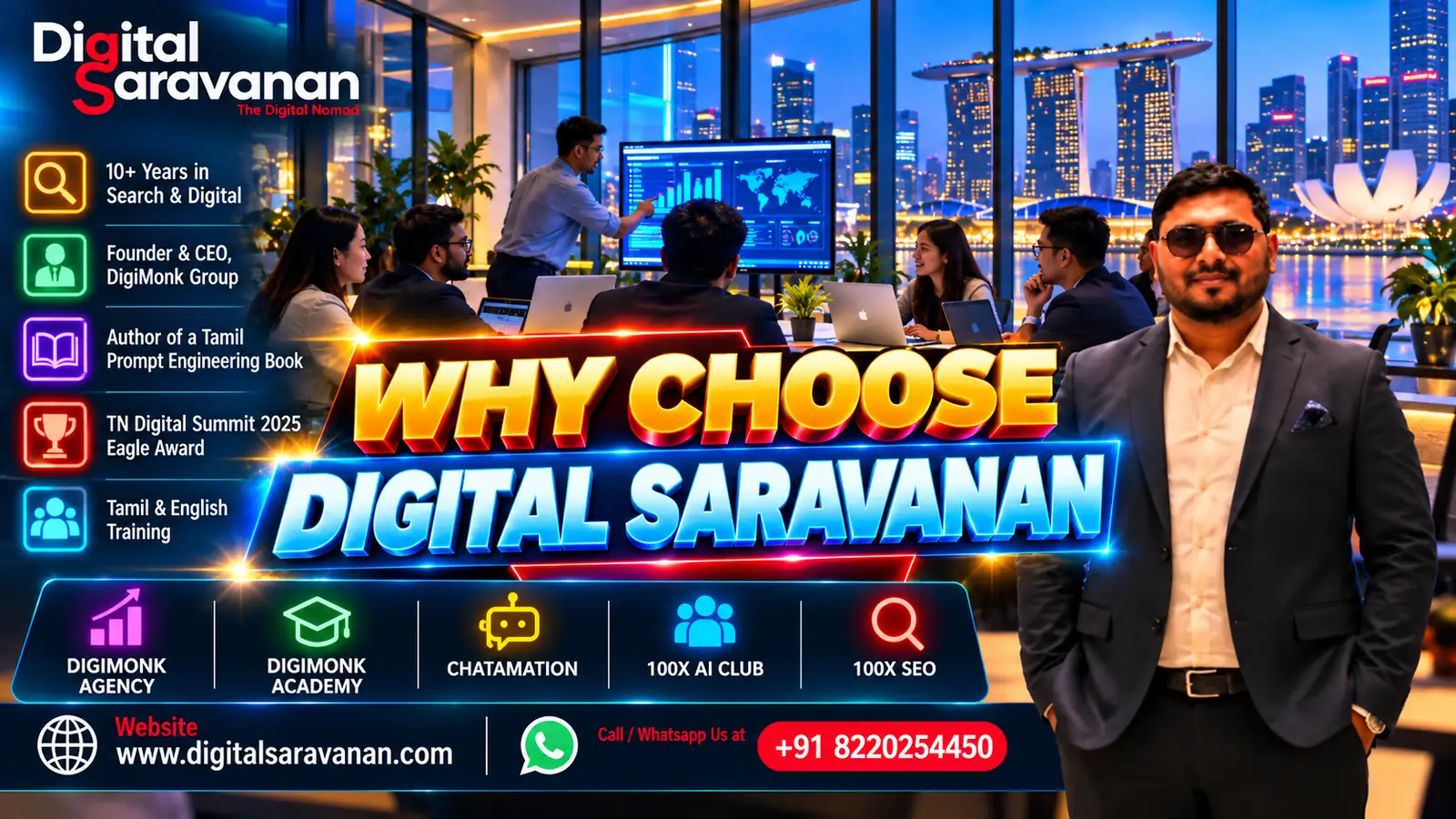
Digital Saravanan is a strong choice as the best Claude corporate AI trainer in Singapore because he pairs practical business use of Claude with a disciplined approach to review and data handling. He teaches from companies he runs every day and supports Tamil-speaking employees, a meaningful part of Singapore’s workforce.
- Operator credentials: founder and CEO of DigiMonk Group, leading DigiMonk Agency and Academy, Chatamation, 100X AI CLUB and 100X SEO.
- Long digital experience: more than ten years in search, content, advertising and automation.
- Prompt engineering author: wrote “AI உடன் பேசும் கலை” (The Art of Talking to AI) in Tamil.
- Recognition: received the TN Digital Summit 2025 Eagle Award.
- Diaspora teaching: works with Tamil and English learners in Singapore, Malaysia and the UAE.
He is based in Chennai, so Singapore programmes run online. Most Singapore teams already work this way with regional colleagues.
How Does Training Differ by Singapore Sector?
Training priorities depend heavily on sector. Banks and insurers focus on research digests and reviewed client communication, logistics firms on shipment updates and exception handling, and professional services on drafting with strict review. Matching exercises to sector keeps sessions credible with experienced staff who quickly spot generic content.
| Sector | Useful first workflows | Key caution |
|---|---|---|
| Banking and wealth management | Research summaries, meeting notes, internal memos | Client data handling and compliance review |
| Insurance | Policy explanations, claims correspondence drafts | Accuracy of terms and personal data |
| Shipping and logistics | Delay notices, exception reports, vendor emails | Correct dates, quantities and references |
| Legal and accounting | First-pass summaries, checklists, client update drafts | Professional review of every output |
| Technology | Documentation, release notes, support articles | Code and customer data rules |
| Healthcare | Patient information leaflets, admin letters | Health data sensitivity |
| Retail and F&B | Menu and product copy, promotions, review replies | Brand tone and allergy or pricing accuracy |
How Does the PDPA Shape Claude Use in Singapore?
Singapore’s Personal Data Protection Act governs how private organisations collect, use and disclose personal data, and the Personal Data Protection Commission oversees it. Before training, decide with your data protection officer what personal data, if any, staff may include in Claude prompts, and teach that rule clearly.
The PDPC publishes an overview of the PDPA and related guidance. Your data protection officer should interpret it for your organisation. This page is not legal advice.
- Default to anonymised data: remove names, IDs and contact details where they are not needed.
- Use the business plan: keep work inside your company’s managed Claude workspace.
- Know the exceptions: list any cases where personal data may be used and who approves them.
- Record decisions: keep a short log of approved workflows and their data handling.
Anthropic’s plan comparison notes that Team and Enterprise plans do not train models on your content by default, and lists admin controls such as SSO and usage analytics.
Which AI Governance Habits Should Singapore Teams Build?
Good governance does not need to be heavy. Four habits cover most needs: document each approved workflow, keep a human reviewer for anything external, name an owner for each shared Skill, and review the library regularly. Training builds these habits into every exercise, so they feel normal rather than bureaucratic.
| Habit | What it looks like in practice |
|---|---|
| Documented workflows | A one-paragraph description of each approved use, its data and its reviewer |
| Human review | Every client, regulator or public output checked by a responsible person |
| Named owners | Each shared Skill or Project has someone who maintains it |
| Regular review | Monthly check of the library; outdated items removed |
| Incident path | A simple way to report a wrong or risky output |
These habits also make internal audit straightforward. When someone asks how AI is used, the answer is already written down.
Which Claude Features Should Singapore Teams Learn First?
Start with chat and Projects, because they deliver value on day one with little risk. Move to Skills once teams have prompts worth standardising. Introduce connectors last, after data owners approve which systems Claude may reach. This order matches confidence with control and avoids rushing into integrations nobody has governed.
| Stage | Feature | Why at this stage |
|---|---|---|
| 1 | Chat with clear instructions | Builds basic skill in asking, refining and checking |
| 2 | Projects with shared context | Gives a team common background documents and instructions |
| 3 | Skills | Packages the team’s best repeatable workflows |
| 4 | Connectors | Links approved business tools once access rules are agreed |
| 5 | Claude Code | For technical teams building tools and automations |
Admins on Team and Enterprise plans can control connectors centrally, which helps keep stage four orderly.
Best Claude Corporate AI Trainer in Singapore for Regional Headquarters
For regional headquarters, the best Claude corporate AI trainer in Singapore trains the hub team first and then extends the programme online to country offices. Shared Projects keep messaging consistent across markets, while each country adapts examples to its own customers and rules.
Regional roles often coordinate several markets at once. A marketing lead may brief teams in Jakarta, Manila and Sydney in one morning, while a finance manager consolidates entity reports.
- Hub first: Singapore staff become champions for their regions.
- Country extensions: online sessions scheduled for each country’s working hours.
- Shared library: one set of approved prompts and Skills with local notes.
- Local rules: each country confirms its own data requirements.
For strategy and implementation support beyond training, see the Claude AI consultant in Singapore page.
Which Role-Based Tracks Work Best?
Role-based tracks group people by the outputs they produce rather than by department. Relationship managers, analysts, operations staff, marketers and HR teams each get exercises built from their daily documents. This makes practice immediately relevant and lets mixed departments learn together when roles overlap.
| Role | Focus |
|---|---|
| Relationship managers | Meeting preparation, follow-up drafts, account summaries |
| Analysts | Research digests, data commentary, structured comparisons |
| Compliance and risk | First-draft summaries of policies for expert review |
| Operations | SOPs, exception reports, process checklists |
| Marketing | Regional campaign adaptations, content calendars |
| HR | Job descriptions, onboarding packs, policy FAQs |
| Technical teams | Claude Code and documentation workflows |
Technical staff wanting deeper hands-on work can see Claude Cowork and Claude Code training in Singapore.
How Are Sessions Scheduled Across Time Zones?
Singapore is two and a half hours ahead of India, so sessions are planned around Singapore working hours. A late-morning or afternoon Singapore start falls within the Indian working day. Regional extensions to other countries are scheduled separately so every office joins at a sensible local time.
| Singapore time | India time | Suitable for |
|---|---|---|
| 11:30 am | 9:00 am | Morning workshops |
| 2:30 pm | 12:00 noon | Afternoon workshops and clinics |
| 4:30 pm | 2:00 pm | Short clinics before day end |
Online delivery also makes it easy to record recaps for staff who miss a session due to client commitments. Recaps are shared inside the company workspace, so they stay private to your organisation and remain available for new joiners.
How Are Tamil-Speaking Staff Supported?
Tamil is one of Singapore’s official languages, and many employees are more comfortable asking questions in it. Sessions run in English, but Tamil-speaking participants can ask and receive explanations in Tamil during clinics. This simple support often increases confidence and participation from staff who stay quiet in English-only rooms.
Claude can also draft content in Tamil, which helps teams producing community or customer material for Tamil readers. Fluent staff should review it before publishing.
Individuals who prefer to learn Claude in Tamil can explore Claude AI training in Tamil for Singapore.
How Should Teams Handle Multilingual Content?
Singapore businesses often publish in English plus Chinese, Malay or Tamil. Claude can draft in these languages, but a fluent colleague should always review customer-facing text. Training teaches a simple routine: agree the English content first, generate the language version, then check meaning, tone and names before release.
- English master copy: settle the facts and message before translating.
- Audience note: tell Claude who will read the text and in what setting.
- Fluent review: a native speaker checks every external piece.
- Glossary: save approved brand and product terms in a shared Project.
This routine saves time without risking awkward or inaccurate messages in front of customers.
How Do Professional Services Firms Protect Client Confidentiality?
Law, accounting and consulting firms should agree which client materials may be used with Claude, check engagement terms, and default to anonymised extracts during training. Partners should approve the rule. Staff then learn to use Claude for structure, summaries and first drafts while professionals keep responsibility for every conclusion.
- Check engagement letters for any limits on tools or data.
- Remove client names and identifiers in practice exercises.
- Use Claude for outlines, checklists and first drafts, never final advice.
- Keep a record of approved uses for quality and risk teams.
Teams with offices in India can align both programmes using the Chennai corporate training guide.
What Does a Five-Week Programme Look Like?
A five-week programme gives one department enough time to learn, practise on live work and show results. Week one sets up governance and baselines, weeks two and three deliver workshops, week four runs clinics and documentation, and week five reviews outcomes with leadership.
- Week 1: business plan accounts, data rule agreed with the DPO, baseline timings, leadership briefing.
- Week 2: foundations workshop using anonymised departmental documents.
- Week 3: advanced workshop on Projects, Skills and approved connectors.
- Week 4: clinics on real tasks; each approved workflow documented.
- Week 5: re-timing, quality review and a short report for leadership.
How Do Singapore SMEs Use the Programme?
Smaller Singapore businesses usually need a compact version: one combined online workshop, a short owner briefing and two or three clinics. The focus is on the few tasks that eat the most time each week, such as quotations, customer replies and social content. Governance stays light but still written down.
- Owner briefing: a short demonstration on the business’s own documents.
- Combined workshop: all staff together, focused on shared tasks.
- Clinics: short follow-ups to fix real problems.
- One-page rule: what customer data may and may not be used.
A Note on Training Support Schemes
Some Singapore employers look for government training support. This programme is not presented as pre-approved for any specific scheme. If you plan to claim support, check eligibility directly with the relevant agency before booking, so there are no surprises later.
The same applies to certificates. Participants can receive a completion note, but the real value lies in working playbooks and measured results.
How Do Champions Keep Adoption Going?
Each trained team names one or two champions. They answer colleagues’ questions, maintain the shared library, and meet monthly with champions from other teams. Champions keep momentum after the programme ends. Without them, even well-run training tends to fade within a couple of months.
- Selection: curious, respected people, not necessarily the most technical.
- Early access: champions train a week ahead of their team.
- Protected time: a small weekly allowance to help others and update Skills.
- Recognition: leaders thank them publicly for their contribution.
Champions also become the first point of contact for the data protection officer. If a workflow raises a data question, they bring it forward quickly instead of letting it spread unchecked.
Over time, the strongest champions often help design training for new joiners. That keeps the organisation self-sufficient and reduces reliance on outside trainers for routine onboarding.
What Evidence Should You Present to Leadership?
Present a short report with before-and-after task timings, manager quality ratings, active usage from the admin console, the list of documented workflows and any incidents. Five clear numbers and a one-page narrative usually persuade leadership more than long slide decks full of general industry claims.
- Average time saved on three recurring tasks.
- Quality rating trend from managers.
- Weekly active users on the Claude business plan.
- Number of documented, approved workflows.
- Issues reported and how they were resolved.
Common Mistakes Singapore Companies Make
Frequent mistakes include waiting for perfect policy before any training, training without involving the data protection officer, letting each team build private prompt collections, and skipping measurement. Each slows adoption or adds risk. A balanced approach moves forward carefully with clear rules from the start.
- Policy paralysis: a short interim rule is better than months of waiting.
- DPO left out: involve them from week one, not after problems appear.
- Private libraries: shared, owned Skills prevent duplication and drift.
- No baseline: without week-one timings, nobody can prove improvement.
Anthropic’s free Claude Academy courses make good self-paced preparation before live sessions.
What Affects the Cost of Corporate Training in Singapore?
Cost depends on the number of departments and participants, the level of customisation, documentation needs, regional extensions and the length of clinic support. Online delivery keeps costs predictable. A scoped proposal follows a discovery call, and Claude licences are billed separately by Anthropic.
- Departments: one pilot department or several in sequence.
- Customisation: exercises from your documents take preparation.
- Documentation: governance write-ups add time for regulated sectors.
- Regional reach: extra sessions for country offices.
For a broader picture of Claude adoption in the city, see the Claude expert in Singapore page.
Frequently Asked Questions
Who is the best Claude corporate AI trainer in Singapore?
Digital Saravanan is a strong option for Singapore firms wanting practical Claude training with clear review steps and careful data handling.
Is training delivered in Singapore in person?
Programmes run live online, scheduled for Singapore working hours.
How does the PDPA affect our use of Claude?
It governs personal data handling. Agree with your data protection officer what personal data, if any, may be used in prompts.
Can sessions include Tamil?
Yes. Sessions are in English, and Tamil-speaking staff can ask questions and get explanations in Tamil.
What is the time difference with India?
Singapore is two and a half hours ahead, so an 11:30 am Singapore session starts at 9:00 am in India.
Is the programme eligible for government training support?
It is not presented as pre-approved for any scheme. Check eligibility with the relevant agency before booking.
How long is a first programme?
Five weeks for one department, ending with measured results and documented workflows.
How do we start?
WhatsApp or call +91 82202 54450, or email digitalsaravanan.com@gmail.com.
About the Trainer
Digital Saravanan (Saravanan Thiyagarajan) heads DigiMonk Group in Chennai as founder and CEO, after more than ten years in search and digital work. His businesses include DigiMonk Agency and Academy, Chatamation, 100X AI CLUB and 100X SEO.
He wrote “AI உடன் பேசும் கலை”, a Tamil book on prompt engineering, and received the TN Digital Summit 2025 Eagle Award. He teaches Tamil and English learners in India, Singapore, Malaysia and the UAE.
Book a Discovery Call for Your Singapore Team
Share your sector, the department to start with and any data protection requirements. You will receive a five-week programme outline with governance steps and the measures used to judge success.
Contact: WhatsApp or call +91 82202 54450, or email digitalsaravanan.com@gmail.com.