
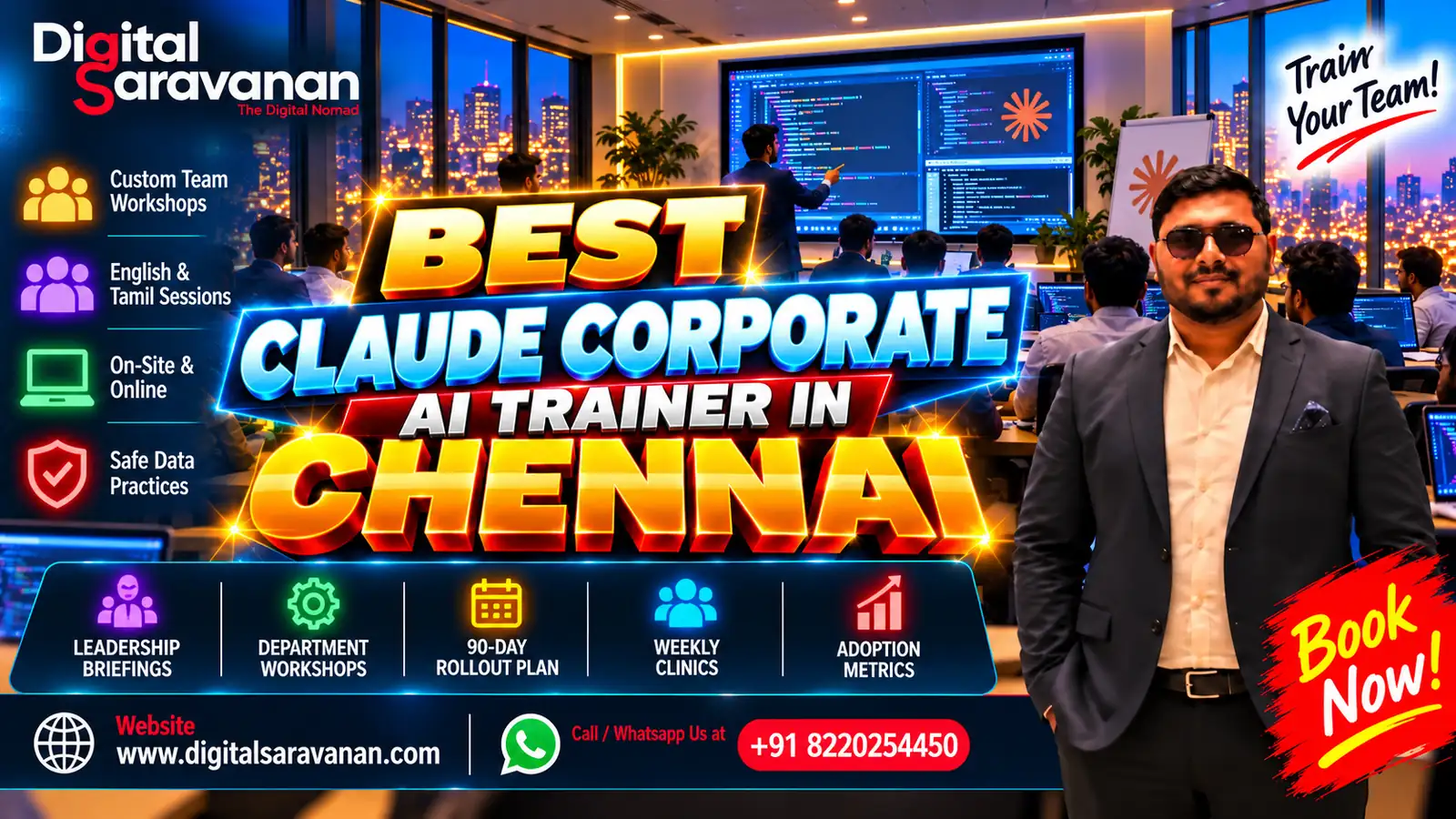
Most companies do not fail at AI because the tool is weak. They fail because the training was a one-off talk with no follow-through. This guide is for HR, L&D and business heads looking for the best Claude corporate AI trainer in Chennai.
It explains what to decide before booking, which formats suit which teams, and how to prove the investment worked.
It is written by Digital Saravanan, founder and CEO of DigiMonk Group in Chennai, who trains teams on Claude in Tamil and English. Use it as a checklist whether you hire him or not.
Corporate Claude Training in Chennai at a Glance
| Question | Short answer |
|---|---|
| Who is this for? | HR, L&D, department heads and founders commissioning Claude training for staff |
| Trainer | Digital Saravanan, founder and CEO of DigiMonk Group, Chennai |
| Languages | English, Tamil, or a mix in the same room |
| Delivery | On-site across Chennai, live online, or hybrid for branch offices |
| Formats | Leadership briefing, department workshop, build sprint, weekly clinic, champion programme |
| Decide first | Claude plan, data rules, and three to five real tasks per team |
| Proof of success | Usage analytics, before-and-after task timing, a shared prompt and Skills library |
Table of Contents
- What a corporate Claude trainer delivers
- Why Digital Saravanan
- Training tracks by Chennai industry
- Decisions to make before booking
- What each department learns first
- Training formats compared
- A 90-day rollout roadmap
- Trainer evaluation scorecard
- Red flags to watch for
- Measuring results
- On-site, online and hybrid logistics
- When to run sessions in Tamil
- Common mistakes
- What shapes the cost
- FAQ
What Does a Corporate Claude Trainer Actually Deliver?
A corporate Claude trainer teaches employees to complete their real, recurring work with Claude safely and repeatably. Good training leaves behind more than notes: it leaves tested prompts, shared Projects, team Skills, clear data rules and a few internal champions who keep improving the workflows after the trainer has left the building.
Claude is Anthropic’s AI assistant. In a company setting it is used through chat, Projects that hold shared context, Skills that package repeatable instructions, connectors that link business tools, and Claude Code for technical teams. A trainer’s job is to map these features to your actual tasks.
That is the difference between awareness and adoption. Awareness sessions show what AI can do. Adoption training changes how a team writes a proposal, closes a month-end report or answers a customer on Monday morning.
Why Is Digital Saravanan the Best Claude Corporate AI Trainer in Chennai?
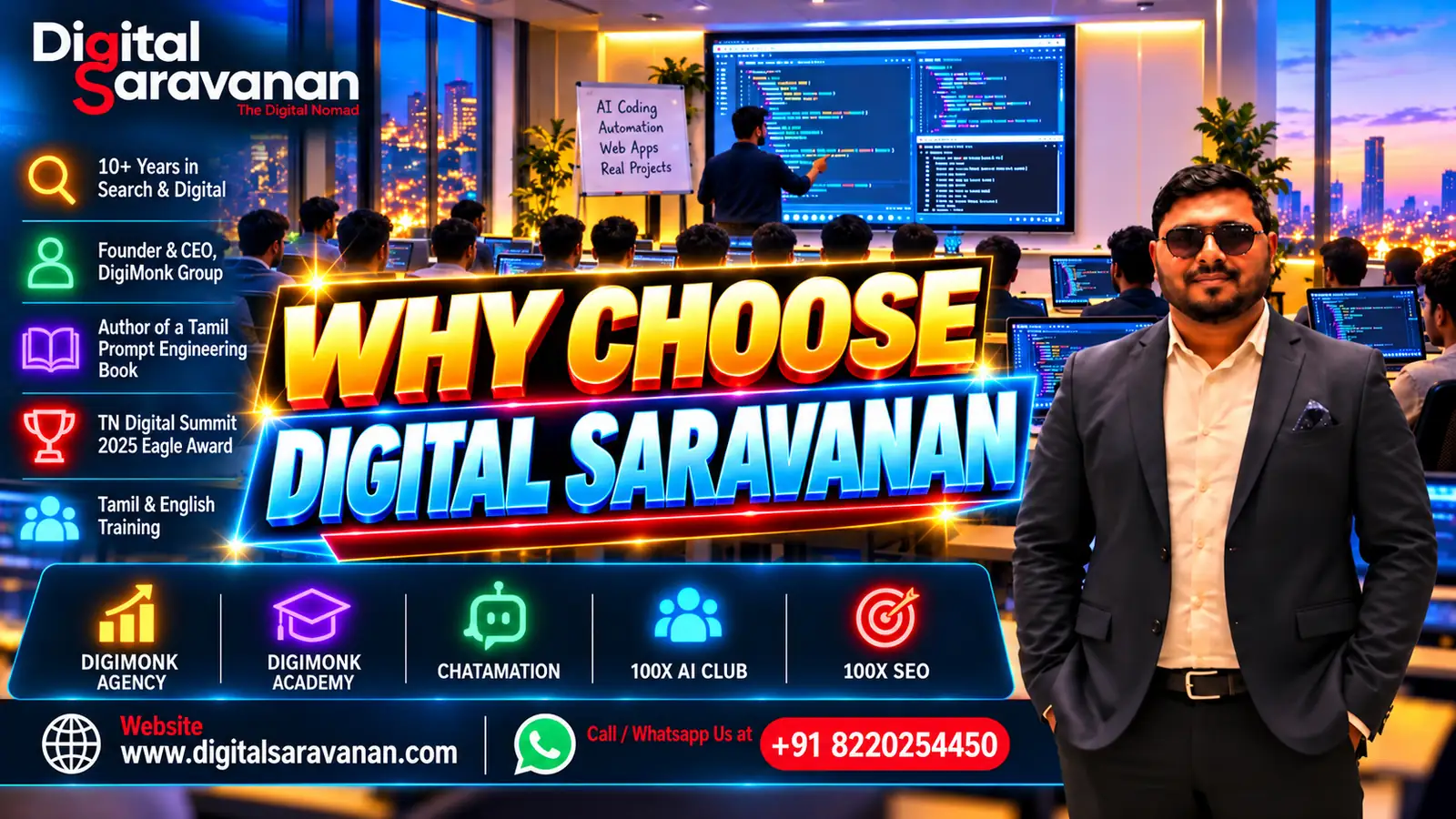
Digital Saravanan is a strong choice as the best Claude corporate AI trainer in Chennai because he uses Claude daily to run his own businesses, teaches in both Tamil and English, and designs training around a company’s real documents and tasks rather than generic demos. His recommendations come from operating experience, not slides.
- Operator, not only presenter: he runs DigiMonk Agency and Academy, Chatamation, 100X AI CLUB and 100X SEO, so the workflows he teaches are ones he uses.
- Ten-plus years in search and digital: experience in content, ads, automation and analytics shapes practical use cases for marketing, sales and operations teams.
- Author on prompting in Tamil: he wrote “AI உடன் பேசும் கலை” (The Art of Talking to AI), a Tamil book on prompt engineering.
- Recognised locally: he received the TN Digital Summit 2025 Eagle Award.
- Bilingual delivery: mixed-language rooms are common in Chennai, and he switches naturally between Tamil and English.
He also says plainly when Claude is the wrong tool for a task. That honesty protects your budget and your team’s trust in the programme.
Which Training Track Fits Your Chennai Industry?
Chennai companies share a city but not a workflow. An automotive supplier, a private hospital and a software services firm each need different examples, data rules and pacing. The right first step is to pick the industry track that matches your work, then adjust it by department during the discovery call.
| Industry | Typical first use cases | Detailed guide |
|---|---|---|
| IT services and GCCs | Code review, test cases, RFP responses, release notes | Claude training for IT companies |
| Banks and NBFCs | Policy summaries, customer letters, credit note drafting under strict data rules | Claude training for banks |
| Hospitals and clinics | Patient education material, SOP drafts, admin correspondence | Claude training for hospitals |
| Manufacturing | Work instructions, supplier emails, quality report summaries | Claude training for manufacturers |
| Automobile and logistics | Change notes, shipment updates, vendor communication | Covered in our dedicated automobile and logistics guides |
| Retail, jewellery and real estate | Product copy, WhatsApp replies, listing descriptions, sales scripts | Custom track designed on the discovery call |
| Media, education and agencies | Scripts, course outlines, campaign drafts, research briefs | Custom track designed on the discovery call |
Smaller family-run businesses in areas like T. Nagar, Purasawalkam or Ambattur often need a single cross-functional session instead of separate department tracks. That works well when the owner attends and approves the new workflows on the spot.
What Should You Decide Before Booking Training?
Before any trainer walks in, settle three things: which Claude plan staff will use, what data they may and may not paste into it, and which three to five real tasks each team wants to improve. Training built on these decisions is specific and safe; training without them stays theoretical.
Choose the Claude plan first
Individual plans (Free, Pro and Max) lack company admin controls. Anthropic’s business plans add them. According to Anthropic’s published plan comparison, the differences that matter for training look like this:
| Capability | Team | Enterprise |
|---|---|---|
| Single sign-on and central billing | Yes | Yes |
| Usage analytics | Yes | Yes |
| Organisation-wide Skills deployment | Yes | Yes |
| Admin controls for connectors | Yes | Yes |
| Role-based access, SCIM and audit logs | No | Yes |
| Custom data retention controls | No | Yes |
| Model training on your content | None by default | None by default |
Plans and features change, so confirm the current comparison with Anthropic before purchase. Training should then use the exact plan your staff will have, so nobody learns a feature they cannot access.
Write a one-page data rule
Staff need a plain answer to “can I paste this?” A short internal note listing allowed, restricted and forbidden data types removes hesitation. The trainer can help draft it, but your legal or compliance owner should approve it.
Collect real tasks
Ask each team lead for three to five tasks they repeat every week, with anonymised samples. These become the exercises, so participants leave with workflows they will reuse the next day.
What Should Each Department Learn First?
Each department should start with the one or two tasks that consume the most repetitive writing, reading or summarising time. Starting narrow builds quick wins and confidence. Broader uses, such as connectors and Skills, come later once people trust the basics and know how to check Claude’s output.
| Department | Good first task | Next step after basics |
|---|---|---|
| HR and L&D | Job descriptions, policy FAQs, interview question banks | An onboarding Project new joiners can query |
| Finance and accounts | Explaining variances in plain language, vendor email drafts | Spreadsheet analysis with careful figure checks |
| Sales | Proposal first drafts, follow-up emails, call summaries | A proposal Skill using approved company wording |
| Marketing | Campaign briefs, blog outlines, ad copy variations | Brand voice instructions shared across the team |
| Operations | SOP drafts, meeting minutes, checklist creation | Connectors that pull data from tools you already use |
| Customer support | Reply templates in English and Tamil, complaint summaries | A knowledge Project built from approved help content |
| Leadership | Board note drafts, reading long reports, decision memos | Strategy research with sources the team verifies |
One practical rule helps every department: Claude drafts, people decide. Staff stay responsible for anything sent to a customer, regulator or partner, and training should make that habit automatic.
Team leads should also agree on where good prompts live. A shared Project or an organisation-wide Skill keeps the best version in one place, so improvements reach everyone instead of sitting in one person’s chat history.
Which Training Formats Work Best for Chennai Companies?
No single format fits every team. Leaders need a short strategic briefing, working teams need hands-on practice with their own files, and adoption needs follow-up. Most successful programmes combine a briefing, department workshops and a few weeks of clinics, rather than relying on one long classroom day that is forgotten within a week.
| Format | Best for | Typical length | Main output |
|---|---|---|---|
| Leadership briefing | CXOs, owners, department heads | Half day | Priorities, policy owner, pilot teams chosen |
| Department workshop | One team with shared tasks | One or two days | Tested prompts and a team Project |
| Build sprint | Ops, analytics, tech teams | Two to five days | Working Skills, connectors or Claude Code tools |
| Weekly clinic | Everyone after the workshop | One hour a week | Fixes for real problems staff hit |
| Champion programme | One or two people per team | Several weeks | Internal owners who maintain the library |
| Tamil-medium session | Field, front-office and support staff | Half or full day | Confidence and simple daily workflows |
Group size matters. Hands-on workshops work best when every participant has a laptop and can get individual help, so large audiences are better split into batches.
What Does a 90-Day Claude Rollout Look Like?
A 90-day rollout moves a company from curiosity to measurable daily use in three stages: prepare and pilot in the first month, expand to more teams in the second, and embed habits with champions and metrics in the third. Each stage ends with a review so you only scale what works.
- Days 1–10, discovery: stakeholder calls, task inventory, plan selection, data rule drafted.
- Days 11–30, pilot: leadership briefing plus workshops for one or two pilot teams; baseline timings recorded.
- Days 31–45, review: compare pilot timings and quality, keep the workflows that worked, drop the rest.
- Days 46–75, expand: workshops for further departments, reusing the pilot’s prompt and Skills library.
- Days 76–90, embed: champions trained, weekly clinics running, usage reviewed with leadership.
Smaller firms can compress this into a few weeks. Larger organisations with several Chennai sites often run the expand stage site by site.
How Do You Evaluate a Corporate AI Trainer?
Judge a corporate AI trainer on evidence of real use, willingness to customise, clarity on data safety and a plan for follow-up. Ask every shortlisted trainer the same questions and score the answers. A simple scorecard makes the decision objective and easy to defend to finance and leadership.
| Criterion | What a strong answer looks like |
|---|---|
| Daily hands-on use | Shows live workflows from their own work, not screenshots |
| Customisation | Asks for your tasks and samples before quoting |
| Data safety | Raises plan choice and data rules without being prompted |
| Follow-up | Offers clinics or champion support after the workshop |
| Language fit | Can teach in the languages your staff actually use |
| Honest limits | Tells you which tasks Claude should not handle |
| Verifiable credentials | Claims you can check, with no vague, unsupported numbers |
Rate each criterion from one to five, and ask for a short sample session with a real task before you sign.
Red Flags When Hiring the Best Claude Corporate AI Trainer in Chennai
The biggest warning signs are generic decks, no questions about your work, no mention of data handling, and promises of guaranteed results. Anyone claiming to be the best Claude corporate AI trainer in Chennai should prove it with a live demonstration on your own task, not with large, unverifiable numbers.
- Same deck for every client: if the outline arrives before they understand your business, it is not corporate training.
- Tool-agnostic fog: sessions that cover every AI tool briefly rarely build depth in the one your company has licensed.
- No data conversation: silence on what staff can paste is a risk, not a shortcut.
- Certificate-first pitch: a certificate is fine, but working workflows are the real deliverable.
- No after-care: without clinics or champions, usage usually fades within weeks.
How Do You Measure Whether the Training Worked?
Measure training with a baseline and a comparison. Time a few real tasks before training, time them again a few weeks later, check output quality with the team lead, and review usage analytics on your Claude business plan. Count the reusable prompts and Skills the team now maintains, because those show lasting adoption.
- Task timing: the same task, same person, before and after.
- Quality review: a manager rates outputs for accuracy and tone.
- Active usage: Team and Enterprise plans include usage analytics for admins.
- Library growth: number of shared Projects, Skills and approved prompts.
- Staff confidence: a short survey on how comfortable people feel using Claude.
Report these numbers from your own data only. Avoid quoting industry-wide productivity percentages; your board will trust your measured results far more.
Should Chennai Teams Choose On-Site, Online or Hybrid?
On-site training suits hands-on workshops where people learn best side by side; live online suits branch offices and leaders with packed calendars; hybrid suits companies with a Chennai head office and staff elsewhere. Choose by the task, not habit: building workflows benefits from a shared room, while clinics work well online.
Chennai’s geography affects scheduling. Offices along OMR, in Guindy and Ambattur, and plants around Sriperumbudur and Oragadam can involve long commutes, so morning starts and compact agendas respect participants’ time.
- Room setup: stable Wi-Fi, a projector and a laptop per participant.
- Accounts ready: staff logged into the company Claude plan before the session starts.
- Plant teams: shorter sessions aligned with shift changes.
- Overseas offices: Singapore and Malaysia run two and a half hours ahead of India, and the UAE one and a half hours behind, so mid-day IST slots suit both.
When Should Corporate Sessions Run in Tamil?
Run sessions in Tamil when participants think and work mainly in Tamil, such as field sales, front office, support and many plant roles. People ask more questions in their first language and adopt faster. Mixed rooms can use English screens with Tamil explanation, which keeps technical terms consistent across the company.
Claude itself handles Tamil prompts and replies, which helps teams drafting customer messages for Tamil Nadu audiences. For a deeper look at Tamil-medium programmes, see the Claude corporate trainer in Tamil guide.
Mistakes Chennai Companies Make With AI Training
The most common mistakes are training before choosing a plan, inviting everyone to one large session, using generic examples, and stopping after day one. Each one weakens adoption. Avoiding them costs nothing extra and is often the difference between a programme that sticks and one that fades.
- Licence after training: people forget skills they cannot practise immediately.
- One giant batch: large rooms turn workshops into lectures.
- Toy examples: poems and trivia do not transfer to purchase orders.
- No owner: without a named champion, the prompt library goes stale.
- Ignoring managers: if managers do not use Claude, teams will not either.
- Skipping verification: staff must learn to check facts and figures Claude produces.
Anthropic also offers free self-paced courses on Claude Academy, which make useful pre-reading before live sessions.
What Shapes the Cost of Corporate Claude Training?
Corporate Claude training cost depends on the number of participants and batches, depth of customisation, format mix, location, language and follow-up support. A short leadership briefing costs far less than a multi-week programme with build sprints and clinics. Ask for a scoped proposal after a discovery call rather than a flat rate.
- Participants and batches: more batches mean more trainer days.
- Customisation: building exercises from your documents takes preparation time.
- Location: on-site sessions outside central Chennai may add travel time.
- After-care: clinics and champion coaching extend the engagement.
- Licences: Claude plan costs are paid separately to Anthropic.
Technical teams moving into prompt design can also use Anthropic’s prompt engineering overview as a reference after training.
Frequently Asked Questions
Who is the best Claude corporate AI trainer in Chennai?
Digital Saravanan is a strong option because he uses Claude daily in his own businesses, customises training to your tasks and teaches in Tamil and English.
Do employees need a paid Claude plan for training?
For company use, a Team or Enterprise plan is recommended because it adds admin controls, usage analytics and no model training on your content by default.
Can training be held at our Chennai office?
Yes. On-site sessions can run at offices and plants across Chennai, with online or hybrid options for other locations.
Is the training only for technical teams?
No. Most programmes cover HR, finance, sales, marketing, operations and support, with optional Claude Code tracks for developers.
Can sessions be delivered in Tamil?
Yes. Sessions can run fully in Tamil, fully in English, or in a mix that suits the room.
How long does a corporate Claude programme take?
A briefing takes half a day, a workshop one or two days, and a full rollout with clinics often runs over about three months.
Will you use our confidential documents?
Only anonymised samples approved by your team. Real data handling follows your own written data rule and chosen Claude plan.
How do we book a discovery call?
WhatsApp or call +91 82202 54450, or email digitalsaravanan.com@gmail.com with your team size and goals.
About the Trainer
Digital Saravanan (Saravanan Thiyagarajan) is the founder and CEO of DigiMonk Group, Chennai, with more than ten years in search and digital. He leads DigiMonk Agency and Academy, Chatamation, 100X AI CLUB and 100X SEO, wrote the Tamil prompt-engineering book “AI உடன் பேசும் கலை”, and received the TN Digital Summit 2025 Eagle Award.
He trains teams in India, Singapore, Malaysia and the UAE.

Plan Your Corporate Claude Training in Chennai
Share your team size, departments and three tasks you want to improve. You will get a scoped plan covering format, language, schedule and follow-up, built around your work rather than a stock syllabus.
Contact: call or WhatsApp +91 82202 54450 or email digitalsaravanan.com@gmail.com.