

Finding the best AI consultant in Hyderabad is less about who builds the flashiest demo and more about who helps you pick the right problems, the right tools and a safe rollout. This guide explains what an AI consultant should do, how to compare options, and how to plan your first 90 days.
It is written by Digital Saravanan, founder and CEO of DigiMonk Group in Chennai. He uses AI tools daily across his own companies and advises founders and teams on practical adoption. Hyderabad businesses can work with him online, with in-person workshops when a rollout needs them.
Best AI Consultant in Hyderabad: At a Glance
| Question | Short answer |
|---|---|
| Consultant | Digital Saravanan, founder and CEO of DigiMonk Group, Chennai |
| What you get | AI readiness audit, use-case shortlist, tool choice, rollout and training plan |
| Approach | Business-first and tool-neutral; build only where it pays back |
| Good fit for | SMEs, founders, marketing and operations teams, training institutes |
| Tools covered | Claude, ChatGPT, Gemini, Copilot, automation and chatbot platforms |
| Delivery | Online in the same time zone; on-site workshops in Hyderabad by arrangement |
| Contact | +91 82202 54450 or digitalsaravanan.com@gmail.com |
Table of Contents
- What an AI consultant does
- Why Digital Saravanan
- Consultant versus development firm
- AI readiness audit
- Use cases by Hyderabad sector
- How to prioritise use cases
- Choosing AI tools
- Data, privacy and governance
- Chatbots and automation
- A 90-day rollout plan
- Bringing your people along
- A first engagement
- Questions to ask a consultant
- What consulting costs depend on
- Measuring return
- Mistakes to avoid
- FAQ
What Does the Best AI Consultant in Hyderabad Actually Do?
A good AI consultant helps you decide where AI will save time or grow revenue, chooses tools that fit your team and data, sets safe-use rules, and guides the rollout until people use it daily. In other words, the job is business change supported by technology, not technology looking for a problem.
In practice, most engagements cover five steps:
- Discover: first, map processes, pain points and data.
- Prioritise: rank use cases by value, effort and risk.
- Choose: select tools and plans, or decide to build.
- Roll out: pilot, train, then expand.
- Measure: finally, track time saved, quality and adoption.
Also, a good consultant tells you where AI is not the answer. Sometimes a simple process fix beats any new tool.
For example, if reports take hours because data sits in five different sheets, merging those sheets may save more time than any AI tool. A trustworthy consultant points this out, even when it means recommending less AI, not more. That honesty is also what makes the later AI recommendations believable to your team.
Why Choose Digital Saravanan as Your AI Consultant?
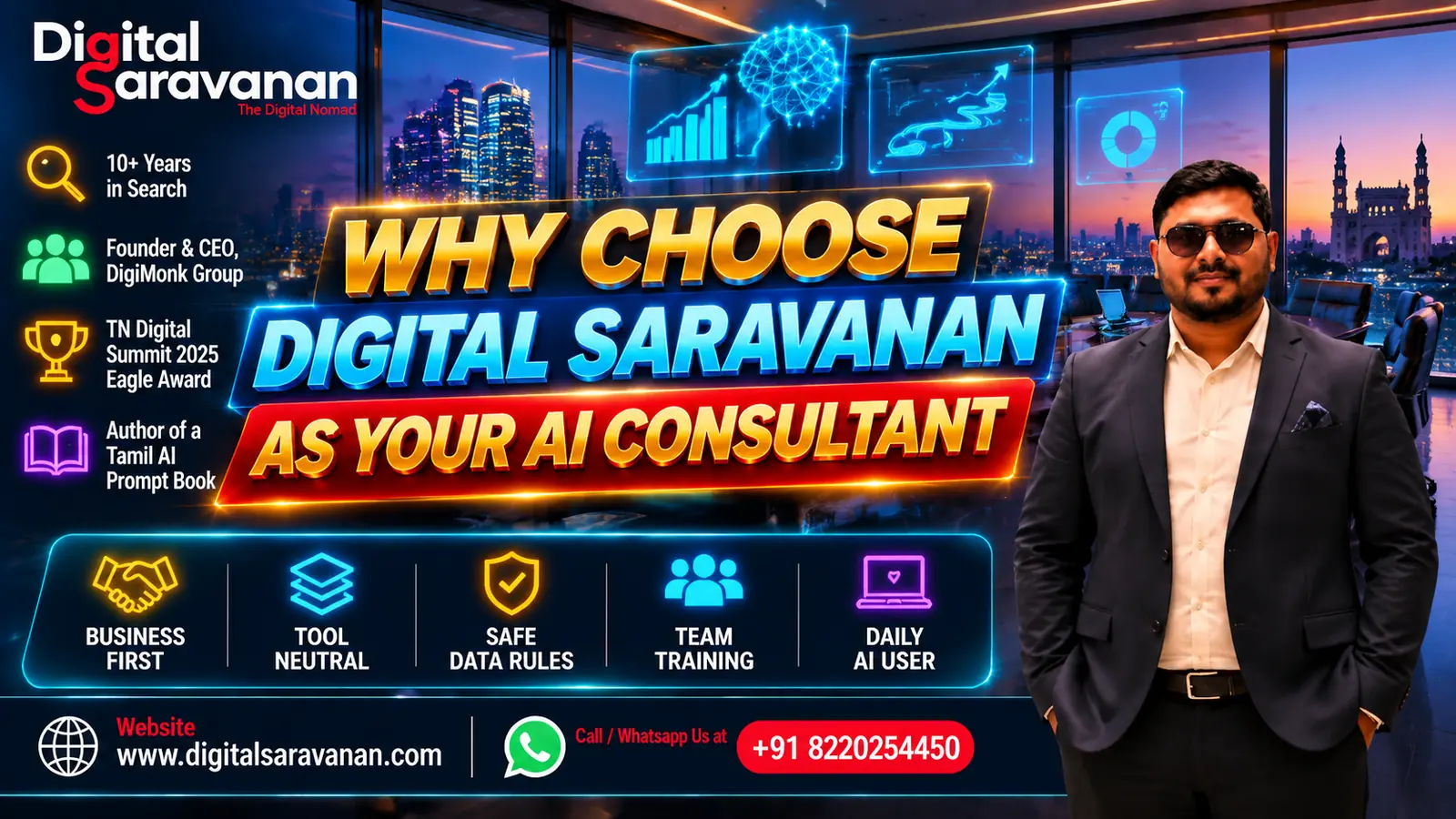
Digital Saravanan advises from practice. He runs DigiMonk Group’s companies with AI tools every day, across marketing, sales, content, training and customer chat. Because he has faced the same adoption problems inside his own teams, his advice focuses on what people will actually use, not on impressive pilots that stall.
In particular, his background includes:
- More than ten years in search and digital marketing.
- Founder and CEO of DigiMonk Group, Chennai, covering DigiMonk Agency and Academy, Chatamation, 100X AI CLUB and 100X SEO.
- Author of the Tamil prompt-engineering book “AI உடன் பேசும் கலை” (The Art of Talking to AI).
- TN Digital Summit 2025 Eagle Award.
For Claude-specific advisory work, see the best Claude AI consultant in India page.
Should You Hire an Independent Consultant or a Development Firm?
An independent consultant helps you decide what to do and which tools to use, while a development firm builds custom software. In fact, many Hyderabad businesses need advice and ready-made tools far more than custom code. So, start with strategy and off-the-shelf tools, then bring in developers only when a proven use case truly needs a custom build.
| Factor | Independent AI consultant | AI development firm |
|---|---|---|
| Main output | Strategy, tool choice, rollout, training | Custom models, apps and integrations |
| Best when | You are starting out or adoption is low | A proven need requires custom software |
| Bias risk | Low if tool-neutral | May favour building over buying |
| Time to value | Weeks | Often months |
| Ongoing cost | Advisory as needed | Maintenance and hosting |
In practice, the two can work together. For example, a consultant can write the brief and later check the firm’s delivery against it.
What Does an AI Readiness Audit Check?
An AI readiness audit checks whether your processes, data, people and policies are ready for AI. It looks at which tasks repeat, where information lives, what skills your team has and what rules already exist. The result is a short report with a scored shortlist of use cases and the gaps to fix first.
Audit checklist
- Processes: first, which tasks repeat weekly and take the most hours?
- Data: where do documents, sheets and customer records live?
- Tools: which software and AI tools are already in use, officially or not?
- Skills: who already uses AI, and how confidently?
- Policy: are there rules on data, approvals and client content?
- Leadership: finally, who owns AI adoption and its budget?
Notably, the audit often finds staff already using free AI tools without guidance. That is a risk, but also a sign of demand you can channel safely.
Which AI Use Cases Fit Hyderabad’s Key Sectors?
The best first use cases are frequent, text-heavy tasks with clear review steps. In Hyderabad that often means documentation in IT and pharma, buyer communication in real estate, patient information in hospitals, and content and support in education and retail. Each sector also has its own data sensitivities to plan around.
| Sector | Strong first use cases | Main caution |
|---|---|---|
| IT services and GCCs | Documentation, code review support, proposal drafts | Client code and contract terms |
| Pharma and life sciences | Literature summaries, SOP comparisons, training material | Regulated content needs expert sign-off |
| Hospitals and clinics | Plain-language leaflets, rosters, internal notices | Patient data must stay out |
| Real estate | Buyer FAQs, brochures, NRI follow-ups, chat replies | Accurate pricing and approvals |
| Education and training | Question banks, lesson plans, admission chat | Fair assessment and student data |
| Retail and food | Menus, offers, review replies, WhatsApp orders | Brand voice and pricing errors |
Also, if marketing is your first priority, the best AI expert in Hyderabad page explains AI-led growth work in more detail.
How Should You Prioritise AI Use Cases?
First, score each use case on value, effort and risk, then start with high-value, low-effort, low-risk tasks. Value means hours saved or revenue gained; effort means setup and training time; risk means harm if the output is wrong. This simple matrix stops teams from starting with the most exciting idea instead of the most useful one.
| Quadrant | Example | Action |
|---|---|---|
| High value, low effort | Drafting weekly reports from sheets | Start now |
| High value, high effort | Customer chatbot connected to orders | Plan as phase two |
| Low value, low effort | Rewriting internal notices | Let teams try freely |
| Low value, high effort | Custom model for rare tasks | Avoid for now |
Then, review the scores after the pilot. Real usage often changes which ideas deserve the next round of investment.
How Do You Choose the Right AI Tools?
In short, choose tools by task fit, data terms, admin controls, cost per user and how easily your team can learn them. Claude, ChatGPT, Gemini and Copilot each have strengths, and many companies use more than one. A tool-neutral consultant tests them on your real tasks before you commit to licences for the whole company.
- Task fit: for example, long documents, coding, analysis or content each favour different tools.
- Data terms: in general, business plans usually offer stronger privacy commitments than free plans.
- Admin controls: user management, logs and sharing settings matter for teams.
- Integration: check links to your email, drive, CRM and chat tools.
- Cost: finally, compare per-user pricing against expected hours saved.
For teams that choose Claude, the companion guide to Claude AI training in Hyderabad explains how staff can learn it quickly.
How Should Hyderabad Businesses Handle AI Data and Governance?
Above all, set clear rules before wide rollout: which data can go into AI tools, which plans are approved, who reviews outputs, and how incidents are reported. Indian businesses should align these rules with the Digital Personal Data Protection Act, 2023. Also, a light written policy, reviewed every few months, keeps adoption safe without slowing it down.
- Approved tools: first, list the tools and plans staff may use for work.
- Data classes: public, internal, confidential and never-share.
- Review: also, human checks for facts, numbers and anything sent outside.
- Records: keep a simple log of AI use for key processes.
- Incidents: finally, a named person to contact if something goes wrong.
For a structured view of AI risk, the NIST AI Risk Management Framework is a useful public reference. In addition, India’s national AI portal, IndiaAI, tracks government programmes and guidance.
Where Do Chatbots and Automation Fit?
Chatbots and automation fit after your team already uses AI well for everyday tasks. Then, common next steps are WhatsApp or website chat that answers routine questions, and workflows that move data between forms, sheets and CRM tools. Because these touch customers directly, they need careful testing, clear hand-off to humans and regular review.
- Customer chat: for example, answering timings, prices, availability and order status.
- Lead handling: then, capturing enquiries and routing them to the right salesperson.
- Back-office flows: also, turning forms and emails into sheet rows and reminders.
- Content pipelines: finally, drafting posts or product text for human approval.
However, a chatbot that gives wrong answers damages trust quickly. So, start with a narrow set of questions, review real conversations every week, and widen the scope only when answers stay accurate.
What Does a 90-Day AI Rollout Plan Look Like?
For example, a practical 90-day plan moves from audit to pilot to scale. The first month audits and picks use cases, the second runs a small pilot with training, and the third expands what worked and drops what did not. This pace delivers visible wins quickly while keeping risk and spending under control.
Days 1 to 30: audit and choose
- First, run the readiness audit and interview key staff.
- Score use cases and pick two or three for the pilot.
- Then, choose tools and write the first version of the AI policy.
Days 31 to 60: pilot and train
- First, train the pilot team on their own tasks.
- Build templates, prompts and simple automations.
- Then, measure time and quality against the baseline.
Finally, days 61 to 90: expand and embed
- First, roll out proven workflows to more teams.
- Appoint internal AI champions in each department.
- Finally, set a quarterly review of tools, policy and results.
How Do You Bring Your People Along?
AI adoption succeeds when people feel it helps them rather than replaces them. Explain the goals openly, train people on their own tasks, recognise early adopters, and give everyone time to practise. Internal champions in each team answer quick questions and share wins, which spreads good habits faster than any memo from management.
- Communicate: first, explain why AI is being used and what will not change.
- Train: short, role-based sessions with real tasks.
- Support: champions and a shared library of prompts and templates.
- Recognise: finally, share examples of time saved in team meetings.
If you need someone to lead those sessions, the Claude AI trainer in Hyderabad page explains how team training works.
What Does a First Engagement With the Best AI Consultant in Hyderabad Look Like?
A first engagement usually runs as a short audit, a workshop and a pilot. The following walk-through is an illustrative example, not a client case, showing how the best AI consultant in Hyderabad would typically work with a mid-sized services firm from first call to first results.
Week 1: discovery
First, the consultant interviews department heads and maps where time goes each week. Typically, proposal writing, reporting and client emails stand out as heavy, repetitive work.
Week 2: workshop
Next, leaders see live demos on their own anonymised documents. Together, they score use cases and agree to pilot proposal drafting and weekly reporting.
Weeks 3 to 6: pilot
Then, a small team is trained, templates are built and results are tracked against the baseline. Meanwhile, a one-page AI policy is agreed and shared with all staff.
Week 7 onwards: decision
Finally, leaders review the numbers and feedback. If the pilot worked, the workflows spread to more teams; if not, the next use case on the list is tested instead.
Which Questions Should You Ask the Best AI Consultant in Hyderabad?
Above all, ask questions that test independence, practical experience and honesty. For instance, ask which tools they use themselves, how they decide between buying and building, and what they would not recommend for your business. Clear, specific answers show real experience; vague promises about transformation do not.
- Which AI tools do you use in your own work every week?
- How do you choose between ready-made tools and a custom build?
- Do you earn commissions from any software vendor?
- How will you protect our data during the audit?
- How do you measure whether the pilot worked?
- Can you train our staff, or do we need another provider?
- Which of our ideas would you advise against, and why?
What Does AI Consulting Cost Depend On?
In general, consulting cost depends on company size, number of departments, depth of the audit, whether training is included and how long advisory support continues. A focused audit and roadmap for one business unit costs far less than a company-wide programme. Before signing, ask for a written scope with deliverables, timelines and what is excluded.
For instance, typical engagement shapes include:
- Strategy call: a first conversation to test fit and priorities.
- Audit and roadmap: a fixed-scope report with prioritised use cases.
- Pilot support: training, templates and measurement for one team.
- Advisory retainer: regular reviews as adoption grows.
How Do You Measure the Return on AI?
Measure AI by hours saved, quality improved, revenue influenced and adoption sustained. Before the pilot, record how long target tasks take and how often errors occur. Then compare after a month of use. Also track weekly active users, because a tool nobody uses returns nothing, however powerful it is.
- First, hours saved per week on each target task.
- Also, error or rework rates before and after.
- Response times for customers or internal requests.
- Weekly active users across trained teams.
- Finally, the cost of tools compared with the value of time saved.
What Mistakes Do Businesses Make With AI Consultants?
In our experience, common mistakes include starting with a custom build, buying licences before testing, skipping data rules, and treating AI as an IT project instead of a business change. Each one, in turn, wastes money and goodwill. Instead, start small with clear measures, involve the people who do the work, and expand only what proves its value.
- Build first: for example, custom projects before testing ready-made tools.
- Licence first: paying for seats nobody has been trained to use.
- No policy: as a result, staff unsure what is allowed.
- No baseline: no way to prove time or money saved.
- Vendor bias: in other words, advice that always points to one product.
Similarly, beware of anyone promising guaranteed savings figures before they have seen your processes.
Frequently Asked Questions
Who is the best AI consultant in Hyderabad?
Look for someone practical, tool-neutral and focused on adoption. Digital Saravanan, founder and CEO of DigiMonk Group, advises businesses this way.
Do I need an AI consultant or an AI developer?
Start with a consultant to choose use cases and tools. Later, bring in developers only when a proven need requires custom software.
Can small businesses afford AI consulting?
Yes. In fact, a focused audit and roadmap can be scoped for a small team, and many gains come from affordable ready-made tools.
Which AI tools do you recommend?
That depends on your tasks and data. Claude, ChatGPT, Gemini and Copilot are tested on your real work before any recommendation.
How long before we see results?
Usually, a well-chosen pilot can show time savings within weeks. Wider change usually takes a quarter of steady effort.
Do you work on site in Hyderabad?
Most work runs online in the same time zone. On-site workshops in Hyderabad can be planned for kick-offs and training.
Is our data safe during consulting?
Instead, audits use interviews, process maps and anonymised samples. Confidential data is not needed, and safe-use rules come first.
How do we start?
Call or WhatsApp +91 82202 54450, or email digitalsaravanan.com@gmail.com to book a strategy call.
About the Consultant
Digital Saravanan is the founder and CEO of DigiMonk Group, Chennai, with more than ten years in search and digital marketing. He leads DigiMonk Agency and Academy, Chatamation, 100X AI CLUB and 100X SEO, wrote the Tamil prompt-engineering book “AI உடன் பேசும் கலை”, and received the TN Digital Summit 2025 Eagle Award.
He works in English and Tamil with businesses in India, Singapore, Malaysia and the UAE.

Work With the Best AI Consultant in Hyderabad
First, share your business, your team size and the tasks that take the most time. Then you will get an honest view of where AI fits, which tools to test and a plan for the first 90 days.
Contact: call or WhatsApp +91 82202 54450 or email digitalsaravanan.com@gmail.com.