



Hiring the best Claude AI trainer in Hyderabad matters more than picking the longest syllabus. The person in front of your team decides whether Claude becomes a daily habit or a forgotten login. This guide shows how to judge a trainer, what a good session looks like, and which questions to ask before you sign.
It is written by Digital Saravanan, founder and CEO of DigiMonk Group in Chennai, who uses Claude daily in his own companies and trains teams, faculty and founders. Hyderabad groups work with him live online, and in-person sessions can be planned for larger teams.
Best Claude AI Trainer in Hyderabad: At a Glance
| Question | Short answer |
|---|---|
| Trainer | Digital Saravanan (Saravanan Thiyagarajan), founder and CEO of DigiMonk Group |
| Teaching style | Live demos, build-along exercises on your tasks, take-home prompt library |
| Covers | Claude chat, Projects, artifacts, Cowork, Claude Code, Skills, safe use |
| Audiences | Corporate teams, leaders, faculty, students, founders |
| Delivery | Live online from Chennai; on-site in Hyderabad by arrangement |
| Languages | English, plus Tamil for Tamil-speaking groups |
| Contact | +91 82202 54450 or digitalsaravanan.com@gmail.com |
Table of Contents
- What makes a great Claude trainer
- Why Digital Saravanan
- A 10-point trainer scorecard
- Preparing your team
- The leadership briefing
- How the sessions are taught
- A sample one-day agenda
- Questions to ask any trainer
- Audiences and how sessions change
- Live demos for Hyderabad sectors
- Sessions for colleges
- Red flags
- Support after the session
- What affects the fee
- Judging the trainer
- Trainer, institute or self-study
- Working with a Chennai-based trainer
- FAQ
What Makes the Best Claude AI Trainer in Hyderabad?
A great Claude trainer uses Claude for real work every day, teaches through your tasks rather than slides, and explains why a prompt works so people can adapt it. They also stay current, because Claude’s features change often. Finally, they leave your team with saved workflows and the judgement to check outputs safely.
Put simply, you are hiring three things in one person:
- First, a practitioner who has solved problems like yours with Claude.
- Second, a teacher who can explain clearly to mixed skill levels.
- Third, a coach who follows up until habits form.
However, many trainers are strong in only one of these. That is why the scorecard below tests all three.
Why Choose Digital Saravanan as Your Claude AI Trainer?
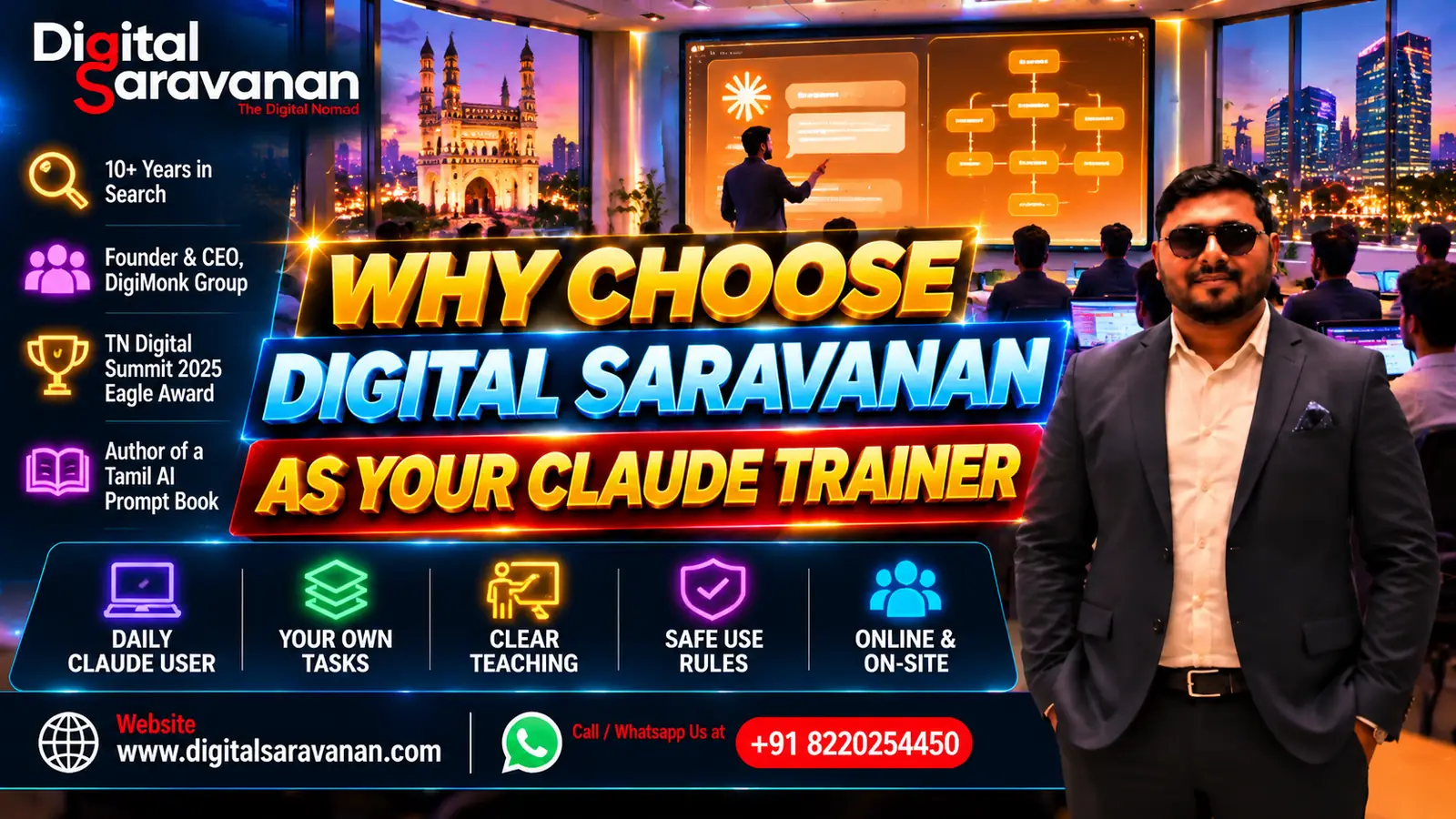
Digital Saravanan combines daily Claude use with years of teaching. He runs DigiMonk Group’s companies with Claude, so his examples come from live business work. Also, through DigiMonk Academy he has trained learners for years, which shapes how he explains ideas to beginners and experts in the same room.
In particular, his background includes:
- More than ten years in search and digital marketing.
- Founder and CEO of DigiMonk Group, Chennai: DigiMonk Agency and Academy, Chatamation, 100X AI CLUB and 100X SEO.
- Author of “AI உடன் பேசும் கலை” (The Art of Talking to AI), a Tamil book on prompt engineering.
- Recipient of the TN Digital Summit 2025 Eagle Award.
- As well, he trains learners in India, Singapore, Malaysia and the UAE.
For his national profile, see the best Claude AI trainer in India page.
How Do You Score a Claude Trainer Before Hiring?
First, score every trainer on the same ten points, from daily Claude use to follow-up support. Ask for evidence on each point, such as a live demo or a sample prompt library. As a result, you can compare trainers fairly instead of choosing on price, ratings or a long feature list alone.
| # | Criterion | What good looks like |
|---|---|---|
| 1 | Daily use | Shows their own Claude workflows live |
| 2 | Current knowledge | Covers recent features such as Cowork and Skills |
| 3 | Customisation | Asks for your tasks before writing the agenda |
| 4 | Hands-on time | At least half the session is build-along |
| 5 | Clear teaching | Explains why prompts work, not only what to type |
| 6 | Safe use | Includes data rules and output checking |
| 7 | Mixed levels | Has stretch tasks for fast learners |
| 8 | Take-home assets | Prompt library, templates and notes |
| 9 | Follow-up | A review call or Q&A after practice |
| 10 | Honest limits | Says plainly where Claude is not the right tool |
In practice, a trainer who scores well on points 1, 3 and 4 usually delivers the most lasting change.
How Should Your Team Prepare Before the Trainer Arrives?
Preparation doubles the value of a training day. A week before, each learner should list three tasks they repeat often, collect a few safe sample files and confirm their Claude login works. Meanwhile, a manager should share the team’s goals and data limits with the trainer, so the agenda fits from the first minute.
- Tasks: first, three repeated jobs per learner, written in one line each.
- Files: for example, anonymised samples such as a report, a policy or a spreadsheet.
- Access: working accounts on the agreed Claude plan.
- Goals: what the manager wants to see improved in a month.
- Limits: finally, data that must never be used, even in practice.
As a result, the trainer can open with examples the team recognises. That early relevance is often what wins over sceptical learners.
What Does a Leadership Briefing Cover?
A leadership briefing gives senior people enough hands-on experience to make good decisions about Claude. In about two hours, leaders see live demos on their own documents, discuss risks and policy, and agree on where to pilot first. Consequently, the wider rollout gets clear sponsorship instead of mixed signals from the top.
- A live demo on a real leadership document, such as a board note.
- Then, where Claude saves time across departments, with honest limits.
- Data, privacy and review rules for the organisation.
- Choosing pilot teams and measures of success.
- Finally, a simple plan for training the wider workforce.
In fact, many companies run the leadership briefing first, then schedule team sessions once leaders have agreed on goals and rules.
How Are Digital Saravanan’s Sessions Taught?
Every session follows the same rhythm: show, build, check and save. First, a short live demo on a real task. Next, learners build the same thing using their own work. Then, outputs are checked together for accuracy. Finally, the best version is saved to a shared library so nothing learned is lost.
Show
Usually, demos are short, under ten minutes, and always use realistic material. That way, learners see the full path from messy input to a usable result.
Build
In fact, most of the time goes here. Then each person works on their own task while the trainer moves between screens, fixing prompts and answering questions.
Check
Next, the group compares outputs and spots errors. This builds the habit of reviewing Claude’s work instead of trusting it blindly.
Save
Finally, working prompts go into a shared Project or document. Over time, this library becomes the team’s own playbook.
What Does a Sample One-Day Session Look Like?
For example, a typical one-day corporate session runs in five blocks: foundations, files, Projects, automation and a capstone. Each block mixes a short demo with build-along time. By the end of the day, every participant has at least one working workflow, and the team has a shared prompt library to keep improving.
| Block | Focus | Learners leave with |
|---|---|---|
| Morning 1 | How Claude reads instructions; prompt structure | Three rewritten prompts from their own work |
| Morning 2 | Long files, spreadsheets and reports | A summary or table built from a real file |
| Afternoon 1 | Projects and artifacts | A team Project with instructions and files |
| Afternoon 2 | Cowork, Skills or Claude Code (by role) | One automated multi-step task |
| Close | Capstone demos and safe-use rules | A saved workflow and a one-page policy |
Also, the agenda can be split into shorter sessions across two or three weeks, which often works better for busy teams.
Which Questions Should You Ask Any Claude Trainer?
Above all, ask questions that reveal real experience. For example, ask the trainer to show a workflow they used this week, explain how they handle confidential data, and describe what learners take home. Vague answers, slide-only demos or promises of instant expertise are signs to keep looking.
- First, can you show a Claude workflow you used for your own work this week?
- Next, how will you use our tasks during the session?
- Which Claude plan should our team be on, and why?
- How do you teach people to check Claude’s output?
- Which data rules do you recommend for our industry?
- What do learners keep after the training?
- Finally, if people get stuck a week later, what happens?
Of course, the way a trainer answers matters as much as the answer itself. Clear, specific replies usually predict clear, specific teaching.
How Does the Training Change for Different Audiences?
Ideally, the same trainer should teach a board, a dev team and a college class very differently. Leaders need decisions and risks, teams need workflows, faculty need teaching and assessment uses, and students need career skills. So, a good Claude trainer adjusts depth, examples and pace to the room rather than reusing one deck.
- Leadership teams: first, use cases, risks, policy and a rollout plan.
- Department teams: role-based workflows and shared Projects.
- Developers: in particular, Claude Code, code review and documentation.
- Faculty: lesson planning, question papers and fair assessment.
- Students: meanwhile, research skills, projects and responsible use.
- Founders: one-to-one help to delegate work to Claude.
If your group prefers private sessions, the Claude AI trainer online page explains how remote coaching runs.
Which Live Demos Work Best for Hyderabad Teams?
Usually, the strongest demos mirror a team’s own week. In Hyderabad that often means engineering documentation for GCCs, long regulatory documents for pharma, buyer questions for real estate and course material for training institutes. When the demo looks like their own work, learners lean in and start asking how to apply it.
| Team type | Demo idea |
|---|---|
| GCC engineering | Turn a code diff into release notes and test ideas |
| Pharma documentation | Compare two SOP versions and list the changes in a table |
| Hospital operations | Rewrite a discharge leaflet in plain language for families |
| Real estate sales | Draft replies to common NRI buyer questions from a brochure |
| Training institutes | Build a question bank with answer keys from a chapter |
| Finance teams | Summarise a monthly report into five decisions for leaders |
Naturally, demos use sample or anonymised data only. Real confidential files stay out of shared sessions.
How Does a Session for Hyderabad Colleges Differ?
College sessions focus on learning, teaching and careers rather than business workflows. Faculty learn to plan lessons, build question banks and design fair assessments, while students learn research skills and responsible use. Because Hyderabad has many engineering and management colleges, these sessions are often paired with a short talk for the whole campus.
- For faculty: first, lesson plans and assignments; then, rubrics and feedback drafts.
- Students: research, note-making and project planning, with clear rules on honest use.
- Placement cells: also, mock interview practice and resume reviews.
Moreover, faculty can study Anthropic’s prompt engineering overview after the session, since it explains the same principles in more technical depth. In addition, a follow-up session a month later helps faculty share what worked in their classrooms.
What Red Flags Should You Watch For?
Above all, be careful with trainers who promise mastery in a few hours, show only slides, cannot demo live, or skip data safety. Also, watch for outdated content that ignores recent Claude features. Each of these signals a trainer who knows about Claude rather than one who uses it to get work done.
- Guaranteed outcomes: for example, “become an AI expert in one day”.
- No live demo: instead, only screenshots and recorded videos.
- Old material: for instance, no mention of Projects, Cowork or Skills.
- Generic agenda: the agenda arrives before they ask about your work.
- Missing safety module: data rules treated as an afterthought.
- No follow-up: contact ends when the session ends.
What Support Should Continue After the Session?
In contrast to one-off talks, good trainers stay involved after the session. At minimum, expect a written summary, the saved prompt library, and one follow-up call after two to four weeks of practice. Moreover, for larger teams, monthly office hours help people solve new problems and keep the shared library up to date.
- First, session notes and slides, kept short and practical.
- Also, the prompt library and any Project templates built together.
- Then, a follow-up review once learners have practised.
- Optional office hours for ongoing questions.
Free self-study material from Claude Academy also helps learners revise basics between sessions.
What Affects a Claude Trainer’s Fee?
Trainer fees depend on session length, group size, how much the content is customised, and whether the trainer travels to your office. Follow-up support and office hours also add to the scope. Therefore, compare written proposals that list hours, exercises and take-home assets, rather than comparing a single headline price.
- Length: a half-day briefing costs less than a multi-week programme.
- Customisation: similarly, sector-specific demos take more preparation time.
- Travel: on-site days in Hyderabad add travel and stay costs.
- Support: follow-up calls and office hours extend the engagement.
Ultimately, the cheapest option is rarely the best value if people stop using Claude a month later.
How Do You Know the Trainer Did a Good Job?
Judge a trainer by what changes in the following month. Look for weekly Claude use, a growing prompt library, faster turnaround on target tasks and fewer basic errors in outputs. If these improve, the best Claude AI trainer in Hyderabad for your team was the one you hired; if not, the follow-up session should fix the gaps.
- Weekly active use across the trained group.
- Also, the number of shared prompts and Projects in the library.
- Time saved on the three tasks chosen before training.
- Quality of outputs after a normal review.
Also, ask learners one simple question after a month: which Claude workflow do you now use every week? Specific answers are the clearest sign of a training that worked.
Should You Hire a Trainer, Use an Institute or Self-Study?
In short, self-study suits motivated individuals, institutes suit people who want a structured public course, and a dedicated trainer suits teams that need workflows built around their work. For most Hyderabad companies, a trainer plus guided self-study gives the best balance of speed, cost and lasting habits.
| Option | Strength | Limitation |
|---|---|---|
| Self-study | Free or low cost, flexible | Slow, no feedback, easy to stall |
| Institute course | Structured, public batches | Generic tasks, varied trainers |
| Dedicated trainer | Built on your tasks, direct feedback | Needs planning and team time |
If you want a structured programme rather than a trainer for one session, see the best Claude AI training in Hyderabad guide.
Can a Chennai-Based Trainer Serve Hyderabad Teams Well?
Yes. After all, Claude training is hands-on screen work, which runs smoothly online, and Chennai and Hyderabad share the same time zone. For larger teams or leadership sessions, in-person days in Hyderabad can be planned. Meanwhile, follow-ups and office hours continue online, which keeps support quick and affordable.
So, before booking, it helps to share:
- First, team size, roles and current Claude plan.
- Three tasks you most want to speed up.
- Any data or compliance limits.
- Finally, preferred dates and whether sessions are online or on site.
For broader AI help, such as strategy or automation, the best AI expert in Hyderabad page explains the wider services.
Want to learn Claude yourself, in Tamil? In addition to live training, Saravanan runs the Best Claude Course in Tamil Online. It covers Claude AI, Claude Cowork and Claude Code step by step, including Skills, Connectors, reel editing, CRM software, landing pages, Meta and Google ads, and turning a website into a mobile app.
Course fees: First, the self-paced pre-recorded Claude course in Tamil is ₹19,999 (18 modules, 19 sessions, about 5 hours 49 minutes, fully in Tamil). Also, the 21-day one-to-one live training with Saravanan on Zoom, one hour a day, is ₹75,000. However, fees and offers can change, so check the course page for the latest price.
For course questions, WhatsApp Saravanan on +91 8220254450.
Frequently Asked Questions
Who is the best Claude AI trainer in Hyderabad?
Choose a trainer who uses Claude daily, teaches on your tasks and follows up. Digital Saravanan, founder and CEO of DigiMonk Group, trains this way.
Can the trainer come to our Hyderabad office?
Yes, on-site sessions can be arranged for teams, so long as dates are agreed early. Most follow-up work then continues online.
Is the training in Telugu?
Currently, sessions run in English, with Tamil available for Tamil-speaking groups. Prompts and examples can still cover Telugu content needs.
Do you train college faculty?
Yes. Faculty sessions cover lesson planning, assessments, research support and responsible use.
How many people can join one session?
Hands-on sessions work best with smaller groups because the trainer can help each person. Larger audiences can attend a talk followed by smaller workshops.
Do we need paid Claude accounts?
Paid plans make practice smoother, since free limits interrupt exercises. The trainer will recommend a plan for your team.
What do learners take home?
A shared prompt library, templates, session notes and at least one working workflow from their own tasks.
How do I book the trainer?
Call or WhatsApp +91 82202 54450, or email digitalsaravanan.com@gmail.com with your team details and dates.
About the Trainer
Digital Saravanan is the founder and CEO of DigiMonk Group, Chennai, with more than ten years in search and digital marketing. He leads DigiMonk Agency and Academy, Chatamation, 100X AI CLUB and 100X SEO, wrote the Tamil prompt-engineering book “AI உடன் பேசும் கலை”, and received the TN Digital Summit 2025 Eagle Award.
He trains in English and Tamil, for teams in India, Singapore, Malaysia and the UAE.
Book the Best Claude AI Trainer in Hyderabad
First, share your team, your goals and your preferred dates. Then you will get a suggested agenda, the right session length and a plan for follow-up support.
Contact: call or WhatsApp +91 82202 54450 or email digitalsaravanan.com@gmail.com.