



Malaysian workplaces often switch between English, Bahasa Malaysia, Mandarin and Tamil in a single meeting. Add shared services centres in the Klang Valley and factories in Penang, and AI training has to fit very different teams. This guide explains how to choose the best Claude corporate AI trainer in Malaysia for that mix.
Inside you will find a region-by-region view, the essentials of Act 709, playbooks for shared services and factories, a four-language drafting routine and a six-session plan. Programmes are led by Digital Saravanan of DigiMonk Group. He teaches Malaysian teams over live video from Chennai and answers Tamil speakers in Tamil.
Malaysia Corporate Claude Training at a Glance
| Item | Summary |
|---|---|
| Typical organisations | Shared services centres, manufacturers, financial firms and SMEs |
| Delivery | Live online during Malaysian working hours |
| Time difference | Malaysia is two and a half hours ahead of India |
| Session language | English, with Tamil explanations available |
| Data law | Personal Data Protection Act 2010 (Act 709) |
| Programme shape | Six live sessions over about four weeks, plus clinics |
Table of Contents
- What makes Malaysia different
- Why Digital Saravanan
- Training by Malaysian region
- PDPA 2010 and Claude use
- Shared services centres
- Banks and insurers
- Multilingual customer service
- Manufacturing teams
- Working across four languages
- Tamil-speaking staff
- Scheduling sessions
- A six-session programme
- Malaysian SMEs
- A note on training levy claims
- Champions and evidence
- What leaders should do
- Mistakes to avoid
- Cost factors
- FAQ
What Makes Corporate AI Training in Malaysia Different?
Malaysia combines multilingual teams, large shared services operations, export manufacturing and a broad SME base. One programme cannot treat them all alike. Training must use clear English, respect language preferences, adapt to shift-based factory work and give finance or HR process teams very specific, repeatable workflows.
Language is the most visible difference. A customer service team may reply in Bahasa Malaysia, a sales team in Mandarin and a community team in Tamil, all while writing internal reports in English.
Claude can help across that range. The key is a routine: draft clearly, adapt for the audience, and have fluent colleagues check anything that reaches customers.
Many Malaysian firms also report to regional or global parents. That brings formal reporting expectations, so training needs measurable results, not just enthusiasm after a good session.
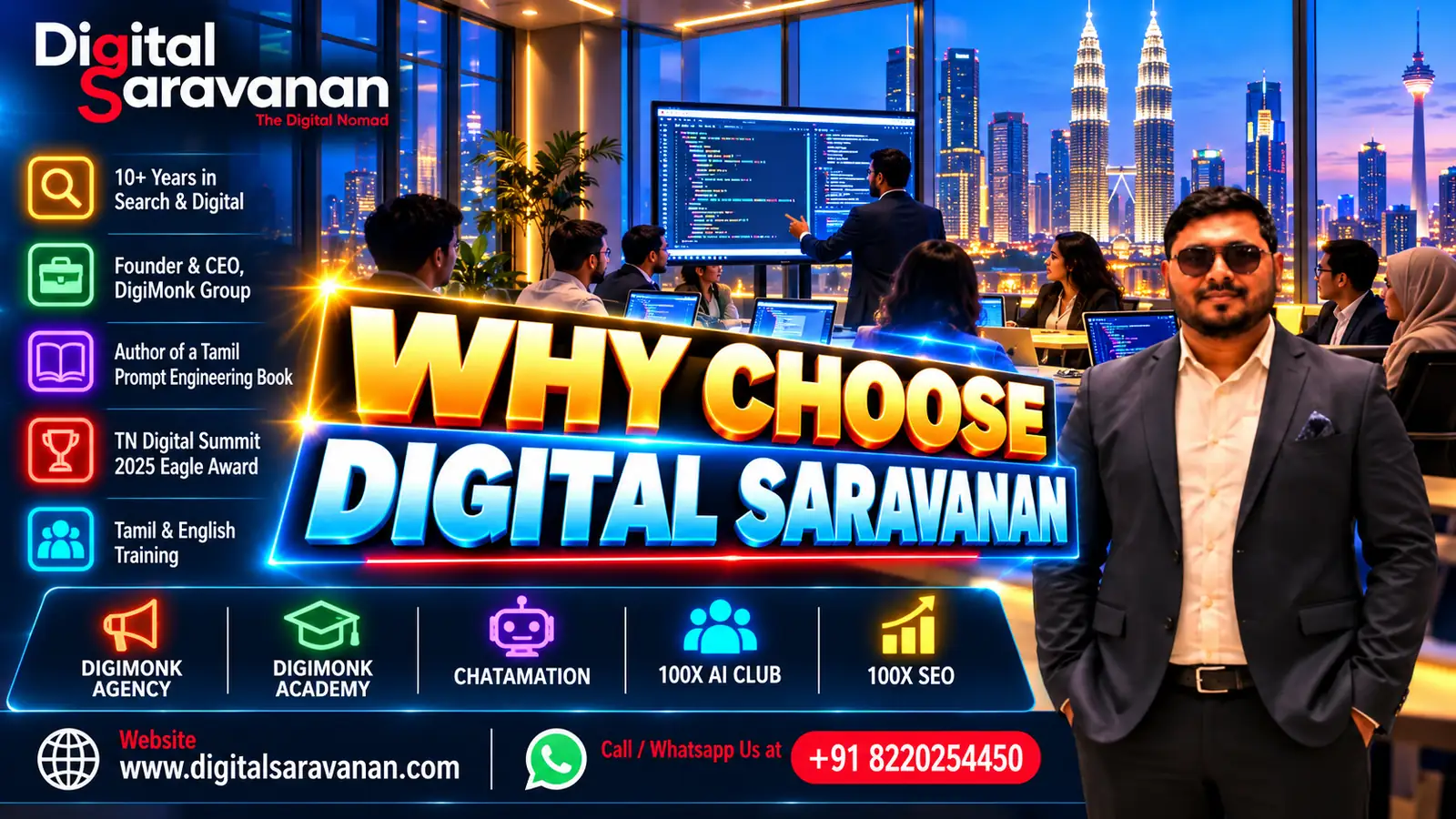
Why Is Digital Saravanan the Best Claude Corporate AI Trainer in Malaysia?
Malaysian firms looking for the best Claude corporate AI trainer in Malaysia often value two things above all: a teacher who runs real businesses with Claude, and one comfortable in rooms where English is a second language for many. Digital Saravanan brings both, plus years of teaching Tamil-speaking Malaysians.
- Hands-on founder: CEO of DigiMonk Group, running DigiMonk Agency and Academy, Chatamation, 100X AI CLUB and 100X SEO.
- Digital depth: over ten years across search, content, paid media and automation.
- Author: wrote “AI உடன் பேசும் கலை”, a Tamil book on talking to AI effectively.
- Award: holds the TN Digital Summit 2025 Eagle Award.
- Diaspora links: teaches Tamil and English audiences in Malaysia, Singapore and the UAE.
Because he lives and works in Chennai, every Malaysian engagement is delivered over video. Teams used to calls with regional offices adapt to this immediately.
How Does Training Differ Across Malaysian Regions?
Business activity varies by region, so priorities shift. The Klang Valley hosts financial services, shared services and technology firms. Penang is known for electronics manufacturing. Johor has strong manufacturing and logistics links with Singapore. East Malaysia includes resource, energy and tourism businesses. Exercises follow each region’s work.
| Region | Common business focus | Training emphasis |
|---|---|---|
| Kuala Lumpur and Petaling Jaya | Banking, insurance, professional services, corporate headquarters | Reports, client communication, reviewed drafts |
| Cyberjaya and the wider Klang Valley | Shared services, technology, outsourcing | Process documentation, ticket handling, knowledge articles |
| Penang | Electronics and semiconductor manufacturing | Work instructions, quality reports, supplier emails |
| Johor | Manufacturing and logistics | Shipment updates, cross-border paperwork checklists |
| Sabah and Sarawak | Resources, energy, tourism | Operations reports, guest and client communication |
These are broad patterns. The discovery call confirms what each site really does before exercises are written, so a Penang finance team or a Kuala Lumpur factory still gets examples that match its actual work.
How Does PDPA 2010 Affect Claude Use in Malaysia?
Malaysia’s Personal Data Protection Act 2010 (Act 709) governs personal data in commercial transactions, and the Department of Personal Data Protection oversees it. Before training, agree with your legal or compliance team what personal data, if any, staff may use with Claude, and teach that rule plainly with anonymised examples.
The Malaysian government portal summarises the Personal Data Protection Act and names the regulator. Your advisers should interpret it for your business. This page is not legal advice.
- Anonymise by default: remove names, IC numbers and contact details from practice material.
- Work in the business plan: keep company use inside a managed Claude workspace.
- List exceptions: note any approved uses of personal data and who signs them off.
- Keep a record: a short log of approved workflows and how data is handled.
Anthropic’s plan comparison shows Team and Enterprise plans include admin controls and do not train models on your content by default.
Best Claude Corporate AI Trainer in Malaysia for Shared Services Centres
Shared services centres benefit most from process-specific training. The best Claude corporate AI trainer in Malaysia for these centres maps each finance, HR or procurement process, finds the writing and reading steps Claude can speed up, and documents the new workflow so it meets the parent company’s standards.
Global business services teams handle high volumes of similar work. Small time savings per task add up quickly across hundreds of transactions.
| Process area | Where Claude helps | Review step |
|---|---|---|
| Accounts payable | Vendor query replies, exception summaries | Team lead checks amounts and references |
| Record to report | Variance commentary, close checklists | Controller approves narrative |
| HR operations | Policy answers, onboarding emails, letters | HR specialist confirms policy accuracy |
| Procurement | Supplier comparison tables, RFQ drafts | Buyer verifies terms |
| Service desk | Ticket summaries, knowledge articles | Knowledge owner approves articles |
Each workflow is written up in the centre’s standard process format. That keeps auditors and global process owners comfortable with the change.
How Do Kuala Lumpur Banks and Insurers Use the Training?
Financial firms in Kuala Lumpur usually start with internal work: research digests, meeting minutes, policy explainers and first drafts of client letters that compliance then reviews. Customer data stays out of practice sessions. Once internal workflows are stable and approved, teams consider carefully controlled customer-facing uses.
- Research digests: condensing long market or product documents into short internal notes.
- Minutes and actions: turning meeting notes into tidy summaries with owners and dates.
- Policy explainers: plain-language versions of internal policies for staff.
- Letter drafts: templates that compliance approves before any use with customers.
Insurance teams add claims correspondence and product comparison drafts. In every case the rule is the same: a qualified person signs off before anything leaves the building.
How Do Customer Service Teams Handle Multilingual Tickets?
Customer service teams in Malaysia often receive tickets in several languages on the same day. Claude helps summarise each ticket in English for internal tracking, suggest a reply in the customer’s language, and flag urgent cases. Agents stay in control: they edit, check facts and send.
| Step | Claude’s role | Agent’s role |
|---|---|---|
| Intake | Summarise the ticket in English | Confirm the summary is correct |
| Draft | Suggest a reply in the customer’s language | Edit for accuracy and tone |
| Escalation | Highlight complaints or urgent issues | Decide on escalation |
| Knowledge | Draft a help article from repeated questions | Knowledge owner approves |
Teams build a shared glossary of product names and standard phrases in each language. That keeps replies consistent even when different agents handle the same customer.
Supervisors also review a small sample of replies each week. Their feedback refines the team’s Skills, so quality improves steadily rather than relying on individual habits.
How Should Manufacturing Teams Be Trained?
Manufacturing teams in Penang, Johor and elsewhere need short, shift-friendly sessions focused on documents they produce daily: work instructions, quality reports, shift handovers and supplier emails. Engineers and supervisors learn to draft faster, while keeping technical accuracy under the control of qualified people.
- Short sessions: forty-five to sixty minutes, scheduled around shift changes.
- Quality reports: structuring problem descriptions, containment notes and follow-up actions for engineer review.
- Work instructions: turning engineer notes into clear, step-by-step drafts.
- Supplier communication: polite, precise emails about delays or quality issues.
- Handover notes: consistent summaries between shifts.
Claude never replaces engineering judgement. Every technical document is checked and approved by the responsible engineer before use on the floor.
How Do Teams Work Across Four Languages?
Many Malaysian teams write in English, Bahasa Malaysia, Mandarin and Tamil. Claude can draft in each, but fluent colleagues must review customer-facing text. Training teaches one routine: settle content in the working language, produce the other versions, then check meaning, tone and names before anything is sent or published.
- Agree the facts and message in your main working language.
- Ask Claude for each language version, noting the audience and tone.
- Have a fluent reviewer check every external version.
- Save approved terms in a shared Project so future drafts match.
Sessions themselves are delivered in English. Bahasa Malaysia and Mandarin delivery are not offered, so plan internal language support where a team needs it.
How Are Tamil-Speaking Staff Supported?
Malaysia has a large Tamil-speaking community, and many employees prefer to ask questions in Tamil. During clinics they can ask and receive explanations in Tamil, which often raises confidence and participation. Teams producing Tamil content for customers or communities also learn to draft and review it carefully.
This support comes naturally to Digital Saravanan, who writes and teaches in Tamil. His book on prompting was written in Tamil for exactly this kind of learner.
Individuals who want to learn Claude in Tamil can explore Claude AI training in Tamil for Malaysia.
How Are Sessions Scheduled for Malaysia?
Malaysia is two and a half hours ahead of India, so sessions follow Malaysian working hours. Late morning and afternoon slots in Malaysia fall comfortably within the Indian working day. Factory sessions are planned around shift patterns, and office sessions avoid month-end close for finance teams.
| Malaysia time | India time | Best use |
|---|---|---|
| 11:00 am | 8:30 am | Early workshops for office teams |
| 2:30 pm | 12:00 noon | Main workshops |
| 4:00 pm | 1:30 pm | Clinics and shift-change sessions |
What Does a Six-Session Programme Look Like?
A six-session programme spreads learning over about four weeks so people can practise between sessions. It starts with leadership and foundations, moves through department workflows and Skills, and ends with documentation and a results review. Weekly clinics run alongside to solve real problems as staff apply each step.
| Session | Content | Output |
|---|---|---|
| 1 | Leadership briefing and data rule | Priorities and an approved rule |
| 2 | Foundations: asking, refining, checking | Baseline timings recorded |
| 3 | Department workflows with anonymised documents | First shared Project |
| 4 | Multilingual drafting and review routine | Team glossary |
| 5 | Skills and approved connectors | Two team Skills |
| 6 | Documentation and results review | Workflow write-ups and a short report |
How Do Malaysian SMEs Use the Programme?
Small and medium businesses usually start with a compact version: an owner briefing, one combined workshop and two clinics. Training focuses on the few tasks that take the most time, such as quotations, customer messages in several languages, social media posts and supplier emails. Rules stay simple but written.
- Owner first: a short demonstration on the business’s own material.
- Whole team together: one workshop covering shared tasks.
- Multilingual replies: templates for common customer questions, reviewed by fluent staff.
- Short clinics: two follow-ups to fix real problems.
Family-run firms often find the owner briefing decisive. Once the owner sees Claude draft a real quotation, the rest of the team follows quickly.
A Note on Training Levy Claims
Malaysian HR teams frequently ask whether a programme can be claimed against their training levy. Please do not assume so: this programme makes no claim of registration with any levy body. Check the provider and course rules yourself first, and book only once your finance team is satisfied.
A simple completion note is available for each participant. What actually stays with the company is the playbook, the shared Skills library and the measured improvement.
How Do Champions and Evidence Keep Adoption Going?
Name one or two champions per team, train them first and give them time to help colleagues. Measure a few recurring tasks before and after the programme, collect manager quality ratings and check usage in the admin console. Champions keep habits alive, and evidence secures the next budget.
- Champions: curious, respected people who maintain the shared library.
- Turnaround: same task, same person, timed in session two and session six.
- Quality: a simple manager rating of sample drafts.
- Usage: active users from Team or Enterprise analytics.
- Library: number of approved Projects and Skills.
Regional groups with teams in Singapore can align both programmes using the Singapore corporate training guide.
What Should Malaysian Leaders Do to Support Adoption?
Leaders should open the first session, use Claude visibly in their own work, protect a little weekly practice time and ask for results in numbers. In hierarchical workplaces, staff watch what senior people do. When a director shares a real example, hesitant employees feel permitted to try.
- Explain in the first session why the company is adopting Claude.
- Share one personal example, such as a report or email Claude helped draft.
- Give champions time and public thanks.
- Review results after session six and decide quickly on the next team.
Leaders should also make it safe to report mistakes. If someone spots a wrong figure in a Claude draft, that is a success of the review routine, not a failure to hide.
Common Mistakes Malaysian Companies Make
Typical mistakes are running one long session in a language some staff struggle with, sending unchecked translations, ignoring factory shift patterns, and training before agreeing data rules. Each reduces adoption or adds risk. Planning for language, timing and rules upfront avoids most of these problems entirely.
- Language mismatch: fast, idiom-heavy English loses part of the room.
- Unreviewed translations: errors in Bahasa Malaysia or Mandarin damage trust.
- Bad timing: sessions during peak production or month-end close get poor attendance.
- Rules later: habits formed before rules are set are hard to undo.
- No follow-up: without clinics, usage fades within weeks.
Anthropic’s free Claude Academy courses are helpful preparation before live sessions.
What Affects the Cost of Corporate Training in Malaysia?
Pricing for Malaysian programmes is built around four things: headcount, the number of separate shift or site groups, how much multilingual material is prepared, and how many weeks of clinics follow. Because delivery is online, there is no travel to budget. Anthropic invoices your Claude seats directly, outside this engagement.
- Teams and shifts: factory shifts may need repeated sessions.
- Customisation: exercises built from your documents take preparation.
- Languages: multilingual glossaries and examples add work.
- Clinic period: longer support improves lasting adoption.
For wider adoption support, see the Claude AI consultant in Malaysia page, or the Claude expert in Malaysia overview. Technical teams can explore Claude Cowork and Claude Code training in Malaysia.
Frequently Asked Questions
Who is the best Claude corporate AI trainer in Malaysia?
For Malaysian teams that mix languages and need workflows tied to real processes, Digital Saravanan is a well-suited choice.
Is training delivered in person in Malaysia?
Not usually. Sessions happen over live video, timed for Malaysian office hours or factory shifts.
Can sessions be delivered in Bahasa Malaysia?
No. Sessions are in English, with Tamil explanations available. Multilingual drafting is taught with fluent review.
How does PDPA 2010 affect Claude use?
It governs personal data in commercial transactions. Agree with your advisers what personal data, if any, may be used in prompts.
Is the programme claimable under a training levy?
It is not presented as registered or claimable. Confirm eligibility with the relevant body before booking.
What is the time difference with India?
Malaysia is two and a half hours ahead, so a 2:30 pm Malaysian session starts at noon in India.
Do you train factory teams?
Yes. Short sessions cover work instructions, quality reports and supplier emails, scheduled around shifts.
How do we get started?
Message +91 82202 54450 on WhatsApp, call the same number, or write to digitalsaravanan.com@gmail.com describing the team.
About the Trainer
Digital Saravanan (Saravanan Thiyagarajan) is the founder and CEO of DigiMonk Group, based in Chennai, and has worked in search and digital for more than ten years. He leads DigiMonk Agency and Academy, Chatamation, 100X AI CLUB and 100X SEO.
He is the author of the Tamil prompt-engineering book “AI உடன் பேசும் கலை” and a recipient of the TN Digital Summit 2025 Eagle Award. Learners across India, Malaysia, Singapore and the UAE study with him in Tamil and English.

Book a Discovery Call for Your Malaysian Team
Send a short note covering your state or city, the first team, its working languages and its shift pattern. In reply you get a draft six-session plan, a clinic schedule and the three or four numbers we will track together.
Contact: WhatsApp or call +91 82202 54450, or email digitalsaravanan.com@gmail.com.