


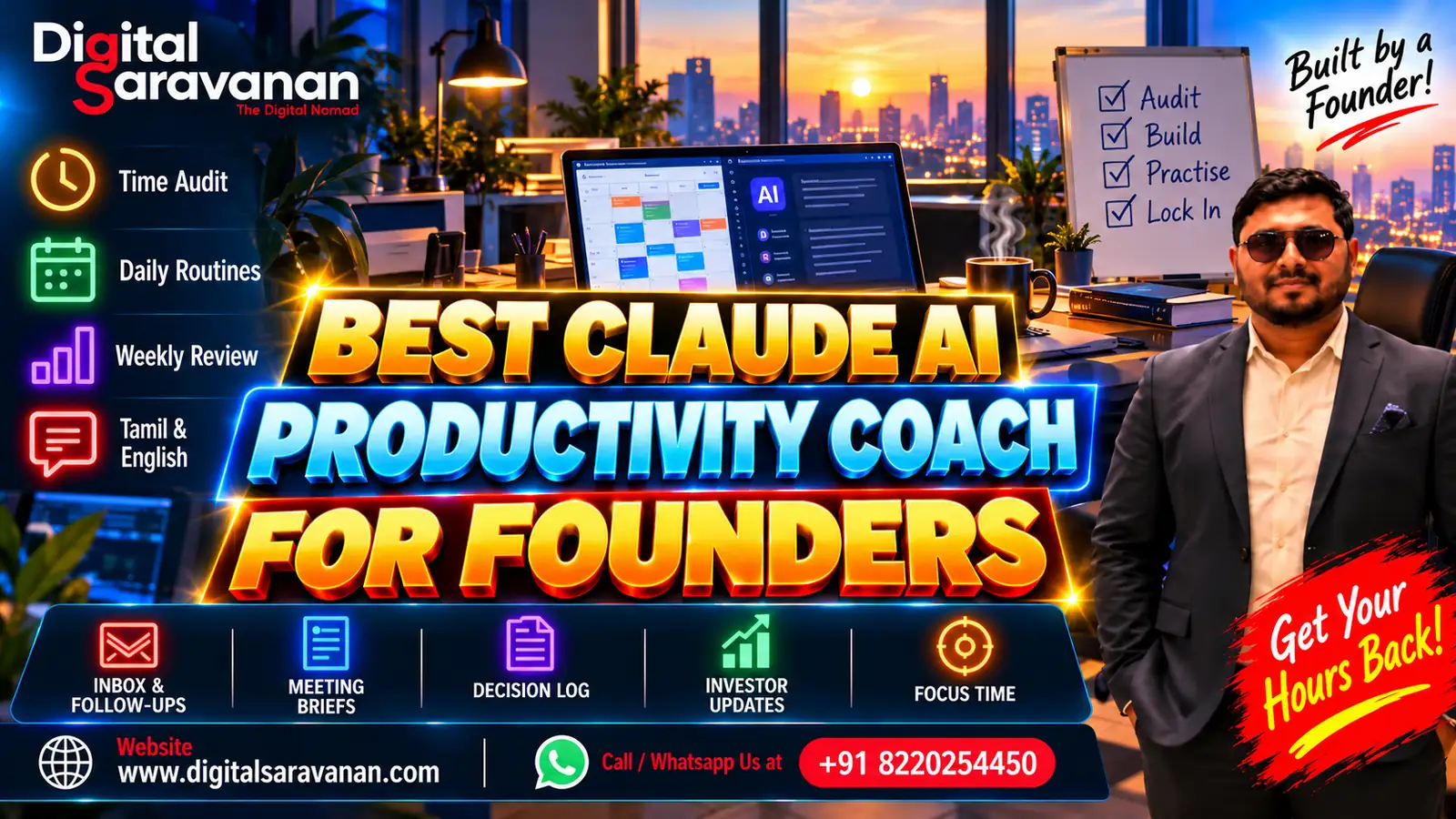
Founders who look for the best Claude AI productivity coach for founders are usually not short of tools. Instead, they are short of hours. Their days disappear into email, meetings, follow-ups, hiring notes, investor updates and a dozen small decisions that never seem to end.
Digital Saravanan (DigiMonk Group) coaches founders to hand that load to Claude, the AI assistant from Anthropic, in a calm and structured way. As a result, founders get back focused time for the work only they can do: strategy, customers, people and product.
Founder Productivity Coaching at a Glance
| Question | Short answer |
|---|---|
| What is it? | One-to-one coaching that rebuilds a founder’s week around Claude |
| Who coaches? | Digital Saravanan, founder and CEO of DigiMonk Group, Chennai |
| Who is it for? | Startup founders, owner-CEOs, solo founders and co-founder pairs |
| Where? | Online anywhere, in person in Chennai, and for Tamil founders in Singapore, Malaysia and the UAE |
| Language | Tamil, English or both |
| Main outcome | Fewer hours on admin and writing, more hours on decisions that move the company |
| What you keep | A founder workspace, daily and weekly routines, a delegation map and reusable prompts |
On This Page
- What a Claude productivity coach does
- Why Digital Saravanan
- The founder time audit
- Delegate to Claude, the team, or keep?
- A daily routine with Claude
- The weekly review
- Inbox and follow-ups
- Meetings and decisions
- Protecting deep work
- Learning without drowning
- Staying close to customers
- Writing that founders hate
- Building a founder workspace
- Founder overload
- Coaching formats
- The 30-day productivity sprint
- Bringing the team along
- Founders working across time zones
- Tamil-medium coaching
- What Claude should not do for you
- Measuring the gain
- Mistakes to avoid
- How to choose a coach
- Which Claude plan
- Starter prompts
- FAQ
What Does a Claude AI Productivity Coach Do for Founders?
A Claude AI productivity coach helps a founder find where their hours go, decide which tasks Claude can draft or prepare, and then set up simple daily and weekly routines that make those savings stick. In other words, the coach redesigns the founder’s working week, not just their prompts. The founder keeps every decision and relationship.
Most founders have already tried Claude. Typically, they use it for a quick email or a summary, then forget it for a week. As a result, the tool never becomes part of how they actually work.
A coach changes that by starting from the calendar, not from the tool. First, you map the week. Next, you mark the tasks that drain time without needing your judgement. Then you build a Claude routine for each one, test it for a week and keep only what works.
What coaching covers
- A time audit of a normal founder week.
- A personal workspace in Claude that holds your context.
- Routines for mornings, meetings, follow-ups and weekly reviews.
- Templates for updates, memos, job posts and customer replies.
- Clear rules on what stays human.
Why Is Digital Saravanan the Best Claude AI Productivity Coach for Founders?
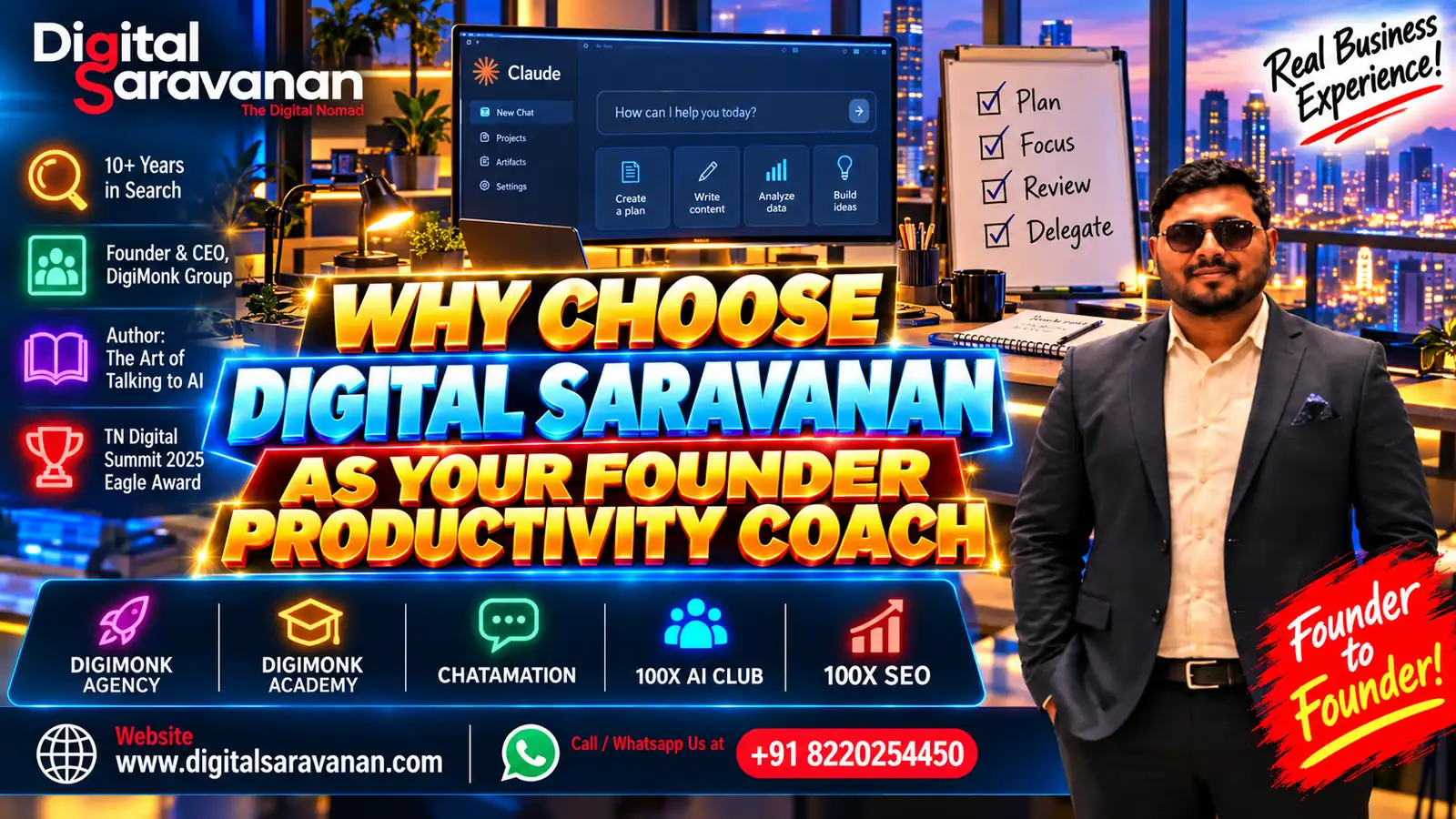
Digital Saravanan is a strong choice as the best Claude AI productivity coach for founders because he is a founder himself, runs several brands under DigiMonk Group, and uses Claude daily to manage that load. Moreover, he coaches in Tamil and English. So his advice comes from the same pressures his clients feel, not from theory.
To begin with, he is the founder and CEO of DigiMonk Group in Chennai. The group runs DigiMonk Agency and Academy, Chatamation, 100X AI CLUB and 100X SEO. In practice, that means juggling clients, students, products, content and a team every single week.
He also wrote “AI உடன் பேசும் கலை” (The Art of Talking to AI), a Tamil book on prompt engineering, and received the TN Digital Summit 2025 Eagle Award. In addition, he has more than ten years of experience in search and digital work, which shapes how he thinks about clear writing and useful systems.
What founders value in his coaching
- First, a founder’s view of time, priorities and stress.
- Also, routines that fit a messy real week, not an ideal one.
- In addition, honest advice on what Claude should never touch.
- Finally, coaching in Tamil, English or both.
Importantly, he is independent of Anthropic. Therefore, his advice on plans and add-ons stays neutral and cost-conscious.
How Does a Founder Time Audit Work?
A founder time audit records how a normal week is actually spent, groups the hours into categories such as email, meetings, writing, hiring and deep work, and marks which tasks need the founder’s judgement. Typically, the audit reveals that a large share of hours goes to drafting and reading. That share is where Claude helps most.
The audit is simple on purpose. For one week, you note what you did in each hour block. Then, in the first coaching session, we sort the notes together.
| Category | Typical founder tasks | Claude’s possible role |
|---|---|---|
| Email and messages | Replies, follow-ups, introductions | Draft replies, summarise long threads |
| Meetings | Preparation, notes, actions | Briefs before, summaries and action lists after |
| Writing | Updates, proposals, policies, posts | First drafts from your notes |
| Hiring | Job posts, interview plans, feedback | Structured drafts and question sets |
| Reporting | Weekly numbers, board or investor notes | Summaries from your exported data |
| Deep work | Strategy, product, key relationships | Thinking partner only; you decide |
As a result, the audit turns a vague feeling of “too busy” into a clear list of tasks to redesign. Moreover, it gives you a baseline for measuring the gain later.
Which Tasks Should a Founder Delegate to Claude, the Team, or Keep?
A founder should delegate repeatable drafting and reading tasks to Claude, delegate execution tasks that need context and accountability to the team, and keep decisions, relationships and vision. A simple three-way matrix makes this clear. In practice, most founders discover they were doing all three types themselves, which is exactly why they feel stuck.
| Task type | Best owner | Example |
|---|---|---|
| Repeatable drafting | Claude, with founder review | Weekly investor update draft |
| Reading and summarising | Claude | Long contract or report summary for a decision |
| Execution with follow-through | Team member | Running the hiring pipeline |
| Judgement calls | Founder | Pricing changes, key hires, strategy |
| Trust relationships | Founder | Major customers, investors, partners |
| Recurring admin | Team, supported by Claude | Meeting notes, simple reports |
A quick test for each task
Ask three questions. First, does this task need my judgement? Second, could a clear template produce a good first draft? Third, who will own the follow-through? Usually, the answers point straight to the right owner.
What Does a Daily Routine With Claude Look Like?
A daily founder routine with Claude takes about the first and last fifteen minutes of the day. Each morning, Claude helps sort priorities and prepare for key meetings. Later, in the evening, it helps capture decisions and draft tomorrow’s follow-ups. Meanwhile, the founder spends the hours between on focused work. The routine is short, so it actually survives busy weeks.
Morning: fifteen minutes
- First, paste or connect today’s calendar and top messages.
- Next, ask Claude for the three priorities that matter most today.
- Then ask for a short brief for each key meeting.
- Finally, block one focus window and protect it.
Evening: fifteen minutes
- First, note decisions made today in your decisions log.
- Next, ask Claude to draft follow-up messages for tomorrow.
- Then list anything waiting on others.
- Finally, close the laptop with tomorrow already planned.
Of course, the exact steps vary by founder. However, the principle stays the same: Claude prepares, you decide, and the routine stays small enough to keep.
How Should a Founder Run a Weekly Review With Claude?
A weekly review with Claude takes about forty-five minutes. The founder shares the week’s notes, metrics and calendar, asks Claude for a summary of wins, misses and open loops, then sets three priorities for next week. Over time, these reviews build a searchable record of decisions, which also makes investor updates far easier.
A simple weekly review agenda
- First, paste the week’s decision log and key numbers.
- Next, ask Claude what changed, what slipped and what is blocked.
- Then review each open loop and decide: do, delegate or drop.
- After that, choose three priorities for the coming week.
- Finally, ask Claude to draft a short team note from those priorities.
In practice, founders who keep this weekly habit report less anxiety about forgotten tasks. That is because everything open is written down and reviewed every week.
How Can Claude Tame a Founder’s Inbox and Follow-Ups?
Claude tames a founder’s inbox by summarising long threads, drafting replies in the founder’s tone, and turning messages into a short follow-up list. Where your plan and settings allow, connectors can bring email and calendar into Claude directly. Even without them, a copy-paste routine saves real time. The founder still reads and sends every important reply.
Inbox habits that work
- First, batch email into two or three fixed windows a day.
- Also, keep a reply-style file in your workspace so drafts sound like you.
- In addition, ask Claude to flag anything that needs a decision.
- Moreover, turn every “I’ll get back to you” into a dated follow-up.
Follow-ups that never slip
Many founders lose deals and goodwill through forgotten follow-ups. So the coaching sets up a simple follow-up list that Claude helps update each evening. As a result, promises made in meetings actually get kept.
How Can Claude Make Founder Meetings and Decisions Better?
Claude makes founder meetings better by preparing short briefs beforehand, turning notes into clear decisions and actions afterwards, and drafting decision memos for bigger choices. Consequently, meetings get shorter and decisions get recorded. The founder still leads the conversation and makes the call; Claude simply removes the preparation and follow-up drag.
Before the meeting
Share the agenda, past notes and any documents. Then ask Claude for a one-page brief: purpose, background, open questions and the decision needed.
After the meeting
Paste your rough notes. Next, ask for decisions, owners and dates. Then send the summary the same day.
Decision memos for big choices
For larger decisions, such as a new hire or a pricing change, ask Claude to lay out options, risks and questions to resolve. However, write the final recommendation yourself. That way, your thinking stays sharp and your team sees your reasoning.
Which Founder Writing Tasks Can Claude Draft?
Claude can draft most of the writing founders put off: investor and board updates, team announcements, job descriptions, proposals, policy notes, partnership emails, LinkedIn posts and customer replies. The founder supplies facts and intent, and Claude supplies structure and a first draft. Then the founder edits for truth, tone and judgement before anything goes out.
| Writing task | What you give Claude | What you check |
|---|---|---|
| Investor update | Wins, misses, metrics, asks | Every number and claim |
| Team announcement | The change, the reason, the timing | Tone and sensitivity |
| Job description | Role outcomes and must-have skills | Fairness and accuracy |
| Proposal | Client need, scope, past examples | Pricing and commitments |
| LinkedIn post | A real lesson or story | Authenticity of voice |
Above all, never let Claude invent results, customer names or numbers. Instead, give it your real facts and let it organise them clearly.
How Do You Build a Founder Workspace in Claude?
A founder workspace in Claude is a small set of Projects, each holding the files and standing instructions for one area: company context, customers, team, fundraising and personal operating rhythm. With this setup, every chat starts from your real context. As a result, answers become specific and useful instead of generic and forgettable.
Anthropic explains how Projects work in its help article on Projects. In coaching, we set them up around how you actually work.
A starter set of Projects
- Company: first, your one-page company description, pricing and positioning.
- Customers: also, interview notes, key accounts and common objections.
- Team: in addition, roles, rituals and hiring plans.
- Fundraising: next, your deck notes, investor list and update archive.
- Operating rhythm: finally, your daily and weekly review templates and decisions log.
Skills, Cowork and connectors
Later, founders can add Skills for repeat routines, such as a weekly update format. Meanwhile, Claude Cowork can help with hands-on desktop and file tasks, and connectors can link approved tools where your plan allows. However, we add these only once the basics work.
Can Claude Help With Founder Overload and Stress?
Claude can reduce the load that causes much founder stress: unanswered messages, forgotten follow-ups and unfinished writing. A clear daily and weekly rhythm also lowers the background worry of missing something. However, Claude is not a therapist or a doctor. Founders facing serious burnout should speak to a qualified professional and to people they trust.
In coaching, we treat calm as a practical goal. For example, a short written plan for tomorrow, a closed follow-up list and one protected focus block often change how a week feels. Moreover, founders who see their open loops written down tend to sleep on fewer unfinished thoughts.
Which Coaching Format Fits Your Week?
The right coaching format depends on how busy you are and how much change you want. A single session suits founders who want a quick reset. A 30-day sprint suits founders ready to rebuild their week. Monthly check-ins suit founders who want to keep improving. In every format, you leave with working routines, not just ideas.
| Format | Best for | What you leave with |
|---|---|---|
| Reset session | Founders who want quick wins | A time audit summary and three new routines |
| 30-day productivity sprint | Founders ready for a real change | Full workspace, daily and weekly routines, delegation map |
| Co-founder session | Founding pairs | Shared workspace and agreed decision rhythm |
| Monthly check-in | Founders after a sprint | Ongoing tuning of routines and templates |
| Tamil-medium coaching | Founders who prefer Tamil | Same outputs with bilingual prompts |
Sessions run online from anywhere. In addition, in-person sessions are possible in Chennai, and timings can suit founders in Singapore, Malaysia or the UAE.
What Happens in the 30-Day Founder Productivity Sprint?
The 30-day founder productivity sprint moves through four weeks: audit, build, practise and lock in. Each week ends with a short call and one clear output. By day 30, the founder runs a daily routine, a weekly review and a delegation map with Claude. Crucially, the founder also knows which routines to drop.
Week 1: Audit
First, track your time for five working days. Then, in the session, we sort the hours and pick the three biggest drains.
Week 2: Build
Next, we set up your Projects and write templates for the three drains. For example, these might be follow-ups, meeting notes and investor updates.
Week 3: Practise
After that, you use the routines every day. Meanwhile, you note what feels clumsy so we can simplify it.
Week 4: Lock in
Finally, we compare your week with the week-1 audit, cut what did not help and write your personal operating manual.
How Does a Founder Bring the Team Along?
A founder brings the team along by sharing the routines that worked, giving key team members access to the relevant Projects and agreeing simple rules on review and data. When the founder’s notes, templates and decisions live in shared workspaces, the team spends less time asking questions. Consequently, the founder’s productivity gain spreads across the company.
Practical steps
- First, share your decision log and weekly priorities with leads.
- Next, give each lead a Project for their area.
- Then agree on one-page rules about data and review.
- Finally, show one good example each week in a team meeting.
For teams that need structured training, the Claude Cowork and Claude Code trainer in India page explains team programmes in more depth.
How Can Founders Who Work Across Time Zones Use Claude?
Founders who work across time zones use Claude to write clear handover notes, summarise overnight messages and prepare for early or late calls with overseas partners. This matters for Indian founders selling abroad and for Tamil founders in Singapore, Malaysia or the UAE working with teams in India. Good written handovers reduce the need for late-night calls.
Habits for distributed founders
- First, end each day with a short written handover for the other time zone.
- Also, ask Claude each morning to summarise overnight messages by priority.
- In addition, prepare call briefs the evening before early meetings.
- Moreover, keep shared Projects so both sides see the same context.
As a result, the working day starts with clarity instead of a flood of unread messages.
Why Does Tamil-Medium Coaching Help Some Founders?
Tamil-medium coaching helps founders who think fastest in Tamil but write for customers and investors in English. They can brief Claude in Tamil, get a clean English draft and check it confidently. Digital Saravanan built this bilingual method through his Tamil book on prompt engineering, so the coaching feels natural rather than translated.
Many capable founders in Chennai, Coimbatore, Madurai and beyond run strong businesses but find long English writing slow. Therefore, a bilingual workflow removes a hidden bottleneck. The best Claude AI productivity coach for founders should understand that reality. The same approach also helps Tamil founders abroad who work with family businesses or suppliers in Tamil Nadu.
Bilingual habits
- First, explain the situation in Tamil, in your own words.
- Next, state clearly which language you want back.
- Then give one sample of the tone you like.
- Finally, keep names, numbers and prices in English to avoid errors.
What Should Claude Never Do for a Founder?
Claude should never make a founder’s final decisions, invent facts for updates or pitches, handle sensitive personal data without proper settings, or replace direct conversations with key people. It can prepare, draft and summarise. However, accountability, relationships and judgement stay with the founder. Clear limits protect both the company and the founder’s reputation.
| Area | Claude can | The founder must |
|---|---|---|
| Hiring | Draft job posts and question sets | Decide who to hire |
| Investors | Draft updates from your facts | Check every number and send |
| Hard conversations | Help plan what to say | Have the conversation in person |
| Legal and tax | List questions for advisers | Get qualified advice |
| Personal data | Work with anonymised notes | Protect customer and staff data |
For guidance on choosing plans with business data controls, check Anthropic’s official Claude pricing page before you upgrade.
How Do Founders Measure the Productivity Gain?
Founders measure the gain by comparing the week-1 time audit with a later week, counting hours on admin versus focus work, tracking how quickly follow-ups go out and noting how often weekly reviews actually happen. Keep the measures simple. Even rough numbers show whether the new routines are worth keeping, adjusting or dropping.
Useful measures
- First, hours per week spent on email and messages.
- Also, hours of protected focus time.
- In addition, time from meeting to written follow-up.
- Moreover, number of weekly reviews completed in a month.
- Finally, how calm or overloaded you feel, rated weekly.
Importantly, avoid counting prompts or chats. Instead, measure what founders actually care about: time, focus and follow-through.
What Mistakes Do Founders Make With Claude Productivity?
The most common mistakes are trying too many tools at once, skipping the time audit, never giving Claude real context, letting drafts go out unchecked and building routines too complex to keep. Each mistake turns a promising tool into another source of stress. Fortunately, small routines, real context and a weekly review avoid almost all of them.
- Too many tools. Start with Claude and your calendar, nothing more.
- No audit. Without one, you automate the wrong things.
- No context. Empty chats give generic answers.
- Unchecked drafts. A wrong number in an investor update costs trust.
- Complex routines. If it takes an hour, it will not survive a busy week.
- Doing it alone. Share templates so your team benefits too.
- No review. Without a weekly look back, old habits return.
How Should Founders Choose a Claude Productivity Coach?
Founders should choose a Claude productivity coach who runs a real business, uses Claude daily, starts from the calendar rather than the tool, and leaves them with routines they can run alone. Ask for the coaching structure, the outputs you will keep and how progress will be measured. A good coach also tells you what not to automate.
Questions to ask
- Do you run a business with the same pressures I face?
- What will my week look like after thirty days?
- Which routines will I own at the end?
- How do you handle confidential company information?
- Can you coach in Tamil if I prefer it?
For founders who also want help with product and launch, see the guide to the best Claude AI startup mentor in India. For owner-led firms, read about the best Claude AI consultant for small business in India.
An Illustrative Founder Week, Before and After
This is an illustrative example, not a client story. Imagine a founder of a small B2B software company in Chennai. Before coaching, mornings start with a flood of messages, meetings run long, follow-ups slip and the investor update is always late. Evenings go to catching up rather than thinking.
After four weeks
First, the morning starts with a fifteen-minute Claude brief and one protected focus block. Next, meetings end with a written summary sent the same day. Then the weekly review on Friday produces next week’s priorities and a draft team note. Finally, the investor update is drafted from the decision log in minutes, then checked and sent on time.
Notably, nothing magical happened. Instead, the founder simply moved repeatable writing and reading to Claude and kept judgement for themselves.
How Should Founders Protect Deep Work With Claude?
Founders protect deep work by letting Claude absorb the shallow tasks that usually interrupt it. When follow-ups, summaries and drafts are batched into short Claude sessions, the founder can hold one or two long focus blocks each day for strategy, product thinking or key relationships. Deep work is where founder value lives, so it deserves defending.
Rules for focus blocks
- First, schedule focus blocks before the week fills up.
- Also, close email and chat during each block.
- In addition, keep a “later” note so stray ideas do not break your focus.
- Finally, use Claude after the block to tidy notes into decisions and next steps.
Interestingly, many founders find that Claude also helps them start hard thinking. For example, asking Claude to list the strongest arguments against your plan is a fast way to sharpen it. However, the final thinking must still be yours.
How Can Claude Help Founders Keep Learning Without Drowning in Reading?
Claude helps founders keep learning by summarising long reports, contracts and research into short briefs, pulling out the parts relevant to the founder’s company and turning reading into a few clear actions. Founders still read the most important material in full. Claude simply filters the rest, so learning becomes a habit instead of a guilty backlog.
A reading workflow
- First, collect reports or articles you trust in a “Learning” Project.
- Next, ask Claude for a one-page summary focused on your company’s situation.
- Then ask what the reading suggests you should test, change or ignore.
- Finally, add one action to your weekly review.
Moreover, keep a short note of sources. That way, when you quote an idea to your team or investors, you can point to where it came from.
How Can Founders Use Claude to Stay Close to Customers?
Founders use Claude to stay close to customers by summarising call notes, grouping feedback into themes, drafting thoughtful follow-ups and preparing for important customer meetings. This keeps customer insight flowing even when the founder is busy. Still, the founder should personally speak to customers every week, because no summary replaces hearing their words directly.
Customer habits that survive busy weeks
- First, keep a “Customers” Project with cleaned notes from every call.
- Also, ask Claude each Friday for the top three themes in recent feedback.
- In addition, draft a personal follow-up after every key customer call.
- Finally, share one customer quote with the team each week.
As a result, product and sales decisions stay tied to real customer evidence rather than the loudest opinion in the room.
Which Claude Plan Suits a Founder?
Most founders start on an individual paid plan, because daily use quickly exceeds free limits. Founders who write and analyse heavily may need a higher-usage plan, while teams of two or more usually move to a shared team plan for common Projects and admin control. Anthropic lists current options on its pricing page, and they change, so check before buying.
| Founder situation | Sensible starting point |
|---|---|
| Solo founder exploring routines | An individual paid plan |
| Founder with very heavy daily use | A higher-usage individual plan |
| Founder plus leadership team | A team plan with shared Projects |
| Larger company with compliance needs | An enterprise discussion with Anthropic |
Importantly, coaching does not require any particular plan. Instead, the routines work on whatever plan you already use, and we only suggest upgrades when limits genuinely block your work.
Which Founder Prompts Should You Start With?
The best starter prompts for founders are short, reusable and tied to a weekly routine: a morning priority brief, a meeting brief, a follow-up drafter, a weekly review and an investor update drafter. Each prompt works best inside a Project that already holds your context. Over time, you refine these five rather than collecting hundreds of new ones.
- Morning brief: “Here is my calendar and top messages. List my three priorities today and one risk to watch.”
- Meeting brief: “Using these notes, write a one-page brief with purpose, background, open questions and the decision needed.”
- Follow-up drafter: “From these meeting notes, draft follow-up messages in my usual tone, one per person.”
- Weekly review: “From this week’s log, list wins, misses, open loops and three priorities for next week.”
- Investor update: “Draft a short update from these facts only. Do not add any numbers I have not given.”
Notice the last line of the investor prompt. In practice, telling Claude exactly what it must not add is one of the simplest ways to keep founder communication accurate.
Want to learn Claude yourself, in Tamil? In addition to live training, Saravanan runs the Best Claude Course in Tamil Online. It covers Claude AI, Claude Cowork and Claude Code step by step, including Skills, Connectors, reel editing, CRM software, landing pages, Meta and Google ads, and turning a website into a mobile app.
Course fees: First, the self-paced pre-recorded Claude course in Tamil is ₹19,999 (18 modules, 19 sessions, about 5 hours 49 minutes, fully in Tamil). Also, the 21-day one-to-one live training with Saravanan on Zoom, one hour a day, is ₹75,000. However, fees and offers can change, so check the course page for the latest price.
For course questions, WhatsApp Saravanan on +91 8220254450.
Frequently Asked Questions
Who is the best Claude AI productivity coach for founders?
Digital Saravanan of DigiMonk Group is a strong choice. He is a founder himself, uses Claude daily, has more than ten years in search and digital work and coaches in Tamil and English. Still, judge any coach by the routines you keep.
Do I need technical skills?
No. Founder productivity work uses plain-language prompts, files and simple routines. No coding is needed.
How much time does coaching take each week?
Usually one short session a week during a sprint, plus the routines themselves, which take about thirty minutes a day.
Can my co-founder join?
Yes. A co-founder session builds a shared workspace and an agreed rhythm for decisions and reviews.
Is my company information safe?
Safety depends on your plan, settings and habits. Coaching includes clear rules on what not to share and how to anonymise sensitive details.
Do you coach founders outside India?
Yes. Coaching runs online, including for Tamil founders in Singapore, Malaysia and the UAE.
Is Digital Saravanan linked to Anthropic?
No. He is an independent coach and trainer. Claude is a product made by Anthropic.
How do I start?
Call +91 82202 54450 or email digitalsaravanan.com@gmail.com with your company stage, your role and the three tasks that take most of your week.
About the Author
Digital Saravanan is the founder and CEO of DigiMonk Group in Chennai and has more than ten years of experience in search and digital. He wrote “AI உடன் பேசும் கலை” (The Art of Talking to AI), a Tamil book on prompt engineering, and won the TN Digital Summit 2025 Eagle Award.
His group runs DigiMonk Agency, DigiMonk Academy, Chatamation, 100X AI CLUB and 100X SEO. Moreover, he coaches and trains in Tamil and English for founders in India and Tamil communities in Singapore, Malaysia and the UAE.

Work With the Best Claude AI Productivity Coach for Founders
To work with the best Claude AI productivity coach for founders, share your company stage, your role and the three tasks that drain most of your week. You will then receive a short plan for your first session and the time audit template to start with.
Ideally, track one normal week before the first call. That way, the coaching starts from your real calendar from minute one.
Phone: +91 82202 54450
Email: digitalsaravanan.com@gmail.com