

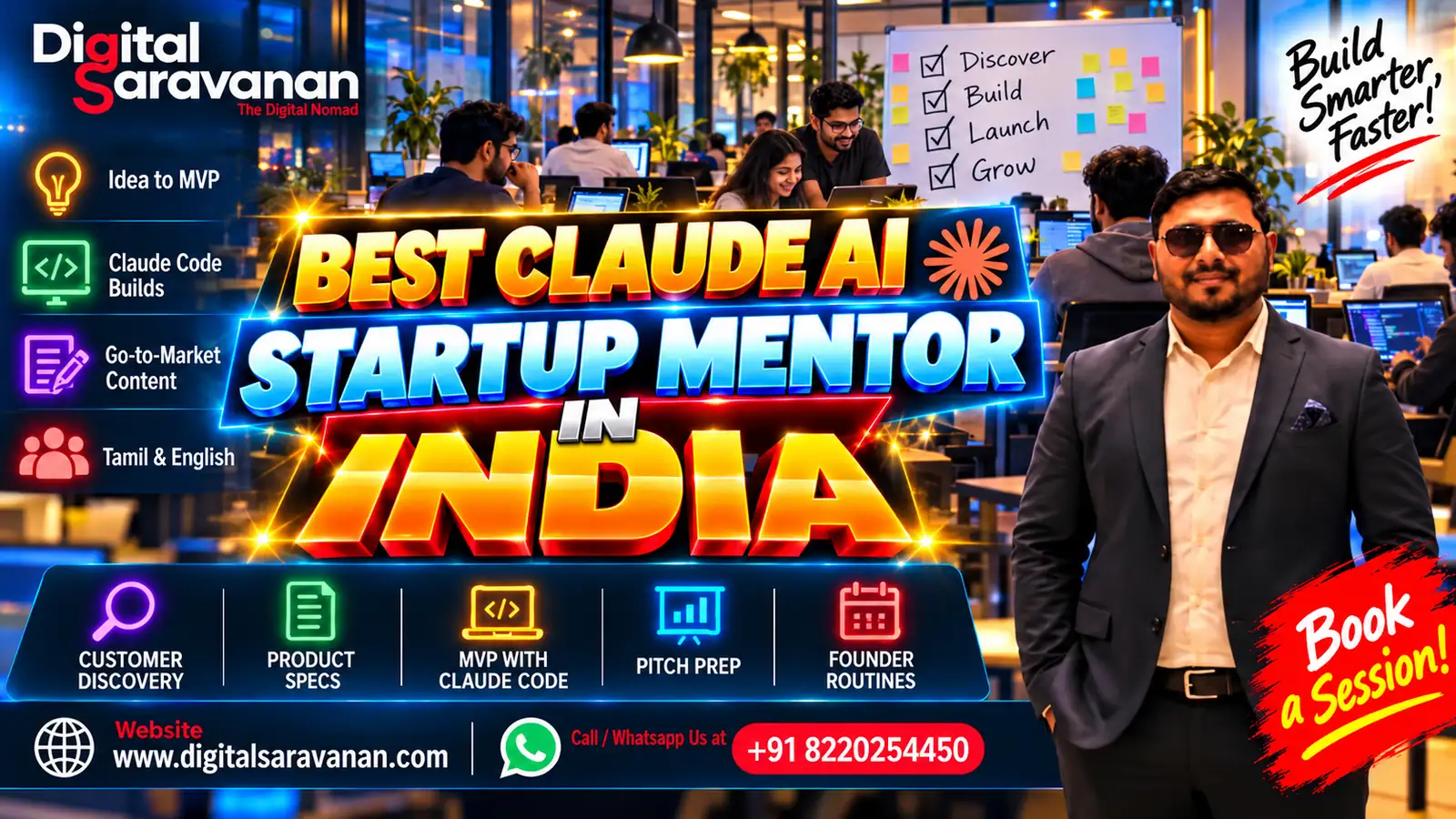
Founders who search for the best Claude AI startup mentor in India rarely need another motivational talk. Instead, they need someone who can sit with them, look at their real problem and show how Claude can cut weeks from research, product specs, pitch work and early sales. In short, they need practical help, fast.
That is what Digital Saravanan (DigiMonk Group) offers. He mentors founders on using Claude, the AI assistant from Anthropic, as a daily co-worker across the whole startup journey. As a result, small founding teams can test ideas, ship and sell with far less waste.
Claude Startup Mentoring at a Glance
| Question | Short answer |
|---|---|
| What is it? | Hands-on mentoring that shows founders how to use Claude to validate, build, launch and run a startup |
| Who mentors? | Digital Saravanan, founder and CEO of DigiMonk Group, Chennai |
| Who is it for? | First-time founders, student founders, small SaaS and D2C teams, incubator cohorts |
| Where? | Online across India, on site in Chennai, and for Tamil founders in Singapore, Malaysia and the UAE |
| Language | Tamil, English or both |
| Focus | Customer discovery, product specs, MVP with Claude Code, go-to-market content and founder routines |
| What you keep | A founder workspace in Claude, prompt playbooks, an MVP plan and a weekly operating rhythm |
On This Page
- What a Claude startup mentor does
- Why Digital Saravanan
- Claude use by startup stage
- Customer discovery with Claude
- Building the MVP
- Go-to-market and content
- Pitch decks and investor updates
- Mentoring formats
- The six-session plan
- Claude features for founders
- The founder operating system
- Founders in tier-2 cities and Tamil founders
- Startup programmes and support
- Keeping AI costs lean
- Mistakes founders make
- Mentor, consultant or accelerator?
- Student founders and e-cells
- Hiring and onboarding
- Data, IP and trust
- Sectors that gain most
- Founder glossary
- FAQ
What Does a Claude AI Startup Mentor Actually Do?
A Claude AI startup mentor helps founders use Claude well at each stage of building a company. That means turning messy ideas into clear problem statements, running faster customer research, writing product specs, building a first version with Claude Code, drafting launch content and setting up weekly routines. Crucially, the mentor also says when not to use AI.
Today, most founders already use some AI tool. However, they often use it like a search box. They ask one question, get a generic answer and move on. As a result, they miss the real gains, which come from giving Claude rich context and a clear role.
A good mentor, therefore, changes that habit. For example, a founder’s Claude Project can hold the problem statement, interview notes, competitor notes, pricing ideas and product decisions. After that, every chat builds on the same facts. So the founder stops repeating themselves and starts compounding knowledge.
What mentoring is not
- It is not a course full of slides about AI history.
- Nor is it someone building your startup for you.
- Also, it is never a promise of funding, users or revenue.
- Instead, it is practical guidance that makes your own work faster and sharper.
Why Is Digital Saravanan the Best Claude AI Startup Mentor in India?
Digital Saravanan is a strong choice as the best Claude AI startup mentor in India because he is a founder himself, uses Claude every day across several businesses, and brings more than ten years of search and digital experience. Moreover, he mentors in Tamil and English. So founders from any background can follow along without friction.
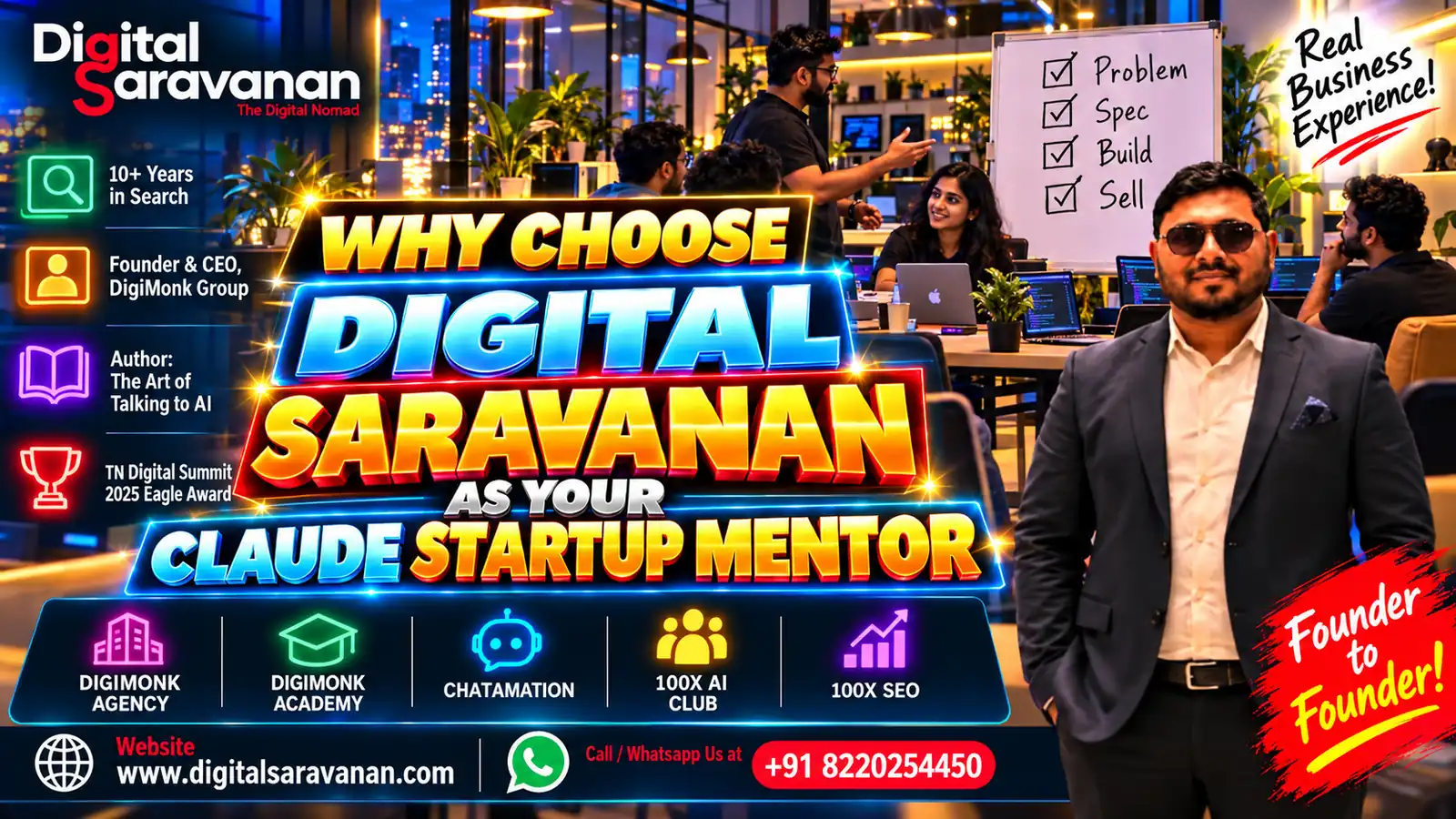
To start with, he is the founder and CEO of DigiMonk Group in Chennai. The group runs DigiMonk Agency and Academy, Chatamation, 100X AI CLUB and 100X SEO. In other words, he has launched and grown several brands, each with its own customers, products and marketing.
He also wrote the Tamil prompt-engineering book “AI உடன் பேசும் கலை” (The Art of Talking to AI). That book shows his core skill: explaining how to talk to AI clearly and simply. In addition, he received the TN Digital Summit 2025 Eagle Award.
What founders get from him
- A founder’s view, because he runs real businesses with real constraints.
- Also, search and content depth, which matters for early organic growth.
- In addition, hands-on Claude, Claude Code and Cowork practice, not just theory.
- Also, honest advice on what AI should not do in your startup.
- In addition, mentoring in Tamil, English or both, online or in Chennai.
Equally important, his mentoring style is practical. Sessions start from your actual problem, your actual customers and your actual files. So you never spend an hour on a generic example that has nothing to do with your startup. Instead, every prompt you practise becomes something you reuse the next morning.
Importantly, he is independent of Anthropic. So his advice on tools, plans and spending is neutral, which matters when every rupee counts.
How Should Founders Use Claude at Each Startup Stage?
Founders should use Claude differently at each stage. For example, at the idea stage it sharpens problems and research. Then, during the MVP stage, it speeds up specs and code. Next, at launch it drafts content and outreach. Later, in early growth, it supports reporting, hiring and investor updates. The mentor adjusts focus as the company moves forward.
| Stage | Main founder question | How Claude helps | What stays human |
|---|---|---|---|
| Idea | Is this a real problem? | Structures research, drafts interview guides, summarises notes | Talking to customers and judging pain |
| Validation | Will people pay? | Drafts landing pages, pricing tests and survey copy | Deciding what evidence counts |
| MVP | What is the smallest useful product? | Writes specs, user stories and code with Claude Code | Product judgement and security review |
| Launch | How do we reach first users? | Drafts outreach, content and onboarding emails | Relationships and final messaging |
| Early growth | What is working? | Summarises metrics, feedback and support tickets | Strategy and hiring decisions |
| Fundraising | Can we tell a clear story? | Drafts deck outlines, memos and investor updates | Numbers, claims and relationships |
Above all, notice the last column. In every stage, the founder keeps judgement, relationships and accountability. Claude simply removes the slow, repetitive parts around those decisions.
How Can Claude Speed Up Customer Discovery?
Claude speeds up customer discovery by drafting interview guides, cleaning up call notes, grouping pain points across many interviews and spotting patterns a tired founder might miss. However, it cannot replace the conversations themselves. The founder must still talk to real people. Claude then helps turn those conversations into clear, evidence-based decisions much faster.
A simple discovery workflow
- First, write the problem hypothesis in two sentences and save it in a Project.
- Next, ask Claude to draft an interview guide with open, non-leading questions.
- Then run real interviews, by phone, video or in person.
- Paste cleaned notes into the Project after each call, with names removed.
- After ten or more calls, ask Claude to group pains, quotes and patterns.
- Finally, decide which segment feels the sharpest pain and test that first.
Prompts founders reuse
- “Act as a sceptical investor. List the weakest assumptions in this problem statement.”
- “Group these interview notes by pain, frequency and current workaround.”
- “Which of these quotes show willingness to pay, and which only show interest?”
Of course, Claude can only work with what you give it. If the notes are thin, the analysis will be thin too. So the habit of careful note-taking matters more than any prompt.
How Do Founders Build an MVP With Claude and Claude Code?
Founders build an MVP with Claude by first writing a tight specification, then using Claude Code to scaffold, write and test the code inside their own project. Non-technical founders can build simple prototypes this way. However, anything that handles payments, personal data or production traffic still needs an experienced developer to review security and architecture before launch.
To explain, Claude Code is Anthropic’s agentic coding tool. It works inside the terminal or code editor, reads the project, edits files and runs commands after the developer approves them. For a small team, that can turn a weekend prototype into a realistic goal.
The MVP mentoring sequence
- Spec first: first, one page with users, the core job, three must-have features and what is out of scope.
- User stories: also, Claude drafts them, and the founder cuts them down.
- Stack choice: in addition, pick boring, well-documented tools that Claude knows well.
- Build in slices: one feature at a time, tested before the next.
- Review: in addition, security, data handling and costs checked by a human expert.
For Chennai founders who want a deeper build partner, see the guide to the best Claude Code expert in Chennai. It covers hands-on Claude Code work in more detail.
How Does Claude Help With Go-to-Market and Early Growth?
Claude helps with go-to-market by drafting positioning statements, landing page copy, outreach emails, social posts, search content outlines and onboarding sequences from the founder’s own research. It saves time on first drafts. However, the founder must still choose the channel, check every claim and keep the voice authentic to the brand.
This is where Digital Saravanan’s search background helps most. Early-stage startups often cannot afford big ad budgets. So organic channels, such as search, content and community, matter a great deal.
Early GTM tasks Claude can speed up
- First, turning customer quotes into a positioning statement and three taglines.
- Also, drafting a landing page with clear problem, solution and proof sections.
- In addition, writing personalised outreach based on public information about each prospect.
- Also, outlining search-focused articles that answer real customer questions.
- Drafting onboarding emails that guide new users to their first win.
For a broader strategic view of launches, also read about the best go-to-market strategist in India. That page covers launch strategy beyond AI tools.
Can Claude Help With Pitch Decks and Investor Updates?
Yes. Claude can help founders outline a pitch deck, tighten the story, draft speaker notes, prepare answers to likely investor questions and write monthly investor updates. However, every number, claim and customer reference must come from the founder’s own verified data. Investors notice inflated or vague claims quickly, so honesty is essential.
A pitch preparation routine
- First, write the story in plain words: problem, who has it, your solution, why now, traction and the ask.
- Next, ask Claude to challenge the story as a tough investor would.
- Then draft slide headlines that each make one clear point.
- Next, prepare a list of hard questions and practise your answers aloud.
- Check every figure against your own records before sharing.
Investor updates
In general, monthly updates build trust. Claude can draft them from a short set of notes: wins, misses, metrics, asks and next steps. Then the founder edits the tone and checks the facts. As a result, updates go out on time instead of slipping for weeks.
Which Mentoring Format Fits Your Startup?
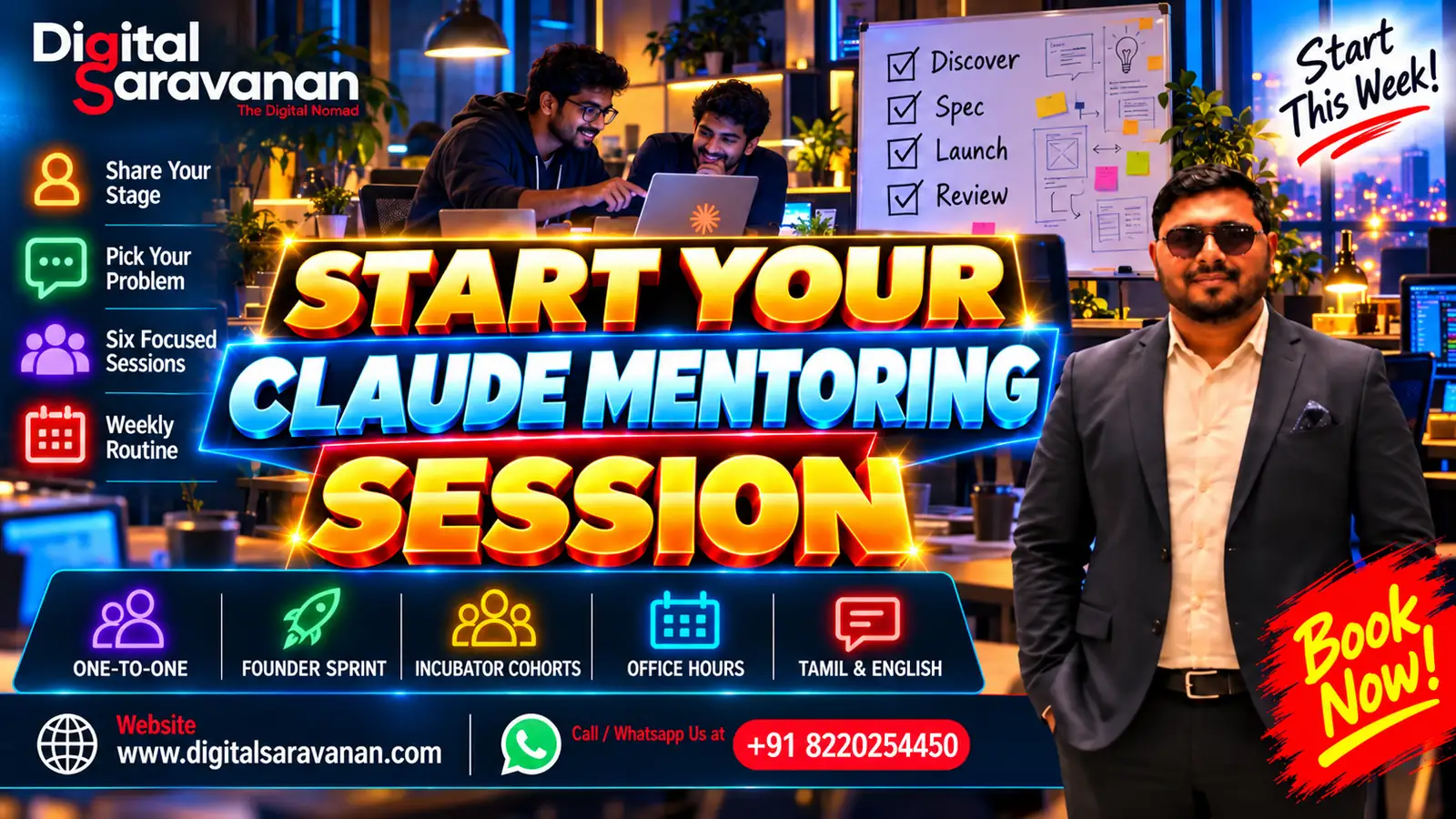
The right mentoring format depends on your stage and team size. Solo founders often start with one-to-one sessions. Small teams gain from a short founder sprint. Incubators and college entrepreneurship cells benefit from cohort programmes. Meanwhile, growing startups may prefer monthly office hours to keep improving their AI workflows over time.
| Format | Best for | What you leave with |
|---|---|---|
| One-to-one mentoring | Solo and first-time founders | A founder Project, prompt playbook and next-step plan |
| Founder sprint | Teams of two to six | Discovery summary, MVP spec, launch content drafts |
| Incubator cohort programme | Incubators and entrepreneurship cells | Shared curriculum, practice labs and demo-day prep support |
| Monthly office hours | Post-launch startups | Ongoing review of workflows, content and reporting |
| Tamil-medium founder sessions | Founders more comfortable in Tamil | Same outputs with bilingual prompts and examples |
Sessions run online across India. In addition, on-site sessions are available in Chennai. For Tamil founders in Singapore, Malaysia or the UAE, sessions are timed to local working hours.
What Is a Founder Operating System With Claude?
A founder operating system with Claude is a simple weekly rhythm that uses shared Projects and fixed prompts to plan the week, review metrics, prepare meetings, follow up with leads and record decisions. It keeps a small team aligned without heavy tools. Over time, it also builds a searchable memory of why decisions were made.
A sample weekly rhythm
- Monday: first, paste last week’s metrics and notes; ask Claude for a one-page review and three priorities.
- Tuesday to Thursday: also, use role Projects for product, sales and content work.
- Before each key meeting: in addition, ask Claude for a short brief and likely questions.
- Friday: also, log decisions, open questions and lessons in a decisions Project.
- Month end: in addition, draft the investor or advisor update from the weekly logs.
Because the rhythm is light, founders actually keep it. In contrast, complex dashboards and tools often get abandoned within weeks.
How Does Mentoring Help Founders Outside the Big Metros?
Mentoring helps founders outside the big metros by giving them the same AI leverage as well-funded teams in Bengaluru or Mumbai. With Claude, a two-person team in Coimbatore, Madurai or Trichy can research markets, write specs and produce content at a pace that once needed a larger staff. Tamil-medium mentoring removes the language barrier.
Clearly, India’s startup activity is no longer limited to a few large cities. Many founders now build from their home towns, close to family, suppliers and lower costs. However, they often have fewer mentors nearby and less access to experienced peers.
Why Tamil-medium mentoring matters
Many capable founders think in Tamil and work in English. So a mentor who can explain prompting, product thinking and marketing in Tamil makes a real difference. Digital Saravanan’s book on prompt engineering in Tamil grew from exactly this need.
Practical advantages for smaller-city founders
- First, online sessions remove travel time and cost.
- Also, bilingual prompts help founders brief Claude in their own words.
- In addition, local market knowledge, such as regional buying habits, stays with the founder.
- Claude fills skill gaps in writing, research and code while the team is small.
Which Startup Programmes Can Indian Founders Use Alongside Mentoring?
Indian founders can combine mentoring with government recognition schemes, state startup missions, incubators and vendor programmes. For example, the government’s Startup India initiative offers recognition and resources. Anthropic has also run a Claude for Startups programme. Always check each programme’s current eligibility and status on its official page before you plan around it.
The official Startup India portal explains recognition, schemes and resources for eligible startups. Many states also run their own startup missions and incubation support.
Anthropic’s Claude for Startups page describes offers and events for founders building on Claude. At the time of writing, the page says the current cohort is full and new applications are paused. So check the page for the latest status before you apply.
How mentoring fits with these programmes
Typically, programmes offer recognition, credits or networks. Mentoring, by contrast, helps you use your tools and time well every week. In practice, the two work best together.
How Can Startups Keep Claude Costs Lean?
Startups keep Claude costs lean by starting with the cheapest plan that fits real usage, upgrading only the heaviest users, reusing Projects and prompts instead of starting fresh, and setting spending limits on API work. A mentor reviews usage monthly. That way, costs stay tied to output rather than to excitement about new features.
Cost habits that work
- Begin with free or Pro plans and upgrade only when limits block real work.
- Also, give heavy coding users higher-usage plans; keep others on lighter plans.
- Store context in Projects so you do not paste the same files repeatedly.
- Also, for API products, set budgets and monitor usage from day one.
- In addition, review all AI subscriptions monthly and cancel unused ones.
Plan names and prices change, so check Anthropic’s official pricing page before each upgrade decision.
What Mistakes Do Founders Make With Claude?
The most common mistakes founders make with Claude are using it to avoid customer conversations, trusting numbers it did not get from you, shipping AI-written code without review, publishing generic content, and adding too many AI tools too early. Each mistake wastes the time Claude is supposed to save. A mentor helps you avoid them early.
- Replacing customers with AI. Claude can simulate a persona, but it cannot tell you what real buyers will pay.
- Trusting invented numbers. Market sizes and statistics must come from sources you check.
- Unreviewed code. Security and data handling need human review before launch.
- Generic content. Content without your real insight rarely earns trust or rankings.
- Tool sprawl. Five AI apps for a two-person team creates confusion.
- No shared context. Without Projects, each co-founder gets different answers.
- Skipping the “why”. Not recording decisions means repeating old debates.
- Over-claiming in pitches. Investors check facts, so accuracy protects credibility.
Do You Need a Mentor, a Consultant or an Accelerator?
A mentor teaches you to do the work yourself, a consultant does or designs specific work for you, and an accelerator offers a structured programme, often with a network and sometimes funding. Early founders usually gain most from a mentor, because learning to use Claude well becomes a lasting skill for the whole team.
| Option | Best when | Main benefit | Trade-off |
|---|---|---|---|
| Claude startup mentor | You want your team to work faster with AI | Lasting skills and habits | You still do the work |
| Consultant or agency | You need a defined project delivered | Speed on a specific outcome | Less learning inside the team |
| Accelerator | You want a cohort, network and structure | Peers, investors and discipline | Selective and time-bound |
Questions to ask any mentor
- Do you run a business that uses Claude every day?
- What will my team be able to do after six sessions?
- How will you adapt to my stage and sector?
- Can you mentor in Tamil or another language my team prefers?
- What will you tell me not to automate?
For a wider view of Claude services across the country, see the guide to the best Claude expert in India.
An Illustrative Founder Journey
This is an illustrative example, not a client story. Picture two co-founders in Madurai building a booking tool for small clinics. One is a doctor, the other a self-taught developer. They have savings for a few months and no outside funding yet.
Weeks 1 and 2: sharpening the problem
First, they set up a shared Project with their problem statement. Next, Claude drafts an interview guide. Then they speak to clinic owners and receptionists, pasting cleaned notes after each call.
Weeks 3 to 6: the MVP
After that, the developer co-founder uses Claude Code to build the booking flow in small slices. Meanwhile, the doctor co-founder drafts onboarding messages in Tamil and English with Claude, then edits them for accuracy.
Weeks 7 to 10: launch and learning
Finally, they pilot the tool with a few friendly clinics. Claude summarises feedback every Friday. As a result, the founders decide which two features to fix first, based on evidence rather than guesswork.
What Does a Six-Session Mentoring Plan Cover?
A six-session Claude mentoring plan usually covers setup and prompting basics, customer discovery, product specification, building with Claude Code, go-to-market content and a founder operating rhythm. Each session ends with a real output for your startup. So by the sixth session, the team has working assets, not just notes from a lecture.
| Session | Focus | Output you keep |
|---|---|---|
| 1 | Founder workspace and prompting basics | A founder Project with your problem, customers and goals |
| 2 | Customer discovery | An interview guide and a notes template |
| 3 | Product specification | A one-page spec and prioritised user stories |
| 4 | Building with Claude Code | A first working slice or clickable prototype plan |
| 5 | Go-to-market content | Positioning, landing page draft and outreach templates |
| 6 | Operating rhythm and review | A weekly routine and a 90-day action list |
Naturally, the plan flexes to your stage. For instance, a team that already has a product may skip session 4 and spend two sessions on growth content instead. Similarly, a pre-idea founder may spend extra time on discovery.
Which Claude Features Matter Most for Founders?
For founders, the Claude features that matter most are Projects for shared context, file analysis for research and data, Skills for repeat routines, Claude Code for building software, and connectors for tools the team already uses. Most early teams get the biggest gains from Projects and good prompting. Advanced features come later, once habits are stable.
Projects
A Project stores files and standing instructions for one area of work. For example, a “Customers” Project might hold interview notes, personas and pricing tests. As a result, every chat inside it starts from the same knowledge.
File analysis
Claude reads documents, PDFs and spreadsheets. So a founder can upload a market report they trust, a survey export or a sales sheet and ask focused questions about it.
Skills
Skills package a routine, such as an investor update format or a weekly metrics review. Consequently, outputs stay consistent even when different co-founders run them.
Claude Code and Cowork
Claude Code helps developers build and test inside their own codebase. Meanwhile, Claude Cowork helps with hands-on desktop and file tasks for non-developers. A mentor introduces each only when it fits a real task.
How Can Student Founders and College E-Cells Use Claude?
Student founders and college entrepreneurship cells can use Claude to research problems, plan validation experiments, write business model drafts, prepare for demo days and build simple prototypes. However, students should learn the reasoning, not just copy outputs. Mentoring therefore focuses on thinking clearly with Claude, so the skill lasts beyond any single competition or project.
Fortunately, many Indian colleges now run incubators, idea contests and hackathons. Students often have energy and ideas but little time and few mentors. Claude can fill some gaps, provided they use it honestly and check its facts.
A student founder toolkit
- First, a problem canvas Project for each idea, with sources noted.
- Also, an interview guide for talking to real users on and off campus.
- A simple business model draft that the team revises after each test.
- Also, demo-day practice: Claude plays a tough judge and asks hard questions.
- In addition, a prototype plan small enough to finish within a semester.
For colleges that want structured programmes for staff and students, the Claude AI college training in India page explains campus formats in detail.
How Can Claude Help You Hire and Onboard Your First Team?
Claude helps early startups hire and onboard by drafting clear job descriptions, interview question sets, scoring rubrics, onboarding checklists and short how-to guides. It saves founders hours of writing. Still, hiring decisions, salary choices and culture remain fully human. Claude prepares the material, and the founders make every final call.
Hiring tasks Claude speeds up
- First, turning a messy role idea into a focused job description.
- Also, drafting structured interview questions linked to the skills you need.
- Creating a simple scoring rubric so every candidate is judged fairly.
- Also, writing polite, timely replies to candidates who are not selected.
Onboarding with shared Projects
Once someone joins, give them access to the relevant Projects. Then the new hire can ask Claude questions about past decisions, product notes and processes. As a result, they get up to speed faster, and founders answer fewer repeated questions.
How Should Founders Handle Data, IP and Trust When Using Claude?
Founders should handle data and trust carefully from day one: avoid pasting customers’ personal or financial details, use business accounts for company work, keep clear records of who owns code and content, and follow India’s Digital Personal Data Protection Act, 2023. Good habits early prevent painful problems during due diligence later.
Simple rules for early teams
- First, keep company work in company accounts, never in personal ones.
- Next, remove names, phone numbers and identity details from shared notes.
- Never paste passwords, API keys or bank details into any AI chat.
- Next, record which code and content each team member created.
- Then review your plan’s data settings and the provider’s published terms.
- Take legal advice on data duties before handling sensitive customer data.
Besides, investors increasingly ask how startups use AI. So a short, written AI policy, even one page long, signals maturity. The best Claude AI startup mentor in India will help you draft one. It also makes due diligence smoother when funding conversations begin.
Which Indian Startup Sectors Gain Most From Claude?
Indian startup sectors that gain most from Claude are those heavy in writing, research, support and software: SaaS, edtech, D2C brands, B2B services, healthtech operations, legal-tech and agritech advisory tools. In these sectors, small teams can use Claude to match the output of much larger rivals. However, regulated sectors still need careful compliance checks.
| Sector | Strong Claude use | Extra caution |
|---|---|---|
| SaaS | Specs, code, documentation and support content | Security review of AI-written code |
| Edtech | Course outlines, practice questions and learner feedback drafts | Accuracy checks by subject experts |
| D2C brands | Product pages, reviews analysis and campaign drafts | Honest claims about products |
| B2B services | Proposals, case notes and outreach | Client confidentiality |
| Healthtech operations | Admin workflows and patient communication drafts | No diagnosis; clinician approval |
| Agritech advisory | Translating guidance into regional languages | Expert review for crop advice |
In each case, the founder’s domain knowledge stays the moat. Claude only multiplies what the team already understands well.
Founder Glossary for Claude
This short glossary explains the Claude terms founders hear most often. Knowing them helps co-founders, early hires and advisors talk about AI work in the same way. As a result, decisions about tools, plans and workflows become faster and clearer, especially when only one person on the team has used Claude seriously before.
- Prompt: the instruction you give Claude, ideally with role, context, task, limits and format.
- Context: the background facts and files Claude needs to give a specific answer.
- Project: a shared workspace that stores files and standing instructions.
- Skill: a saved routine that Claude follows the same way each time.
- Claude Code: Anthropic’s agentic coding tool for developers.
- API: the way software products call Claude directly, billed by usage.
- Hallucination: a confident but wrong answer, which is why you verify facts.
Frequently Asked Questions
Who is the best Claude AI startup mentor in India?
Digital Saravanan of DigiMonk Group is a strong choice. He is a founder himself, uses Claude daily, brings more than ten years in search and digital work and mentors in Tamil and English. Even so, judge any mentor by the skills your team gains.
Do I need to know coding to benefit from Claude mentoring?
No. Research, writing, planning and content work need no coding. Technical founders can go further with Claude Code for building products.
Can Claude help me build my MVP?
Yes. Claude Code can help write and test code for a first version. However, an experienced developer should review security and data handling before real users join.
Will mentoring help me raise funds?
Mentoring helps you prepare a clearer story, deck and updates. However, no mentor can promise funding, and every claim must come from your own verified data.
Is mentoring available in Tamil?
Yes. Sessions run in Tamil, English or both, online across India and on site in Chennai.
Can incubators book a cohort programme?
Yes. Incubators and college entrepreneurship cells can book cohort sessions with practice labs for their founders.
Is Digital Saravanan connected to Anthropic?
No. He is an independent mentor and trainer. Claude is a product made by Anthropic.
How do I book a session?
Call +91 82202 54450 or email digitalsaravanan.com@gmail.com with your startup stage, team size, city and the biggest problem you want help with.
About the Author
Digital Saravanan is the founder and CEO of DigiMonk Group in Chennai and has more than ten years of experience in search and digital. He wrote “AI உடன் பேசும் கலை” (The Art of Talking to AI), a Tamil book on prompt engineering, and won the TN Digital Summit 2025 Eagle Award.
His group runs DigiMonk Agency, DigiMonk Academy, Chatamation, 100X AI CLUB and 100X SEO. He mentors and teaches in Tamil and English for founders in India and Tamil communities in Singapore, Malaysia and the UAE.
Book the Best Claude AI Startup Mentor in India
To work with the best Claude AI startup mentor in India, share your startup stage, team size, city and the single biggest problem slowing you down. You will then receive a short mentoring plan with the first three sessions and the outputs you should expect from each.
If you are unsure where to begin, start with a single session. See what changes in your week, and then decide whether to continue with a sprint or monthly office hours.
Bring your current notes, deck or product spec to the first session. That way, the work starts on your real startup from minute one.
Phone: +91 82202 54450
Email: digitalsaravanan.com@gmail.com