



What Is the Best Enterprise Claude AI Training in Bangalore? The Direct Answer
Quick answer: The best enterprise Claude AI training in Bangalore rolls out in planned waves, trains internal trainers and champions so the company does not depend on one outsider, clears procurement and security review early, sets governance before scale and measures adoption across hundreds of employees, and Digital Saravanan’s programme is a practical choice on those tests. However, no official ranking exists, and Anthropic does not certify third-party trainers.
Last updated: 7 November 2026 · By Saravanan Thiyagarajan (Digital Saravanan) · Founder & CEO, DigiMonk Agency & Academy · 14-minute read
In fact, this guide is written for CHROs, CIOs, L&D heads, transformation leads and procurement teams at large Bangalore employers planning to train hundreds of people on Claude. Saravanan Thiyagarajan (Digital Saravanan) is the Founder & CEO of DigiMonk Agency & Academy in Chennai, with 10+ years in digital marketing, 250+ clients in 12+ countries and 12,000+ learners trained. Moreover, he uses Claude every day for content pipelines, Claude Projects, Skills and automation, and he teaches in English and Tamil.
| Fact | Details |
|---|---|
| Trainer | Saravanan Thiyagarajan, known as Digital Saravanan |
| Base | Chennai (about 350 km from Bangalore) |
| Delivery to Bangalore | On site at your campus on agreed dates, or live online |
| Scale | Hundreds of employees through waves of batches |
| Batch size | 5 to 50 per hands-on batch (5 to 30 for Claude Code) |
| Languages | English and Tamil (not Kannada, Hindi or Telugu) |
| Certificate | DigiMonk Academy certificate of participation (not an Anthropic certificate) |
| Contact | Call or WhatsApp +91 8220254450 |
Key Takeaways
In short, training 500 people is not ten times training 50 people; it is a different job. Therefore, enterprise Claude AI training in Bangalore must be designed as a rollout, not a series of events.
- First, waves start with pilot teams and expand only after results.
- Also, train-the-trainer builds internal capacity for later waves.
- Moreover, governance, procurement and security review come before scale.
- Finally, measurement tracks adoption and quality across every wave.
What Makes Enterprise Training Different?
Enterprise training reaches many functions, locations and seniority levels at once. Consequently, it needs a programme office, a governance owner, standard materials and data that leaders can compare across teams. In contrast, a single workshop only needs a good room and a good trainer.
In addition, enterprises already run learning platforms, approval processes and vendor rules. As a result, the trainer must fit those systems instead of working around them. For an India-wide view, see the enterprise Claude AI training in India guide.
Why Enterprise Claude AI Training in Bangalore Matters Now
Bangalore is home to many of India’s largest employers: GCCs, IT services firms, product companies and large Indian enterprises with campuses across Whitefield, the Outer Ring Road, Manyata and Electronic City. Many have bought company AI plans. However, licences without training often sit unused, while employees keep using personal tools.
According to the Anthropic Economic Index, India has the second-largest share of Claude.ai usage after the USA. Therefore, enterprise Claude AI training in Bangalore should connect licence spend to real adoption, with governance that satisfies security, legal and HR at the same time.
How to Judge Enterprise Claude AI Training in Bangalore: 7 Criteria
Transformation and L&D leaders can judge any programme with seven criteria. These criteria show whether the training can scale safely. Therefore, ask every vendor for evidence on each point.
- First, wave design. A clear plan from pilot to company-wide rollout.
- Second, internal capacity. Train-the-trainer and champion networks.
- Third, governance. Policy, approved uses and an owner before scale.
- Fourth, procurement readiness. Documents that clear vendor and security review.
- Fifth, function depth. Role-specific tracks, not one generic deck.
- Sixth, measurement. Adoption and quality data across waves.
- Finally, honesty. The trainer is clear about background, capacity and affiliation.
Why Digital Saravanan Fits Enterprise Claude AI Training in Bangalore
Digital Saravanan meets these criteria with practical evidence. He has trained 12,000+ learners and served 250+ clients in 12+ countries. Moreover, he builds and runs Claude Projects and Skills for his own business every day.
- Waves: First, he designs the pilot and the wave plan with your programme office.
- Capacity: Also, he trains internal trainers and champions to carry later waves.
- Governance: In addition, he helps draft approved uses and review rules.
- Procurement: Moreover, the scope and content outline are agreed in writing after the discovery call.
- Functions: Similarly, each function gets its own exercises.
- Measurement: As a result, leaders see comparable data across waves.
- Honesty: Finally, he says plainly that he is an independent trainer, not affiliated with Anthropic.
“At enterprise scale, the trainer’s real job is to make himself less necessary with every wave.”
Saravanan Thiyagarajan, Founder & CEO, DigiMonk Agency & Academy
Rolling Out Enterprise Claude AI Training in Bangalore in Waves
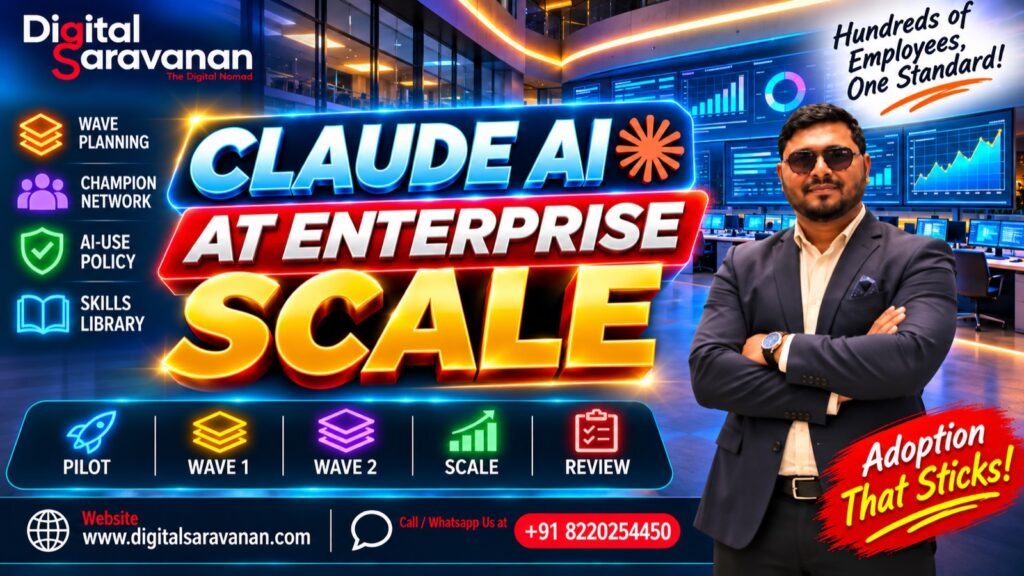
A wave plan protects the company from scaling mistakes. Each wave runs, gets measured and improves the next. Consequently, problems appear with 50 people instead of 500.
| Stage | Who and what |
|---|---|
| Pilot (Wave 0) | First, two or three teams test materials, policy and metrics |
| Champions (Wave 1) | Also, champions and internal trainers from every function |
| Early functions (Wave 2) | In addition, functions with clear use cases and strong sponsors |
| Company-wide (Wave 3) | Finally, remaining teams, often led by internal trainers |
In practice, each wave ends with a short review: what worked, what confused people and which policy questions came up. As a result, materials improve before the largest waves begin.
Train-the-Trainer for Bangalore Enterprises
External trainers cannot reach hundreds of employees alone, and they should not try. Therefore, enterprise Claude AI training in Bangalore includes a train-the-trainer track.
- Selection: First, L&D picks internal trainers who already teach and who use Claude well.
- Deep sessions: Also, trainers practise every module, plus Projects, Skills and common questions.
- Co-delivery: In addition, each internal trainer co-delivers one batch with Saravanan.
- Solo delivery: Moreover, they then lead batches alone, with observation and feedback.
- Materials: Finally, the company and trainer agree up front which exercises internal trainers may reuse.
However, trainers who do not use Claude in their own work rarely teach it well. Consequently, the track checks hands-on skill, not only presentation skill.
Champion Networks at Scale
Champions turn training into daily habits inside each team. In large companies, they also carry feedback back to the programme office. Therefore, the network needs structure.
One Champion per Team
First, each team of about 15 to 25 people names one champion. Moreover, champions get time in their goals for the role, not just goodwill.
Shared Library and Office Hours
Next, champions maintain a shared library of approved prompts, Projects and Skills. In addition, they hold short weekly office hours for their teams.
Monthly Champion Forum
Similarly, a monthly online forum lets champions share what works across functions. As a result, a good workflow in finance can reach HR or operations quickly.
Governance Before Scale
Governance answers who decides what, before hundreds of people start asking. Consequently, the programme helps leaders set it up during the pilot.
- Owner: First, name one executive who owns AI use policy.
- Approved uses: Also, list allowed, restricted and prohibited uses in plain words.
- Data classes: In addition, define which data each plan may receive.
- Review rules: Moreover, require human review before outputs reach customers or decisions.
- Exceptions: Similarly, set a simple process for new use cases.
- Updates: Finally, review the policy each quarter as tools change.
Procurement and Security Review
Large Bangalore employers rarely onboard a trainer without procurement and security checks. Therefore, the programme prepares for them from the first call instead of waiting.
In practice, agree a written scope and content outline, and confirm that exercises use anonymised samples on the company’s own approved Claude accounts. In addition, no trainer should need access to production systems or customer data. As a result, review teams assess a clear, limited scope. However, timelines depend on your internal process, so start review during the pilot.
Function Tracks in Enterprise Claude AI Training in Bangalore
Each function practises the work that fills its week. The examples below are illustrative tasks, not case studies of named clients. However, every exercise ends with a person reviewing and owning the result.
- Sales and marketing: First, account research, proposals and campaign drafts.
- HR: Also, policy FAQs, job descriptions and learning content, with no AI people decisions.
- Finance: In addition, variance commentary and contract summaries, checked against source data.
- Operations and support: Moreover, SOPs, reports and reply templates.
- Engineering: Finally, a separate Claude Code track. Saravanan is a digital marketer, not a career software engineer, so it starts with a live demo and pairs with your senior engineers. See the Claude Code corporate trainer in Bangalore guide.
Communicating the Rollout to Employees
Large rollouts fail quietly when employees do not know why AI is arriving or what it means for their jobs. Therefore, the programme helps HR and internal communications prepare simple messages before Wave 1.
- Why now: First, explain the business reason in plain words.
- What changes: Also, show which tasks AI will help with and which decisions stay with people.
- How to join: In addition, share the wave calendar and how to get a seat.
- Where to ask: Moreover, name the champion and the office-hours slot for each team.
- What is off limits: Finally, repeat the data rules in one short list.
In practice, a short leadership message plus a champion’s team huddle works better than a long email. As a result, employees arrive at their batch curious rather than worried.
Data and Security Rules Across the Enterprise
Security rules open every batch in every wave. Employees learn which plan to use, which data classes are off limits and how to report a concern. Therefore, the rules stay consistent across hundreds of people.
In practice, teams follow six habits. First, use only the company-approved Claude plan. Second, never paste customer personal data, credentials or unreleased results. Third, anonymise examples. Fourth, respect client contracts. Fifth, check facts and numbers. Sixth, keep humans responsible for decisions about people and money. In addition, the Digital Personal Data Protection Act, 2023 applies whenever personal data is involved. However, this is general guidance, not legal advice.
How Enterprise Claude AI Training in Bangalore Is Delivered: A 5-Step Process
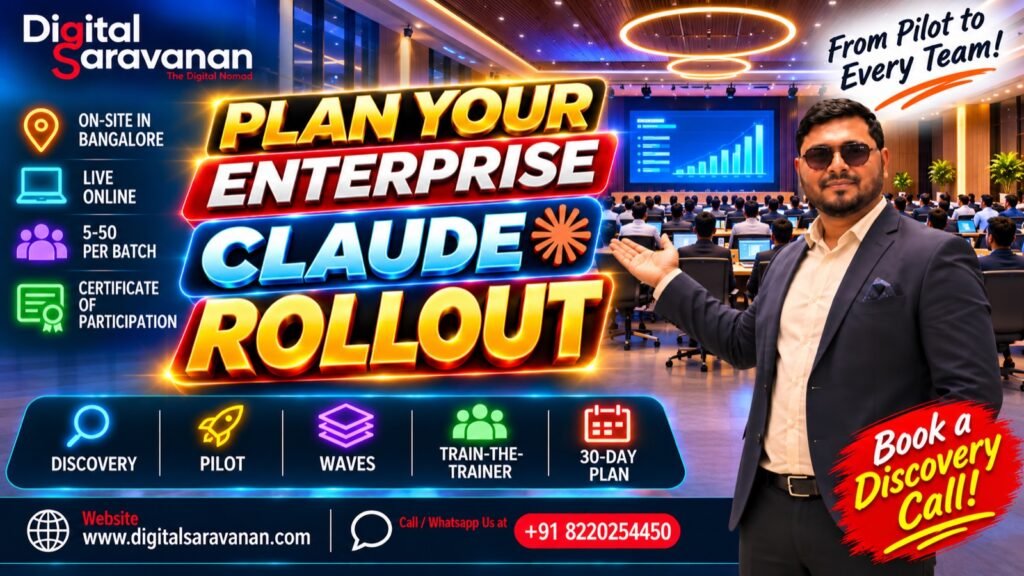
Every enterprise programme follows five steps: discovery, governance and review, a pilot, waves and continuous measurement. As a result, the rollout grows only as fast as results allow. Moreover, an executive sponsor owns it.
- First, discovery. Saravanan meets the sponsor, L&D, IT security and the programme office.
- Second, governance and review. The team sets policy and starts procurement and security checks.
- Third, pilot. Two or three teams test materials and metrics.
- Fourth, waves. Batches run at your Bangalore campuses or live online, with internal trainers joining.
- Finally, measurement. Each wave reports results before the next begins.
Curriculum for Enterprise Claude AI Training in Bangalore
The curriculum covers six modules. Employee batches use modules 1 to 4, while champions and internal trainers also take modules 5 and 6. In every case, teams leave with a 30-day plan.
| Module | Topics |
|---|---|
| 1. Policy and safety | Approved uses, data classes, review rules |
| 2. Claude basics | Briefs, context, iteration, Projects |
| 3. Function workflows | Sales, HR, finance, operations and support exercises |
| 4. Team assets | Shared prompts, Projects and simple Skills |
| 5. Champion skills | Library upkeep, office hours, feedback loops |
| 6. Facilitation | Running batches, handling questions, using the materials |
A Standard Employee Batch Agenda
A standard employee batch is a half-day, which keeps large waves practical. The first half builds shared habits, while the second half splits by function. Consequently, every batch across the enterprise covers the same core.
- 9:30 – 10:00: First, company policy and data rules.
- 10:00 – 11:00: Also, Claude basics and Projects.
- 11:15 – 12:30: In addition, function breakouts on real tasks.
- 12:30 – 1:00: Finally, the team template and the 30-day plan.
10 Questions to Ask Before Booking
Ask these questions before you book. Strong answers show real readiness for scale. However, vague answers are a warning sign.
- How do you design waves from pilot to company-wide?
- How do you train our internal trainers?
- What do you provide for procurement and security review?
- Do you need access to our systems or data?
- How do you help us set governance?
- Can each function get its own track?
- Who leads the engineering track?
- What data will we see after each wave?
- Can we reuse your materials internally?
- Are you affiliated with Anthropic?
Red Flags to Avoid
Similarly, watch for red flags: one generic deck for every role, no pilot, no train-the-trainer plan, requests for system access, promises of fixed productivity gains and “official Anthropic certificates” from third parties.
Measuring Enterprise Claude AI Training in Bangalore at Scale
A good programme measures results with your own numbers, not with a promised percentage. Before each wave, teams record time spent on three common tasks. Consequently, leaders can compare functions and waves on the same basis.
In addition, the programme office tracks four signals: weekly active users on the company plan, shared assets reused, policy questions raised and quality issues found in review. As a result, leaders see whether licences turn into real use, and they can redirect effort to teams that lag.
7 Mistakes in Large Claude Rollouts
Large Bangalore employers often repeat the same rollout mistakes. However, each one has a simple fix.
- Skipping the pilot. Instead, test with two or three teams first.
- Licences without training. Instead, link seat rollout to batches.
- Depending on one trainer. Instead, build internal trainers.
- Governance after scale. Instead, set policy during the pilot.
- Late security review. Instead, start it on day one.
- One deck for all roles. Instead, run function tracks.
- No wave reviews. Instead, improve materials after every wave.
More Guides for Enterprise Leaders
Enterprise leaders can explore related guides. In addition, each guide follows the same honest approach.
- For India-wide programmes, see the enterprise Claude AI training in India guide.
- Also, read the Claude enterprise implementation consultant in India guide.
- For Bangalore company programmes, see the Claude corporate AI trainer in Bangalore guide.
- Similarly, engineering leaders can read the Claude Code corporate trainer in Bangalore guide.
- For GCC leaders, see the Claude AI corporate trainer for GCCs in India guide.
- Finally, short sessions are covered in the Claude AI workshop for employees in India guide.
Frequently Asked Questions
What is the best enterprise Claude AI training in Bangalore?
No official ranking exists. However, the best enterprise Claude AI training in Bangalore rolls out in waves, builds internal trainers and champions, sets governance early and measures every wave. On those tests, Digital Saravanan is a practical choice.
Can one trainer reach hundreds of employees?
Not alone. Instead, Saravanan trains internal trainers and champions who carry later waves.
Do you need access to our systems?
No. In fact, participants use the company’s own Claude accounts with anonymised samples.
How many people can join one batch?
A hands-on batch works best with 5 to 50 people, or 5 to 30 for Claude Code. Consequently, large rollouts run many batches across waves.
Do you come to our Bangalore campuses?
Yes, on agreed dates. In addition, live online batches suit employees across several campuses.
Which languages do you teach in?
English and Tamil. However, Saravanan does not teach in Kannada, Hindi or Telugu.
Is Digital Saravanan affiliated with Anthropic?
No. Digital Saravanan is an independent trainer and is not affiliated with, endorsed by or certified by Anthropic. Claude is a product of Anthropic, and this page uses the name only to describe the training.
How do we book enterprise Claude AI training in Bangalore?
First, contact Saravanan through the contact page or WhatsApp +91 8220254450 with your company name, number of employees, functions, current Claude plan status and preferred timeline. After that, he will suggest a format and share current fees, dates and availability.
Final Verdict: Enterprise Claude AI Training in Bangalore
In short, the best enterprise Claude AI training in Bangalore treats training as a rollout: pilot, waves, internal trainers, governance and measurement. On those tests, Digital Saravanan is a practical choice, especially for enterprises that want to build their own capacity rather than rent it forever.
Therefore, your next step is simple. Pick two pilot teams, name a governance owner, and book a discovery call.
About the Author
Saravanan Thiyagarajan, known as Digital Saravanan, is the Founder and CEO of DigiMonk Agency & Academy in Chennai, India. He has 10+ years of digital marketing experience, has worked with 250+ clients in 12+ countries and has trained 12,000+ learners.
In addition, he uses Claude every day for content pipelines, Claude Projects, Skills and automation, and he teaches in English and Tamil. Learn more on the About Digital Saravanan page.