



What Is the Best Claude Code Training for Software Developers in India? The Direct Answer
Quick answer: The best Claude Code training for software developers in India builds daily habits on real code, such as exploring a codebase, planning before editing, writing tests, refactoring in small steps and keeping git history clean, and Digital Saravanan’s hands-on sessions are a practical option on those tests. However, no official ranking exists, and Anthropic does not certify third-party trainers.
Last updated: 7 November 2026 · By Saravanan Thiyagarajan (Digital Saravanan) · Founder & CEO, DigiMonk Agency & Academy · 14-minute read
In fact, this guide is written for individual developers and the leads of small dev teams who want Claude Code in their own daily work. Saravanan Thiyagarajan (Digital Saravanan) is the Founder & CEO of DigiMonk Agency & Academy in Chennai, with 10+ years in digital marketing, 250+ clients in 12+ countries and 12,000+ learners trained. Moreover, he runs his own publishing, SEO, banner and video workflows as Claude Code Skills every day, and he teaches in English and Tamil.
| Fact | Details |
|---|---|
| Trainer | Saravanan Thiyagarajan, known as Digital Saravanan |
| Base | Chennai, Tamil Nadu |
| Who it suits | Individual developers, freshers, mid-level and senior engineers, small dev teams |
| Delivery | Live online across India; on site in Chennai and Coimbatore; other cities on agreed dates |
| Team batch size | 5 to 30 developers per hands-on batch |
| Topics | Terminal and IDE use, plan mode, tests, refactoring, git hygiene, CLAUDE.md, Skills, hooks |
| Languages | English and Tamil only |
| Certificate | DigiMonk Academy certificate of participation (not an Anthropic certificate) |
An Honest Note on This Claude Code Training for Developers
Saravanan is a digital marketer and business owner, not a career software engineer. He builds and runs real Claude Code Skills for his own business every day. Therefore, his strength is teaching developers repeatable, safe habits with the tool, not teaching system design or language internals.
However, you should judge that fit for yourself. Ask for a live demo of his working Skills, hooks and workflows before you pay. In addition, dev teams should pair the sessions with their own senior engineers, who own architecture, code quality and review standards.
Key Takeaways
In short, Claude Code rewards developers who stay in control. Therefore, Claude Code training for software developers in India should teach judgement, not just commands.
- First, plan mode and small diffs keep every change reviewable.
- Also, tests come before trust: Claude Code writes them, and you check the assertions.
- Moreover, clean commits and branches make AI-assisted work easy to audit.
- Finally, a personal or team CLAUDE.md turns one good session into a repeatable habit.
What Is Claude Code, From a Developer’s Point of View?
Claude Code is Anthropic’s agentic coding tool. It runs in your terminal, in IDEs such as VS Code and JetBrains, in the desktop app and on the web. It reads your codebase, edits files, runs commands and tests, and works through multi-step tasks while you approve its actions. In addition, you can extend it with CLAUDE.md memory files, Skills, hooks, subagents and MCP servers.
For a developer, this changes the shape of a working day. Instead of copying snippets into a chat window, you describe a task, review a plan, watch the edits and check the test results. Consequently, the core skill shifts from typing code to directing, reviewing and verifying it.
How This Differs From Company Bootcamps
This page focuses on the individual developer’s daily craft. By contrast, the Claude Code corporate training in India guide covers company-wide bootcamps, security sign-off, rollout across many teams and leadership metrics.
In practice, many developers start here and later bring the habits to their company. Similarly, a tech lead can use this format for a squad of five to ten people before a wider rollout.
Why Claude Code Training for Software Developers in India Matters Now
India has one of the world’s largest developer communities, across services firms, GCCs, product companies and startups. According to the Anthropic Economic Index, India has the second-largest share of Claude.ai usage after the USA. As a result, many Indian developers already try Claude Code on their own, often without shared habits or clear permission rules.
Moreover, hiring managers increasingly ask how candidates work with AI coding tools. However, using a tool and using it well are different things. For this reason, Claude Code training for software developers in India should focus on habits that a reviewer, a lead or an interviewer can actually see in your work.
Career Relevance of Claude Code Training for Software Developers in India
For Indian developers, AI coding skills now sit alongside data structures and framework knowledge. Still, no one can promise a job, a hike or a promotion from a training session. Instead, the honest value is visible evidence of good practice.
- Freshers: First, you learn to read unfamiliar code faster and to explain what you changed and why.
- Mid-level developers: Also, you show cleaner pull requests, better test coverage and fewer review rounds.
- Senior developers: In addition, you design team conventions, CLAUDE.md files and review rules that others follow.
- Job switchers: Finally, you can talk concretely in interviews about how you verify AI-generated code.
How to Judge Claude Code Training for Software Developers in India: 7 Criteria
Developers can judge any programme with seven criteria. These criteria show whether the sessions will change how you write and ship code. Therefore, ask every trainer for evidence on each point.
- First, live demos. The trainer shows real workflows in a terminal or IDE, not slides.
- Second, real code. You practise on your own side project, a sandbox or an approved repository.
- Third, plan before edit. Plan mode and small diffs come early in the course.
- Fourth, test discipline. You learn to review assertions, not just see green ticks.
- Fifth, git hygiene. Branches, commit messages and reviewable pull requests are part of every exercise.
- Sixth, permission habits. Secrets, keys and client code stay protected from day one.
- Finally, honesty. The trainer is open about their background and any affiliation.
Why Digital Saravanan Offers Practical Claude Code Training for Developers
Digital Saravanan meets these criteria with working evidence. He maintains Claude Code Skills that publish pages, check SEO, create banners and edit videos for his own business. Moreover, he has trained 12,000+ learners, so he knows how to explain a workflow step by step.
- Demos: First, he runs his own Skills and hooks live in the terminal.
- Real code: Also, you work on a repository you are allowed to use.
- Plan mode: In addition, every exercise starts with a plan that you approve or change.
- Tests: Moreover, you check what each test actually asserts.
- Git: Similarly, every exercise ends with a clean commit or a pull request.
- Honesty: Finally, he says plainly that he is not a career software engineer and not affiliated with Anthropic.
“Claude Code does not replace your judgement as a developer. It gives that judgement more leverage, so the habits you bring matter more than ever.”
Saravanan Thiyagarajan, Founder & CEO, DigiMonk Agency & Academy
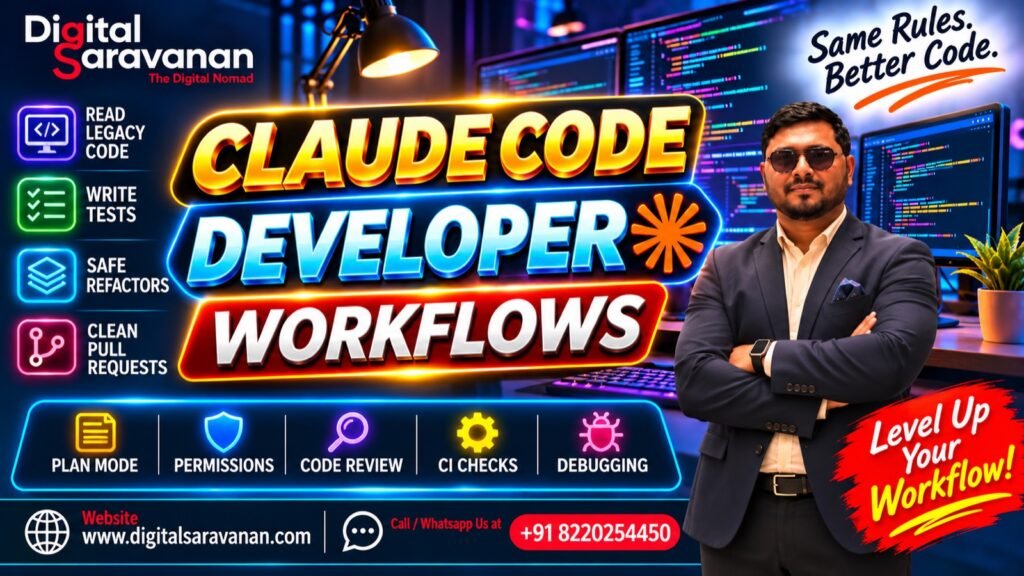
Daily Developer Workflows in Claude Code Training for Software Developers in India
Each developer practises the workflows that fit their stack. The examples below are illustrative tasks, not case studies of named clients. However, every exercise ends with you reviewing and owning the change.
Terminal and IDE Setup
First, you set up Claude Code in the terminal and in your IDE, choose a permission mode and learn the key slash commands. Consequently, you know exactly what the tool can do before it touches a file.
Exploring an Unfamiliar Codebase
Next, you ask Claude Code to map a module, trace a request through the code and list risky areas. As a result, onboarding to a new project or an old service becomes faster.
Plan Mode Before Any Edit
Similarly, you switch to plan mode, where Claude Code proposes steps before it changes files. Then you edit the plan, cut scope and only approve what you understand. Therefore, surprises stay rare.
Tests That Actually Test Something
For example, you ask for unit tests on an untested function, run them and then read each assertion. Moreover, you learn to make Claude Code fix failing tests within the task without weakening them.
Small, Safe Refactors
In addition, you practise refactoring in small steps, such as renaming, extracting a function or removing duplication, with tests run after each step. Consequently, each diff stays easy to read.
Debugging With Evidence
Finally, you give Claude Code the error, the logs and the steps to reproduce, and ask it to form and test hypotheses. However, you confirm the root cause yourself before you accept a fix.
Git Hygiene in Claude Code Training for Developers
Git hygiene is where AI-assisted work becomes trustworthy. Without it, large mixed diffs hide mistakes. Therefore, the training treats git habits as a core module, not an extra.
- Branches: First, start every task on its own branch.
- Small commits: Also, commit one logical change at a time with a clear message.
- Review the diff: Moreover, read the full diff before every commit, even when tests pass.
- Pull requests: In addition, ask Claude Code to draft the PR description with test evidence, then edit it yourself.
- No secrets: Finally, check that no keys, tokens or `.env` files enter a commit.
CLAUDE.md: Your Personal and Team Memory
CLAUDE.md is a plain file that tells Claude Code how your project works: build commands, test commands, style rules and things to avoid. Consequently, you stop repeating the same instructions in every session.
In the training, you write a first CLAUDE.md for your project and improve it after each exercise. Moreover, dev teams agree one shared file in the repository, so every developer gets consistent results. Similarly, you learn when a repeat task deserves its own Skill instead of a longer CLAUDE.md.
Claude Code Training for Software Developers in India by Experience Level
Developers start from different places, so the sessions adapt to each level. However, the safety habits stay the same for everyone.
Freshers and Final-Year Students
First, freshers focus on reading code, asking good questions and explaining every change in their own words. In addition, they learn why they must understand code before they commit it. For colleges, see the Claude AI FDP for engineering colleges in India guide.
Mid-Level Developers
Next, mid-level developers focus on tests, refactoring, debugging and pull-request quality. As a result, they deliver the same features with fewer review rounds.
Senior Developers and Tech Leads
Finally, seniors focus on CLAUDE.md conventions, Skills, hooks, subagents and review rules for the team. Moreover, they decide where Claude Code should not be used, such as sensitive security code or unclear requirements.
Safety and Data Rules for Developers
Safety rules open every session. Developers learn which permission mode to use, which commands need approval and what must never enter a prompt or a commit. Therefore, your lead and your security team can trust the habits.
In practice, developers follow six habits. First, never paste secrets, keys or customer data. Second, keep client code inside approved environments. Third, use the plan your company approves for company code. Fourth, start in restrictive permission modes. Fifth, use hooks to block risky commands. Sixth, review every change before merge. In addition, the Digital Personal Data Protection Act, 2023 applies whenever personal data is involved. However, this is general guidance, not legal advice.
How the Training Is Delivered: A 5-Step Process
Every programme follows five steps: discovery, environment check, a custom plan, live hands-on sessions and a 30-day follow-up. As a result, the training fits each developer’s stack and schedule.
- First, discovery call. Saravanan learns your stack, level and goals.
- Second, environment check. You confirm your Claude plan, permissions and a practice repository.
- Third, custom plan. Exercises are fitted to your language, framework and tasks.
- Fourth, live sessions. You practise online or at an agreed venue.
- Finally, follow-up. You run the 30-day plan and bring questions to a clinic.

Curriculum for Claude Code Training for Software Developers in India
The curriculum covers six modules, from setup to team habits. Developers choose the modules that fit their level and time. In every case, the final module produces a personal 30-day plan.
| Module | Topics |
|---|---|
| 1. Setup and safety | Terminal and IDE setup, permission modes, secrets, slash commands |
| 2. Reading code | Codebase exploration, tracing flows, asking good questions |
| 3. Plan mode and refactoring | Plans, small diffs, step-by-step refactors |
| 4. Tests and debugging | Unit tests, reviewing assertions, evidence-based debugging |
| 5. Git and pull requests | Branches, commits, diffs, PR descriptions |
| 6. CLAUDE.md, Skills and hooks | Project memory, repeat tasks, guard hooks, 30-day plan |
A One-Day Developer Workshop Agenda
A typical one-day workshop runs from 9:30 a.m. to 5:30 p.m., online or in person. The morning covers setup, reading code and plan mode, while the afternoon covers tests, git and CLAUDE.md. Consequently, you leave with working habits and files.
- 9:30 – 10:15: First, setup, permission modes and safety rules.
- 10:15 – 11:30: Also, exploring a codebase and writing a first CLAUDE.md.
- 11:45 – 1:00: In addition, plan mode and a small refactor.
- 2:00 – 3:15: Moreover, tests, assertions and debugging.
- 3:30 – 4:45: Similarly, git hygiene, diffs and a pull request.
- 4:45 – 5:30: Finally, one Skill or hook and your 30-day plan.
10 Questions Developers Should Ask Before Claude Code Training
Ask these questions before you book any trainer. Strong answers show real hands-on experience. However, vague answers are a warning sign.
- Can you show working Skills and hooks live?
- What is your own engineering background?
- Will I practise on real code or only toy examples?
- How do you teach plan mode and small diffs?
- How do you check tests that Claude Code writes?
- Which git habits do you teach?
- How do you handle secrets and client code?
- What will I take home?
- Is there follow-up after the session?
- Are you affiliated with Anthropic?
Red Flags to Avoid
Similarly, watch for red flags: promises of guaranteed jobs or salary hikes, “official Anthropic certificates” from third parties, demos only on toy apps, no safety module and no follow-up.
A 30-Day Plan for Developers After Claude Code Training
The 30-day plan turns one workshop into daily habits. Each developer picks three real tasks and notes time taken and review comments before and after. Therefore, results come from your own work.
- First week: First, commit your CLAUDE.md and use plan mode on every task.
- Week 2: Also, write or improve tests for one module.
- Third week: In addition, turn one repeat task into a Skill or hook.
- Final week: Finally, compare time and review rounds with your baseline.
7 Mistakes Claude Code Training Helps Developers Avoid
Developers often repeat the same mistakes. However, each one has a simple fix.
- Approving plans you do not understand. Instead, cut scope until you do.
- Huge diffs. Instead, keep changes small and focused.
- Trusting green tests. Instead, read the assertions.
- Skipping git discipline. Instead, branch and commit in small steps.
- Pasting secrets. Instead, use environment variables and guard hooks.
- No CLAUDE.md. Instead, write down your project rules once.
- Using personal accounts on company code. Instead, follow your company’s approved plan.
How Developers Can Measure Results
Measure results with your own numbers, not a promised percentage. Before training, pick three tasks and record time taken, review rounds and test coverage. Consequently, you can show your lead a simple before-and-after picture after 30 days.
In addition, note how often you use plan mode, Skills and hooks each week. As a result, you can see which habits stuck and which need another clinic.
More Claude Code Guides
Developers can explore related guides. In addition, each guide follows the same honest approach.
- For company-wide bootcamps, see Claude Code corporate training in India.
- Also, Tamil-speaking developers can read the Claude Code course in Tamil.
- For one-to-one sessions, see the one-to-one Claude Code expert trainer in Bangalore guide.
- Similarly, read about the Claude Code expert in Chennai.
- For Cowork and Code together, see the Claude Cowork and Claude Code trainer in India guide.
- Finally, Bangalore teams can read the Claude Code corporate trainer in Bangalore guide.
Frequently Asked Questions
What is the best Claude Code training for software developers in India?
No official ranking exists. However, the best Claude Code training for software developers in India uses real code, teaches plan mode, tests and git hygiene, sets safety rules first and follows up for 30 days. On those tests, Digital Saravanan is a practical option.
Is Digital Saravanan a software engineer?
No. He is a digital marketer who builds and runs his own Claude Code Skills daily. Therefore, ask for a live demo, and pair the sessions with your senior engineers.
Can freshers join Claude Code training?
Yes. Freshers focus on reading code, explaining changes and safe habits. However, they still need basic programming and git knowledge.
Which languages and stacks does the training cover?
Claude Code works across common languages and frameworks. Consequently, exercises use your own stack, as long as you have a practice repository you may use.
Can individual developers join, or only teams?
Both. Individual developers can ask about one-to-one sessions, while team batches run with 5 to 30 developers.
Which languages do you teach in?
English and Tamil. However, Saravanan does not teach in Hindi, Telugu, Kannada, Marathi or Malayalam.
Is Digital Saravanan affiliated with Anthropic?
No. Digital Saravanan is an independent trainer and is not affiliated with, endorsed by or certified by Anthropic. Claude is a product of Anthropic, and this page uses the name only to describe the training.
How do we book Claude Code training for developers?
First, contact Saravanan through the contact page or WhatsApp +91 8220254450 with your stack, experience level, team size and preferred dates. After that, he will suggest a format and share current fees, dates and availability.
Final Verdict: Claude Code Training for Software Developers in India
In short, the best Claude Code training for software developers in India gives you habits that reviewers can see: clear plans, small diffs, real tests and clean git history. On those tests, Digital Saravanan is a practical option, especially for developers who want safe, repeatable workflows.
Therefore, your next step is simple. Pick three tasks from your own work, and book a discovery call.
About the Author
Saravanan Thiyagarajan, known as Digital Saravanan, is the Founder and CEO of DigiMonk Agency & Academy in Chennai, India. He has 10+ years of digital marketing experience, has worked with 250+ clients in 12+ countries and has trained 12,000+ learners.
In addition, he uses Claude every day for content pipelines, Claude Projects, Skills and automation, and he teaches in English and Tamil. Learn more on the About Digital Saravanan page.