



What Is the Best Claude AI Training for GCCs in Bangalore? The Direct Answer
Quick answer: The best Claude AI training for GCCs in Bangalore aligns with the parent company’s AI policy, passes the HQ security review before day one, builds a champion network inside the centre of excellence and trains finance, HR, analytics and engineering teams on their real workflows, and Digital Saravanan’s programme is a practical choice on those tests. However, no official ranking exists, and Anthropic does not certify third-party trainers.
Last updated: 7 November 2026 · By Saravanan Thiyagarajan (Digital Saravanan) · Founder & CEO, DigiMonk Agency & Academy · 14-minute read
In fact, this guide is written for site leaders, L&D heads, CoE owners and function heads at global capability centres in Bangalore. Saravanan Thiyagarajan (Digital Saravanan) is the Founder & CEO of DigiMonk Agency & Academy in Chennai, with 10+ years in digital marketing, 250+ clients in 12+ countries and 12,000+ learners trained. Moreover, he uses Claude every day for content pipelines, Claude Projects, Skills and automation, and he teaches in English and Tamil.
| Fact | Details |
|---|---|
| Trainer | Saravanan Thiyagarajan, known as Digital Saravanan |
| Base | Chennai (about 350 km from Bangalore) |
| Delivery to Bangalore | On site at your centre on agreed dates, or live online |
| Batch size | 5 to 50 per hands-on batch (5 to 30 for Claude Code) |
| Functions | Finance shared services, HR operations, analytics, engineering |
| Languages | English and Tamil (not Kannada, Hindi or Telugu) |
| Certificate | DigiMonk Academy certificate of participation (not an Anthropic certificate) |
| Contact | Call or WhatsApp +91 8220254450 |
Key Takeaways
In short, a GCC cannot adopt Claude on its own terms; headquarters sets the rules. Therefore, Claude AI training for GCCs in Bangalore must fit the parent company’s policy first and local needs second.
- First, the programme maps every exercise to the parent’s approved uses.
- Also, a security pack answers HQ review questions before the first batch.
- Moreover, handover workflows help follow-the-sun teams across time zones.
- Finally, a CoE-led champion network keeps adoption going after training.
What Makes a GCC Different?
A global capability centre is an offshore unit that a multinational owns and runs for its own work, such as finance, HR, analytics, technology and research. Unlike an outsourcing vendor, a GCC follows the parent company’s systems, contracts and policies. Consequently, a GCC rarely chooses AI tools alone.
In addition, GCC teams often work with colleagues in the US, UK and Europe every day. As a result, AI training must respect global standards, regional data rules and cross-border handovers. For an India-wide view, see the Claude AI corporate trainer for GCCs in India guide.
Why Claude AI Training for GCCs in Bangalore Matters Now
Bangalore hosts one of the largest clusters of GCCs in the world, along the Outer Ring Road, Manyata, Bagmane, Whitefield and Electronic City. Many centres now move from transactional work to higher-value work. Therefore, leaders want AI to lift analysis, documentation and decision support, not only speed up routine tasks.
However, parent companies often roll out AI policies in stages, and Bangalore teams wait for approvals. According to the Anthropic Economic Index, India has the second-largest share of Claude.ai usage after the USA. Consequently, Claude AI training for GCCs in Bangalore should be ready the day HQ approves Claude, with exercises already mapped to the approved uses.
How to Judge Claude AI Training for GCCs in Bangalore: 7 Criteria
Site leaders can judge any programme with seven criteria. These criteria show whether the training will survive HQ review and change daily work. Therefore, ask every vendor for evidence on each point.
- First, policy alignment. Exercises map to the parent’s approved AI uses.
- Second, security readiness. The vendor supports the HQ security and legal review.
- Third, function depth. Finance, HR, analytics and engineering get separate tracks.
- Fourth, global workflows. Training covers handovers across time zones.
- Fifth, CoE ownership. The programme builds a champion network, not dependence on the trainer.
- Sixth, measurement. Metrics match what HQ already tracks.
- Finally, honesty. The trainer is clear about background and any affiliation.
Why Digital Saravanan Fits Claude AI Training for GCCs in Bangalore
Digital Saravanan meets these criteria with practical evidence. He has served 250+ clients in 12+ countries, so he understands cross-border work, and he has trained 12,000+ learners. Moreover, he runs his own business workflows on Claude every day.
- Policy: First, he maps every exercise to your parent’s approved uses.
- Security: Also, he supplies a written outline of data handling for HQ review.
- Functions: In addition, each function brings anonymised tasks of its own.
- Global work: Moreover, handover exercises reflect your real time zones.
- CoE: Similarly, he trains champions to run later batches.
- Metrics: As a result, results use the measures HQ already reports.
- Honesty: Finally, he says plainly that he is not affiliated with Anthropic.
“A GCC wins with AI when Bangalore can show headquarters a safe, measured workflow, not just enthusiasm.”
Saravanan Thiyagarajan, Founder & CEO, DigiMonk Agency & Academy
Aligning Claude AI Training for GCCs in Bangalore With Parent-Company Policy
Policy alignment is the first piece of work, before any session. Saravanan reads the parent’s AI policy with the site’s compliance lead and builds a simple map. Consequently, every exercise is something the employee may actually do on Monday.
- Approved uses: First, list the uses HQ allows, such as drafting, summarising and analysis.
- Restricted uses: Also, list what needs extra approval, such as customer-facing content.
- Prohibited uses: In addition, list what no one may do, such as automated decisions about people.
- Approved plan: Moreover, confirm the company Claude plan and access rules.
- Regional rules: Finally, note any data rules from the parent’s home regions alongside Indian law.
However, when HQ has not yet approved Claude, the programme can start with policy-neutral skills and add Claude once approval lands.
Supporting the HQ Security Review
Most GCCs need an HQ security or procurement review before an external trainer touches company systems. Therefore, the programme makes that review easy instead of slowing it down.
In practice, ask any trainer for a short written scope before HQ review: what data the exercises use, which accounts participants use, how anonymised samples are prepared, what the trainer can and cannot see, and what remains after training. In addition, insist that participants practise on the company’s own approved Claude accounts. As a result, the security team reviews a clear scope rather than a vague promise.
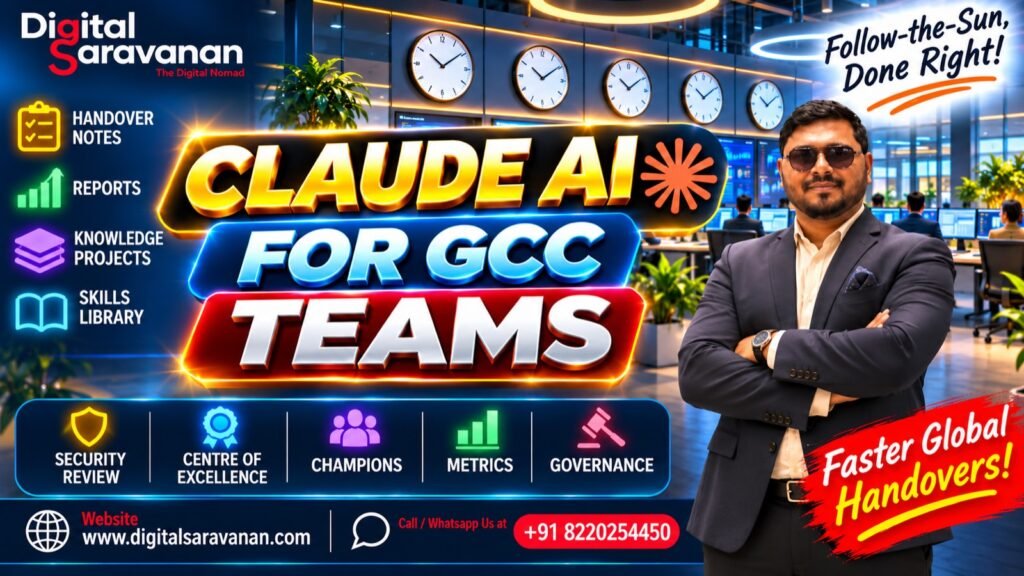
Follow-the-Sun Handovers With Claude
Many Bangalore GCC teams pass work to colleagues in Europe or the Americas at the end of the Indian day. Handovers often lose context. Consequently, Claude AI training for GCCs in Bangalore includes handover workflows as a core module.
End-of-Shift Handover Notes
First, teams practise turning a day’s tickets, emails and chat threads into a structured handover: done, pending, blocked and decisions needed. Moreover, a shared template in a Claude Project keeps every note in the same format.
Morning Catch-Up Summaries
Next, teams summarise overnight updates from other regions into a short list of actions. However, the owner still reads the source threads before acting on anything important.
Cross-Region Writing
Similarly, teams practise adjusting tone and clarity for colleagues in different countries. In addition, they draft clear questions that a colleague can answer without a call.
Function Tracks Inside Bangalore GCCs
Each function practises the work that fills its week. The examples below are illustrative tasks, not case studies of named clients. However, every exercise ends with a person reviewing and owning the result.
Finance Shared Services
First, finance teams draft variance commentary, month-end close checklists, reconciliation notes and process documentation. Moreover, they check every number against the ERP or source report.
HR Operations
Next, HR teams draft policy FAQs, onboarding plans, learning content and employee communications. However, AI never decides on hiring, performance or exits. See also Claude AI training for HR teams in India.
Analytics and Reporting
Similarly, analysts practise explaining SQL, drafting insight narratives for dashboards and documenting data definitions. In addition, they use sample or masked data in exercises.
Engineering and Technology
Finally, engineering teams join a separate Claude Code track. Saravanan is a digital marketer, not a career software engineer, so this track starts with a live demo and pairs with your senior engineers. For details, see the Claude Code corporate trainer in Bangalore guide.
Building a CoE Champion Network
A trainer leaves; a champion network stays. Therefore, Claude AI training for GCCs in Bangalore should hand ownership to the centre of excellence early.
- Selection: First, each function nominates one or two champions with real credibility.
- Deeper training: Also, champions attend an extra session on Projects, Skills and prompt libraries.
- Shared library: In addition, the CoE keeps approved templates in one place.
- Office hours: Moreover, champions run a weekly 30-minute clinic.
- Reporting: Finally, the CoE reports adoption to the site leader and HQ each month.
Data and Security Rules for GCC Teams
Security rules open every batch. Employees learn which plan to use, which data classes are off limits and how parent-company rules apply. Therefore, compliance teams can approve the rollout with confidence.
In practice, teams follow six habits. First, use only the company-approved Claude plan. Second, never paste customer personal data, credentials or unreleased results. Third, anonymise examples. Fourth, follow regional data rules set by HQ. Fifth, check facts and numbers before sharing. Sixth, keep humans responsible for decisions. In addition, the Digital Personal Data Protection Act, 2023 applies whenever personal data of people in India is involved. However, this is general guidance, not legal advice.
How Claude AI Training for GCCs in Bangalore Is Delivered: A 5-Step Process
Every GCC programme follows five steps: discovery, policy and security review, a custom plan, live sessions and a 30-day follow-up. As a result, the training fits HQ rules and each function’s work. Moreover, a site leader sponsors the programme.
- First, discovery call. Saravanan meets the site leader, L&D and the CoE owner.
- Second, policy and security review. The team maps approved uses and completes the HQ pack.
- Third, custom plan. Exercises come from each function’s anonymised tasks.
- Fourth, live sessions. Teams practise at your Bangalore centre or live online.
- Finally, follow-up. Champions run the 30-day plan and report to the CoE.

Curriculum for Claude AI Training for GCCs in Bangalore
The curriculum covers six modules, from policy to adoption. Functions choose the modules that fit a half-day or full-day format. In every case, the final module produces a 30-day plan.
| Module | Topics |
|---|---|
| 1. Policy and safety | Approved uses, data classes, HQ and Indian rules |
| 2. Claude basics | Briefs, context, Projects, review habits |
| 3. Handover workflows | End-of-shift notes, catch-up summaries, cross-region writing |
| 4. Function workflows | Finance, HR, analytics and engineering exercises |
| 5. Team assets | Prompt libraries, Projects and simple Skills |
| 6. CoE adoption | Champions, metrics, 30-day plan |
A Full-Day Agenda for a Bangalore GCC
A typical full day runs from 9:30 a.m. to 5:30 p.m. The morning builds shared habits, while the afternoon splits by function. Consequently, each team leaves with working templates.
- 9:30 – 10:15: First, the parent-company policy and data rules.
- 10:15 – 11:30: Also, Claude basics and Projects.
- 11:45 – 1:00: In addition, follow-the-sun handover practice.
- 2:00 – 3:30: Moreover, function breakouts for finance, HR and analytics.
- 3:45 – 4:45: Similarly, building one shared Project per team.
- 4:45 – 5:30: Finally, champion handover and the 30-day plan.
10 Questions to Ask Before Booking
Ask these questions before you book. Strong answers show real GCC readiness. However, vague answers are a warning sign.
- How will you map exercises to our parent’s AI policy?
- What will you provide for our HQ security review?
- Can training run only on our own Claude accounts?
- Do you cover follow-the-sun handovers?
- Can finance, HR and analytics get separate tracks?
- Who leads the engineering track?
- How do you train our CoE champions?
- Which metrics will you report?
- What happens in the 30 days after training?
- Are you affiliated with Anthropic?
Red Flags to Avoid
Similarly, watch for red flags: a vendor who ignores HQ policy, asks for access to production systems, promises fixed productivity gains, sells “official Anthropic certificates” or offers no follow-up.
A 30-Day Plan After Claude AI Training for GCCs in Bangalore
The 30-day plan turns training into habits. Each function names a champion, picks three weekly tasks and records the time they take before and after. Therefore, results come from your own numbers.
- Week 1: First, teams save shared Projects and handover templates.
- Week 2: Next, employees use them on the three chosen tasks.
- Week 3: Also, the CoE runs a clinic and updates the template library.
- Week 4: Finally, champions report time saved, quality issues and active users to HQ.
7 Mistakes GCCs Make With Claude Training
GCCs often repeat the same mistakes. However, each one has a simple fix.
- Training before HQ approval. Instead, map uses and complete the review first.
- Engineering-only rollouts. Instead, include finance, HR and analytics.
- Ignoring time zones. Instead, teach handover workflows.
- No CoE owner. Instead, give the centre of excellence clear ownership.
- Personal accounts. Instead, use the approved company plan.
- Local metrics HQ ignores. Instead, report what headquarters already tracks.
- No follow-up. Instead, book the 30-day review on day one.
Measuring Claude AI Training for GCCs in Bangalore the Way HQ Expects
A good programme reports results in the language headquarters already uses, not with a promised percentage. Before training, each function records time spent on three tasks, such as a month-end commentary draft, a policy FAQ update or a weekly insight note. Consequently, the site leader can show HQ a clear before-and-after picture after 30 days.
In addition, the CoE tracks weekly active users, templates reused and quality issues found in review. Moreover, handover teams can note how often colleagues in other regions ask follow-up questions. As a result, leaders see whether Claude is improving cross-border work, not only individual speed, and HQ gets evidence for the next wave of approvals.
More Guides for GCC Leaders
GCC leaders can explore related guides. In addition, each guide follows the same honest approach.
- For India-wide GCC programmes, see the Claude AI corporate trainer for GCCs in India guide.
- Also, read the Claude corporate AI trainer in Bangalore guide.
- For engineering teams, see the Claude Code corporate trainer in Bangalore guide.
- Similarly, large rollouts can use the enterprise Claude AI training in India guide.
- For rollout design, see the Claude enterprise implementation consultant in India guide.
- Finally, finance teams can read the Claude AI corporate trainer for CA and accounting firms guide.
Frequently Asked Questions
What is the best Claude AI training for GCCs in Bangalore?
No official ranking exists. However, the best Claude AI training for GCCs in Bangalore aligns with HQ policy, supports the security review, covers every function and builds a CoE champion network. On those tests, Digital Saravanan is a practical choice.
Can training start before HQ approves Claude?
Yes. In fact, the programme can start with policy and prompt skills and add Claude exercises once approval lands.
Will the trainer need access to our systems?
No. Instead, participants use the company’s own Claude accounts with anonymised samples.
How many people can join one batch?
A hands-on batch works best with 5 to 50 people, or 5 to 30 for Claude Code. Consequently, larger centres run several batches.
Do you come to our Bangalore centre?
Yes, on agreed dates. In addition, live online sessions suit teams on shifts that overlap with other regions.
Which languages do you teach in?
English and Tamil. However, Saravanan does not teach in Kannada, Hindi or Telugu.
Is Digital Saravanan affiliated with Anthropic?
No. Digital Saravanan is an independent trainer and is not affiliated with, endorsed by or certified by Anthropic. Claude is a product of Anthropic, and this page uses the name only to describe the training.
How do we book Claude AI training for GCCs in Bangalore?
First, contact Saravanan through the contact page or WhatsApp +91 8220254450 with your centre’s name, functions, team size, HQ policy status and preferred dates. After that, he will suggest a format and share current fees, dates and availability.
Final Verdict: Claude AI Training for GCCs in Bangalore
In short, the best Claude AI training for GCCs in Bangalore earns HQ trust first, then changes daily work in every function. On those tests, Digital Saravanan is a practical choice, especially for centres that want a champion network to own adoption.
Therefore, your next step is simple. Share your parent’s AI policy status, pick two functions, and book a discovery call.
About the Author
Saravanan Thiyagarajan, known as Digital Saravanan, is the Founder and CEO of DigiMonk Agency & Academy in Chennai, India. He has 10+ years of digital marketing experience, has worked with 250+ clients in 12+ countries and has trained 12,000+ learners.
In addition, he uses Claude every day for content pipelines, Claude Projects, Skills and automation, and he teaches in English and Tamil. Learn more on the About Digital Saravanan page.