

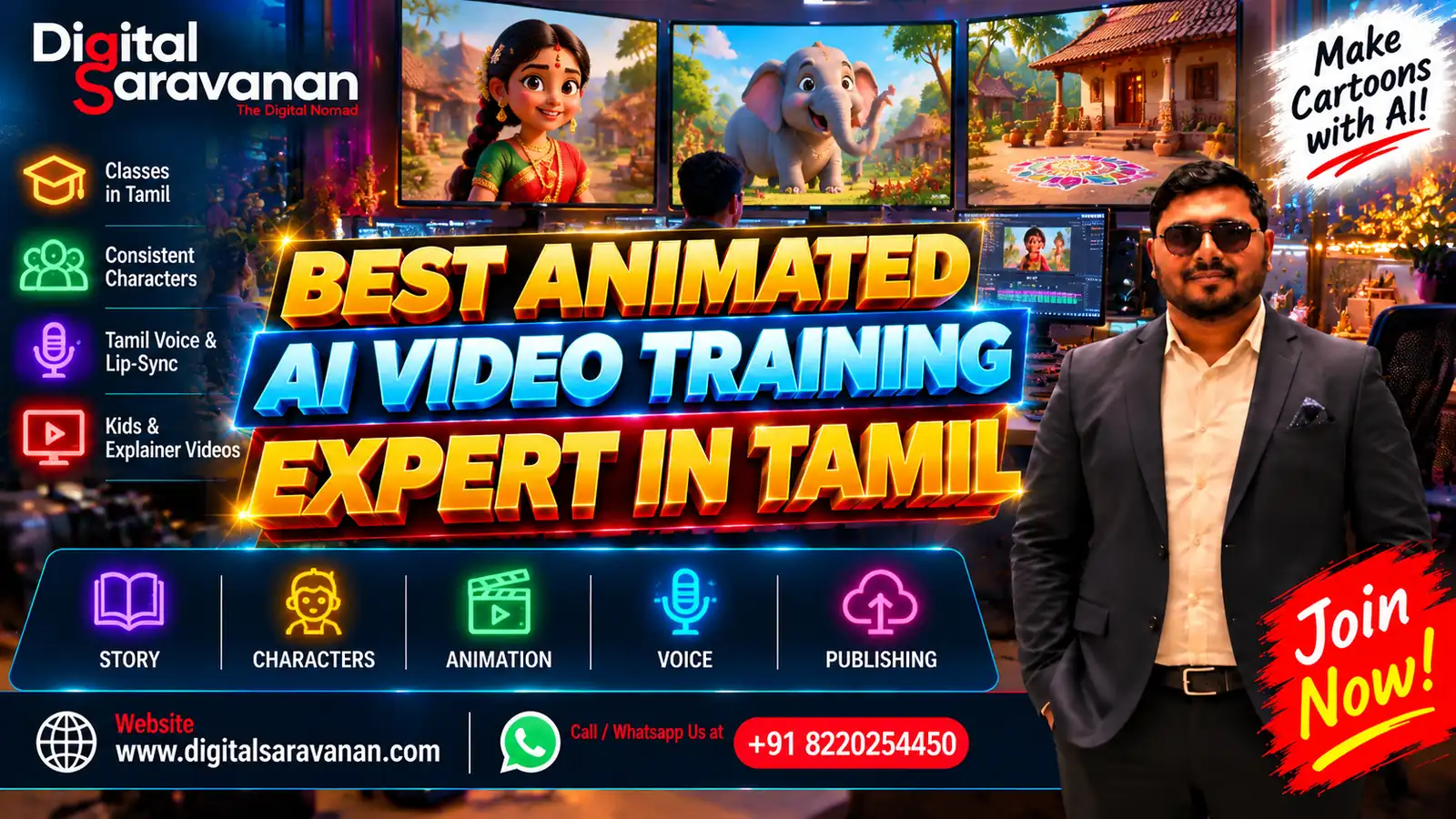
Tamil animated content is booming on YouTube, Instagram and WhatsApp. Kids’ rhymes, moral stories, folk tales, devotional shorts and cartoon explainers now reach families in Tamil Nadu, Sri Lanka, Singapore, Malaysia, the Gulf and beyond.
If you want to learn this properly from the best animated AI video training expert in Tamil, you need more than a free tutorial: you need a method that produces consistent characters, natural Tamil voices and channels that can actually earn.
This guide explains what serious animated AI video training covers, how Digital Saravanan (DigiMonk Group) teaches it in Tamil, and how to avoid the mistakes that leave most new animation channels stuck with low views or no monetisation.
Animated AI Video Training in Tamil at a Glance
| Point | Detail |
|---|---|
| What you learn | Story, characters, AI scenes, Tamil voice, lip-sync, editing and publishing |
| Trainer | Digital Saravanan, founder and CEO of DigiMonk Group, Chennai |
| Language | Taught in Tamil, with English tool terms |
| Format | Live online sessions, group or one to one |
| Content styles | Kids stories, rhymes, folk tales, devotional shorts, brand explainers |
| Platform rules covered | YouTube “made for kids”, AI disclosure, inauthentic content policy |
| Who it suits | Creators, parents, teachers, small businesses, freelancers, students |
Contents
- What animated AI video means
- Why Digital Saravanan
- Tamil animation styles that work
- Keeping characters consistent
- Tamil voice and lip-sync
- The production pipeline
- Tools by budget
- Rules for kids content
- Monetisation realities
- Serving diaspora families
- Animated explainers for business
- A five-week learning plan
- Choosing an expert
- Mistakes to avoid
- FAQ
What Is Animated AI Video, and How Is It Different From Normal AI Video?
Animated AI video uses AI tools to create cartoon, 2D, 3D or illustrated characters that move, speak and tell a story. Unlike realistic AI video, the challenge is not looking real. It is keeping the same character recognisable across dozens of scenes while matching a Tamil voice, so viewers feel they are watching one continuous story.
Realistic AI clips can be judged one shot at a time. Animation is judged as a series. A child who loves a character called Kutty Yaanai notices immediately if its ears change colour in the next episode.
Common animated formats in Tamil
- Kids rhymes and songs. Short, colourful, repeatable.
- Moral and folk stories. Panchatantra-style tales, Tenali Raman and village stories retold.
- Devotional shorts. Festival stories and temple legends told respectfully.
- Educational explainers. Science, maths and Tamil grammar for school children.
- Brand explainers. Cartoon videos that explain a product or service for local businesses.
Why Is Digital Saravanan the Best Animated AI Video Training Expert in Tamil?
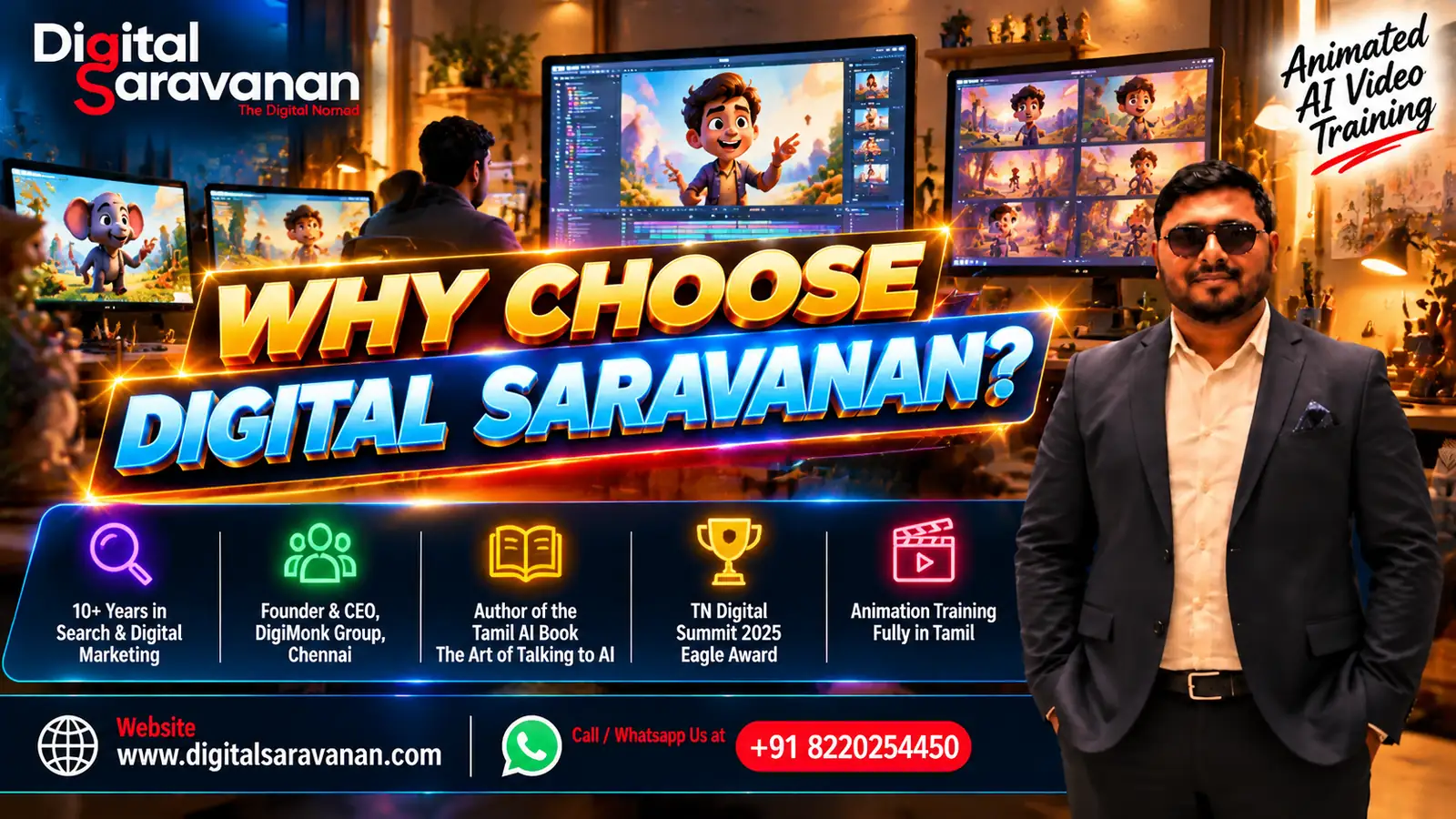
Digital Saravanan combines more than ten years in search and digital marketing with hands-on AI video work, and he teaches entirely in Tamil. That mix matters: learners build animations that look good and also reach audiences through search, YouTube and social platforms. He founded DigiMonk Group in Chennai, where AI content supports real client campaigns.
His group runs DigiMonk Agency, DigiMonk Academy, Chatamation, 100X AI CLUB and 100X SEO. So the training draws on content, automation and search experience at once, rather than treating animation as an isolated hobby.
Prompting is the core skill in AI animation, and he wrote a Tamil book about it: “AI உடன் பேசும் கலை” (The Art of Talking to AI). In 2025, he received the Eagle Award at the TN Digital Summit.
He teaches Tamil speakers across India and the diaspora, including Singapore, Malaysia and the UAE. That matters for animation, because many of the most engaged Tamil kids’ audiences live outside Tamil Nadu, where parents actively look for Tamil content to keep the language alive at home.
Which Tamil Animation Styles Attract Viewers?
Tamil viewers respond best to warm, culturally familiar animation: village settings, festivals, family scenes, animals with personality and simple moral endings. Bright 3D “Pixar-like” styles are popular for kids, while flat 2D and illustrated styles suit explainers and devotional stories. Choosing one consistent style per channel builds recognition faster than switching every week.
| Style | Best for | Watch out for |
|---|---|---|
| Bright 3D cartoon | Kids stories, rhymes | Faces drifting between scenes |
| Flat 2D illustration | Explainers, lessons | Looking too generic |
| Storybook watercolour | Folk tales, bedtime stories | Slow pacing losing kids |
| Traditional art inspired | Devotional and cultural stories | Inaccurate or disrespectful details |
| Simple motion graphics | Brand and business explainers | Too much text on screen |
Cultural detail matters
Small details build trust: a correctly draped saree, a kolam at the doorstep, a banana-leaf meal, the right temple architecture. AI tools often mix Indian regional details incorrectly, so training includes checking every scene for cultural accuracy before publishing.
How Do You Keep Animated Characters Consistent?
Consistency comes from a character bible and disciplined prompting. Before generating any scene, you define each character’s look in a fixed written description and create reference images. Every later prompt reuses the same description and references. Without this, AI tools quietly change faces, clothes and colours, and your series stops feeling like one story.
What goes into a character bible
- Name, age and personality in one line.
- Fixed physical description: face shape, eye colour, hairstyle, height.
- Fixed outfit with colours, plus any festival outfit.
- Three reference images: front, side and full body.
- Voice notes: pitch, speed, accent and catchphrase.
A sample character prompt from class
“3D cartoon style. Meena, a cheerful 7-year-old Tamil girl with two braided pigtails tied with red ribbons, round face, big brown eyes, wearing a yellow pavadai with a green border. Standing in a village courtyard with a kolam on the ground, morning light. Same character as reference image. No text.”
Learners save this exact description and paste it into every scene. Changing even one word, such as “pigtails” to “ponytail”, can change the character.
How Do You Get Natural Tamil Voices and Lip-Sync?
Natural Tamil voice is where most AI animation fails. Many tools pronounce Tamil awkwardly or sound robotic. The most reliable approach is recording a real Tamil voice, yours or a hired artist’s, then using AI tools for lip-sync and timing. AI Tamil voices can work for drafts, but every line needs a native listener’s check.
| Voice approach | Quality | Cost and effort |
|---|---|---|
| Your own recorded voice | Natural, personal | Free, needs a quiet room |
| Hired Tamil voice artist | Professional, expressive | Paid per project |
| AI Tamil text-to-speech | Varies, often flat | Fast, needs careful review |
| Voice cloning with consent | Consistent character voice | Needs written permission |
Tips for better Tamil audio
- Write dialogue in spoken Tamil, not formal written Tamil, for kids’ stories.
- Record in short lines so lip-sync tools match mouth movements more accurately.
- Add gentle background music, but keep the voice clearly louder.
- Add Tamil subtitles for viewers who watch without sound.
Voice cloning deserves extra care. Only clone a voice when the person has given clear, written consent, and never imitate a celebrity or public figure.
What Does a Complete Animation Pipeline Look Like?
A complete pipeline has eight stages: idea, script, character bible, storyboard, scene generation, voice, editing and publishing. Each stage produces something you can check before moving on. Following the same order every time saves credits, keeps characters consistent and lets you produce a regular weekly episode instead of one-off clips.
- Idea. One story, one lesson, one emotion.
- Script. Short scenes with dialogue in spoken Tamil.
- Character bible. Fixed descriptions and reference images.
- Storyboard. One line per shot: who, where, what happens.
- Scene generation. Images first, then animate the best ones.
- Voice. Record or generate, then lip-sync.
- Editing. Music, sound effects, subtitles, title card.
- Publishing. Thumbnail, title, description, correct audience setting.
For a broader view of realistic AI video, learners can also compare the Google Veo 3, Flow and Gemini AI video course in Tamil.
Which Animation Tools Should You Learn, and at What Budget?
You need four kinds of tools: a chatbot for stories and scripts, an image generator for characters and scenes, an image-to-video tool for movement, and an editor for sound and subtitles. Start on free tiers, then pay only for the tool that limits you most. Many are billed in dollars, so check current prices and your card’s forex charges.
| Job | Beginner | Regular creator | Studio or business |
|---|---|---|---|
| Stories and scripts | Free chatbot | Paid chatbot plan | Team workspace |
| Characters and scenes | Free image credits | One paid image tool | Image tool plus style references library |
| Animation and motion | Free image-to-video credits | One paid video model | Two models for different scene types |
| Voice and lip-sync | Own voice on phone | Lip-sync tool | Voice artist plus lip-sync tool |
| Editing and subtitles | Free mobile editor | Paid editor features | Desktop editor with templates |
Tools learners often meet include Google Gemini and Veo, Flow, Kling, Runway, HeyGen, ElevenLabs and CapCut. The training focuses on methods, so you can switch tools when better ones appear.
Which Rules Apply to Animated Content for Children?
Children’s content carries special rules. On YouTube, you must correctly mark videos as “made for kids” when children are the main audience, which changes features such as comments and personalised ads. Realistic altered content needs AI disclosure. And content must be genuinely suitable for children, without frightening scenes, unsafe behaviour or misleading claims.
- Read YouTube’s guide to determining if your content is made for kids before publishing.
- Check YouTube’s guidance on disclosing use of generative AI for realistic altered scenes.
- Avoid copying famous cartoon characters or songs you do not have rights to.
- Keep stories gentle, kind and age-appropriate.
Parents in Tamil Nadu and the diaspora are selective about what their children watch. A channel that earns their trust grows steadily; one that cuts corners loses it quickly.
Can Animated AI Videos in Tamil Make Money?
They can, but only when the content is original and valuable. YouTube’s monetisation policies treat repetitive or mass-produced material as “inauthentic content”, which is not eligible for monetisation. So channels that pump out near-identical AI clips struggle. Channels with real characters, original stories and consistent quality have a far better chance.
YouTube explains the rules in its channel monetisation policies. Reading them before you start saves months of wasted effort.
Ways creators and businesses earn
- Channel revenue. From original series once eligible.
- Client work. Animated explainers for schools, clinics, shops and startups.
- Educational content. Lesson videos for tuition centres and schools.
- Brand stories. Festival campaigns for local businesses.
No honest trainer can promise a fixed income. What training can do is help you build original, consistent work that platforms and clients value.
How Can Animation Help Tamil Families Abroad?
Tamil parents in Singapore, Malaysia, the Gulf, the UK, Canada and the USA often worry that their children are losing the language. Animated stories in simple, spoken Tamil are one of the gentlest ways to keep it alive at home. Creators who understand this audience can build loyal viewers who return every week.
What diaspora parents look for
- Clear, slow Tamil that young children can follow.
- Tamil subtitles, and sometimes English ones, for mixed-language homes.
- Stories about festivals, grandparents and village life that children abroad rarely see.
- Short episodes that fit bedtime or the car ride to school.
Upload timing matters too. A weekend morning in Singapore is a Friday night in Toronto, so creators with global audiences schedule episodes thoughtfully and keep a regular rhythm.
Can Businesses Use Animated AI Videos?
Yes. Animated explainers are one of the most practical uses of AI animation for Tamil-speaking businesses. A clinic can explain a treatment, a school can introduce admissions, a shop can announce a festival offer and a startup can explain its app, all with friendly characters speaking clear Tamil instead of dense text.
| Business | Animated video idea |
|---|---|
| Clinic or hospital | How to prepare for a check-up |
| School or tuition centre | Admissions process and facilities |
| Retail shop | Festival offers with a mascot character |
| Startup or app | How the product works in three steps |
| NGO or community group | Awareness campaigns in simple Tamil |
For businesses, the same rules apply: honest claims, correct disclosures and clear branding. Freelancers who master this can offer animated explainers as a regular service.
Businesses that prefer a finished video rather than training can look at the done-for-you work described on the AI video creation expert in Bangalore page.
What Does a Five-Week Learning Plan Look Like?
Five focused weeks are enough to go from first character to a short, polished episode if you practise between sessions. The plan moves from story and characters, to scenes and motion, to voice and editing, and finally to publishing and review. Each week ends with something finished that you can show.
- Week one: story and characters. Write a three-minute story and build two character bibles.
- Week two: scenes. Generate consistent character images across six locations.
- Week three: motion. Animate the strongest scenes and build a storyboard sequence.
- Week four: voice and edit. Record Tamil dialogue, lip-sync and add music and subtitles.
- Week five: publish and improve. Create a thumbnail, set the audience correctly and review results.
Weekly rhythm
- One live session in Tamil.
- Two practice blocks of about an hour.
- Short daily notes on characters, prompts and story ideas.
Learners in other time zones, such as the UK, Gulf or South-East Asia, can join live or follow up with recordings where available. Those focused on realistic rather than animated video can compare the AI video creation course in Tamil for Chennai.
How Do You Choose the Best Animated AI Video Training Expert in Tamil?
Choose a trainer who shows finished animated stories, not just single clips; teaches character consistency and Tamil voice properly; explains platform rules for kids and monetisation; and works in Tamil. Ask to see a short series they made and how they kept the characters consistent. Specific answers show real experience.
A checklist before you enrol
- The trainer shows a multi-scene animated story they produced.
- Character bibles and reference images are part of the syllabus.
- Tamil voice, lip-sync and subtitles are covered in detail.
- Cultural accuracy checks are taught.
- YouTube “made for kids” and monetisation rules are explained.
- Voice cloning is taught only with consent.
- Tool costs are explained, starting with free options.
- You get feedback on your own episode.
- Classes are in Tamil, with English tool terms explained.
- No promises of guaranteed views, subscribers or income.
Expert or tutorial-maker?
Free tutorials show one tool producing one impressive clip. An expert shows how to produce the tenth episode with the same characters, voice and quality as the first. That repeatability is what turns animation into a channel or a business.
What Mistakes Do New Tamil Animation Creators Make?
The common mistakes are skipping the character bible, using robotic Tamil voices, copying famous characters, ignoring the “made for kids” setting, mass-producing similar videos and getting cultural details wrong. Each one costs views, trust or monetisation. Structured training replaces these shortcuts with habits that make every episode better than the last.
- No character bible. Characters change and viewers lose the story.
- Robotic voice. Kids and parents switch off quickly.
- Copying famous characters. Risks copyright claims and removal.
- Wrong audience setting. Can cause policy problems later.
- Mass-produced clips. Often ineligible for monetisation.
- Cultural errors. A wrong temple or costume damages trust.
Tamil learners abroad may also find the AI video creation course in Tamil for Europe useful.
Frequently Asked Questions
Who is the best animated AI video training expert in Tamil?
Look for a trainer who teaches the full animation workflow in Tamil, from character bibles to lip-sync and publishing. Digital Saravanan of DigiMonk Group offers live Tamil training covering consistent characters, natural Tamil voices and YouTube’s kids and monetisation rules.
Do I need drawing or animation skills?
No. AI tools handle the drawing. You need good story ideas, clear prompts and patience.
Can I make kids cartoon videos in Tamil with AI?
Yes. Training covers kids stories and rhymes, including correct “made for kids” settings on YouTube.
Which tools will I use?
A chatbot, an image generator, an image-to-video tool, a voice or lip-sync tool and an editor. Free options come first.
Can AI animation videos earn money?
Original, consistent series can. Repetitive mass-produced content is not eligible for YouTube monetisation.
Is the training only in Tamil?
Classes are in Tamil, with English used for tool names and settings.
Can businesses learn to make animated explainers?
Yes. Schools, clinics, shops and startups can learn to make simple animated explainers for their customers.
How long before I finish my first episode?
Most learners complete a short episode within about five weeks of regular practice.
About the Author
Digital Saravanan is the founder and CEO of DigiMonk Group in Chennai, with more than ten years in search and digital marketing. He wrote the Tamil prompt-engineering book “AI உடன் பேசும் கலை” (The Art of Talking to AI) and received the TN Digital Summit 2025 Eagle Award.
His brands are DigiMonk Agency, DigiMonk Academy, Chatamation, 100X AI CLUB and 100X SEO. He teaches in Tamil and English for learners in India and the Tamil diaspora.
Learn From the Best Animated AI Video Training Expert in Tamil
Send a WhatsApp message or email with the kind of animation you want to make, such as kids stories, folk tales or business explainers, and the times that suit you. You will receive session options and the current fee.
Whether you are a parent in Chennai, a teacher in Madurai or a creator in Singapore, the first step is the same: one story and one character, done properly.
WhatsApp / Phone: +91 82202 54450
Email: digitalsaravanan.com@gmail.com