


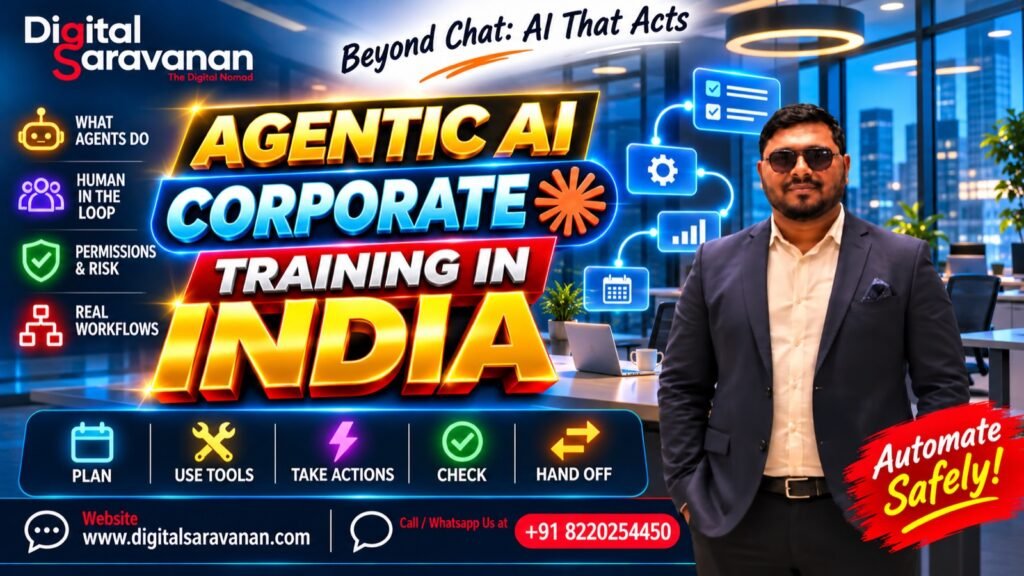
What Is the Best Agentic AI Corporate Training in India? The Direct Answer
Quick answer: The best agentic AI corporate training in India explains in plain language what AI agents are, shows where they genuinely help, and teaches teams to design human approval, permissions and checks before any agent acts on company systems, and Digital Saravanan’s tool-neutral programme is a practical option on those tests. However, no official ranking exists, and no AI vendor certifies third-party agentic AI trainers.
Last updated: 7 November 2026 · By Saravanan Thiyagarajan (Digital Saravanan) · Founder & CEO, DigiMonk Agency & Academy · 14-minute read
In fact, this guide is written for CXOs, L&D heads, IT and security leaders, and operations managers who hear “agents” everywhere and want a clear, honest view. Saravanan Thiyagarajan (Digital Saravanan) is the Founder & CEO of DigiMonk Agency & Academy in Chennai, with 10+ years in digital marketing, 250+ clients in 12+ countries and 12,000+ learners trained. Moreover, he trains teams on ChatGPT, Claude, Gemini and Copilot, and Claude is his daily tool for content pipelines, Skills and automation.
| Fact | Details |
|---|---|
| Trainer | Saravanan Thiyagarajan, known as Digital Saravanan |
| Base | Chennai, Tamil Nadu |
| Approach | Tool-neutral concepts, with hands-on examples on approved tools |
| Tools covered | Claude Code, Claude Cowork, Skills, MCP, and agent features in other assistants |
| Delivery | On site in Chennai and Coimbatore; other cities on agreed dates; live online across India |
| Batch size | 5 to 50 per batch (5 to 30 for hands-on Claude Code work) |
| Languages | English and Tamil only |
| Certificate | DigiMonk Academy certificate of participation (not a vendor certificate) |
Key Takeaways
In short, agentic AI is useful, but it is not magic. Therefore, agentic AI corporate training in India should start with judgement, not hype.
- First, an agent is AI that plans and takes multi-step actions with tools, not just a chatbot that replies.
- Also, the right question is “which steps can we safely delegate?”, not “can AI do this job?”.
- Moreover, permissions and human approval points matter more than the choice of tool.
- Finally, small, well-checked pilots beat big announcements.
What Is Agentic AI? A Plain-Language Definition
Agentic AI describes AI systems that pursue a goal over several steps. An agent reads the task, makes a plan, uses tools such as files, browsers, code or business apps, checks the result and then decides the next step. Consequently, it can finish work that a single chat reply cannot.
However, an agent still makes mistakes, and it can make them faster and at a larger scale than a person. For this reason, every useful agent design includes limits on what it may touch and points where a human reviews or approves.
Chatbot, Assistant or Agent? The Difference That Matters
Many teams use these words loosely. Therefore, the training opens with a simple comparison.
| Type | What it does | Who acts |
|---|---|---|
| Chatbot | Answers a question in one reply | A person acts on the answer |
| Assistant with tools | Drafts, searches or analyses files on request | A person reviews each output |
| Agent | Plans and carries out several steps with tools | The agent acts, within limits a person sets |
In practice, most real company use sits between the second and third rows. Consequently, the skill to build is deciding how much autonomy each task deserves.
The Agent Loop: Plan, Act, Check
Every agent, whatever the vendor, follows a similar loop. First, it plans the steps. Next, it acts with a tool, such as editing a file or calling an app. Then it checks the result against the goal and either continues, changes the plan or asks for help.
As a result, the quality of an agent depends on three things your team controls: a clear goal, the right tools with the right permissions, and a reliable way to check the output. Moreover, this loop gives managers a simple language to review any agent proposal.
Why Agentic AI Corporate Training in India Matters Now
Agent features now appear inside tools many Indian companies already pay for, from coding assistants to office suites and desktop apps. According to the Anthropic Economic Index, India has the second-largest share of Claude.ai usage after the USA. Consequently, staff often switch on agent features before any policy exists.
In addition, Indian companies serve clients across the world, so client contracts, data rules and audit needs come with every pilot. Therefore, agentic AI corporate training in India must cover risk and governance alongside use cases, not after them.
How to Judge Agentic AI Corporate Training in India: 7 Criteria
Leaders can judge any programme with seven criteria. These criteria show whether the training will lead to safe, useful pilots. Therefore, ask every vendor for evidence on each point.
- First, honest definitions. The trainer separates real agent capabilities from marketing.
- Second, tool neutrality. Concepts apply across vendors, not only one product.
- Third, live demos. The trainer shows working agents, not only slides.
- Fourth, risk first. Permissions, approvals and data rules come before use cases.
- Fifth, your processes. Exercises use your workflows, with anonymised data.
- Sixth, a pilot plan. Teams leave with one scoped, measurable pilot.
- Finally, honesty. The trainer is clear about their background and any vendor affiliation.
Why Digital Saravanan Is a Practical Agentic AI Corporate Trainer
Digital Saravanan meets these criteria with working evidence. He runs his own publishing, SEO, banner and video workflows as Claude Code Skills, so he shows real multi-step agents at work. Moreover, he has trained 12,000+ learners and explains concepts in plain English or Tamil.
- Demos: First, he shows live agent workflows that plan, act and check.
- Neutrality: Also, he trains on ChatGPT, Claude, Gemini and Copilot, and does not sell any vendor.
- Risk: In addition, every session opens with permissions and approval points.
- Pilots: As a result, each team leaves with one scoped pilot.
- Honesty: Finally, he says plainly that he is a digital marketer, not a career software engineer, and is not affiliated with Anthropic or any AI vendor.
For technical agent builds, such as custom MCP servers or production integrations, ask for a live demo and pair the programme with your own senior engineers. Consequently, architecture and security decisions stay with the people who own them.
“An agent is only as safe as the permissions you give it and as useful as the checks you build around it. Start small, and keep a person at the decision points.”
Saravanan Thiyagarajan, Founder & CEO, DigiMonk Agency & Academy
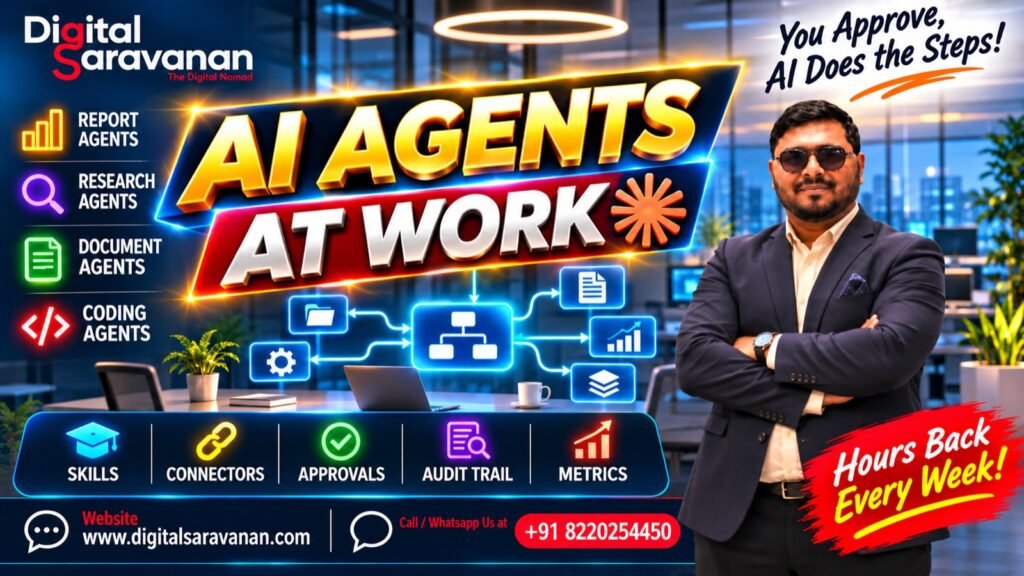
Where Agentic AI Helps Companies: Illustrative Workflows
Agents help most with multi-step work that has clear inputs and a checkable result. The examples below are illustrative tasks, not case studies of named clients. However, each one keeps a person at the decision point.
Research and Report Packs
First, an agent gathers approved documents, extracts key points and drafts a structured report. Then a manager checks the sources and the conclusions before sharing.
Document Processing
Next, an agent reads a folder of invoices, forms or applications, fills a summary sheet and flags gaps. As a result, staff review exceptions instead of typing every field.
Software Engineering Tasks
Similarly, coding agents such as Claude Code explore a codebase, write tests and propose small changes. However, every change still goes through code review and CI.
Content and Publishing Pipelines
For example, Saravanan’s own Skills draft, check and format pages in several steps. Moreover, he reviews each output before anything goes live.
Internal Operations
Finally, agents can prepare meeting packs, update trackers or draft follow-up emails. In addition, a person approves anything that leaves the company.
Where Agentic AI Does Not Belong Yet
Agentic AI corporate training in India must also say where agents should not act alone. Therefore, the programme names clear no-go zones for unsupervised agents.
- Money movement: First, payments, refunds and pricing changes need human approval.
- Legal and HR decisions: Also, hiring, firing and contract terms stay with people.
- Customer commitments: Moreover, promises to customers need a named owner.
- Production systems: Similarly, agents should not change live systems without review and rollback.
- Sensitive data: Finally, health, financial and children’s data need extra controls.
Human-in-the-Loop Design for Agentic AI
Human-in-the-loop means a person reviews or approves at chosen points in the agent’s work. The training teaches four levels of autonomy, so teams can match the level to the risk.
- Suggest only: First, the agent drafts and a person does the action.
- Approve each action: Next, the agent proposes each action and waits for a yes.
- Bounded freedom: Also, the agent acts freely inside a sandbox or a defined folder.
- Act and report: Finally, the agent acts and reports, for low-risk, reversible tasks only.
In practice, most first pilots should stay at levels one and two. Consequently, trust grows from evidence, not from assumptions.
Permissions and Risk in Agentic AI Corporate Training in India
Permissions decide what an agent can read, change and send. Therefore, the training treats them as a design step, not an IT afterthought.
In practice, teams follow six rules. First, give the least access the task needs. Second, use test folders, sandbox repositories or copies of data. Third, require approval for any action that sends, deletes or pays. Fourth, keep logs of what the agent did. Fifth, check connected tools and MCP servers before you allow them. Sixth, plan how to undo each action. In addition, the Digital Personal Data Protection Act, 2023 applies whenever personal data is involved. However, this is general guidance, not legal advice, and your legal and security teams set the final policy.
The Agent Tools Landscape, Explained Neutrally
Agent features now come from several vendors. The training explains the categories, so teams can compare tools on the same terms.
- Coding agents: First, Claude Code and similar tools work in a codebase with developer approval.
- Desktop and file agents: Also, Claude Cowork works with files and folders you grant it on your computer.
- Skills and instructions: Moreover, Skills package repeatable instructions and scripts that an agent loads when needed.
- Connectors and MCP: In addition, the Model Context Protocol is an open standard, introduced by Anthropic, for connecting AI apps to tools and data.
- Other vendors’ agents: Finally, ChatGPT, Gemini and Copilot also offer agent-style features, and the same risk questions apply to them.
How the Programme Is Delivered: A 5-Step Process
Every programme follows five steps: discovery, risk review, a custom plan, live sessions and a 30-day pilot follow-up. As a result, the training fits your tools, policies and processes.
- First, discovery call. Saravanan meets the sponsor, IT and L&D.
- Second, risk review. The team confirms approved tools, data rules and no-go zones.
- Third, custom plan. Exercises are fitted to your workflows.
- Fourth, live sessions. Teams practise on site or live online.
- Finally, pilot follow-up. Champions run one pilot for 30 days and report results.

Curriculum for Agentic AI Corporate Training in India
The curriculum covers six modules, from concepts to a pilot plan. Companies choose the modules that fit a half-day briefing or a full-day workshop. In every case, the final module produces a scoped pilot.
| Module | Topics |
|---|---|
| 1. Concepts | Chatbot vs assistant vs agent, the plan-act-check loop |
| 2. Use cases | Where agents help, where they do not, picking tasks |
| 3. Human-in-the-loop | Autonomy levels, approval points, review habits |
| 4. Permissions and risk | Least access, sandboxes, logs, undo plans, DPDP basics |
| 5. Hands-on demos | Claude Code, Claude Cowork, Skills, MCP and other agents |
| 6. Pilot design | Scope, owner, metrics and a 30-day plan |
A One-Day Agentic AI Workshop Agenda
A typical one-day workshop runs from 9:30 a.m. to 5:30 p.m. The morning covers concepts and risk, while the afternoon covers demos and pilot design. Consequently, teams leave with a plan they can start the next week.
- 9:30 – 10:30: First, what agents are and the plan-act-check loop.
- 10:30 – 11:30: Also, use cases and no-go zones for your company.
- 11:45 – 1:00: In addition, human-in-the-loop design and permissions.
- 2:00 – 3:30: Moreover, live demos on approved tools.
- 3:45 – 4:45: Similarly, groups design one pilot each.
- 4:45 – 5:30: Finally, pilot reviews and the 30-day plan.
10 Questions to Ask Before Agentic AI Corporate Training
Ask these questions before you book any provider. Strong answers show real, hands-on experience. However, vague answers are a warning sign.
- Can you show a working agent live?
- How do you define an agent?
- Are you tied to any AI vendor?
- How do you teach permissions and approval points?
- Which tasks do you say agents should not do?
- Can we use our own workflows with anonymised data?
- How do you cover DPDP and client contracts?
- What is your own technical background?
- What will each team take home?
- How do you measure the pilot?
Red Flags to Avoid
Similarly, watch for red flags: promises that agents will replace whole teams, invented productivity numbers, “official vendor certificates” from third parties, no risk module and no pilot follow-up.
A 30-Day Pilot Plan After Agentic AI Training
The 30-day plan turns the workshop into one measured pilot. Each pilot has an owner, a clear task, an autonomy level and a baseline. Therefore, results come from your own numbers.
- First week: First, set up the tool, permissions and logs in a sandbox.
- Week 2: Also, run the agent at “suggest only” and compare outputs with human work.
- Third week: In addition, move to “approve each action” if quality holds.
- Final week: Finally, report time saved, error rates and decisions for the next step.
7 Agentic AI Mistakes Corporate Teams Make
Companies often repeat the same mistakes with agents. However, each one has a simple fix.
- Starting with the hardest process. Instead, pick a small, checkable task.
- Giving broad access. Instead, grant the least access needed.
- No approval points. Instead, keep a person at decisions.
- No logs. Instead, record what the agent did.
- Buying before defining. Instead, define the task and risk first.
- Ignoring staff concerns. Instead, explain what changes and what does not.
- Declaring success too early. Instead, measure against a baseline.
How to Measure Results After Agentic AI Training
Measure results with your own numbers, not a vendor’s headline. Before the pilot, record time taken, error rates and rework for the chosen task. Consequently, leaders can make a clear go or no-go decision after 30 days.
In addition, track how often people override or correct the agent. As a result, you learn whether to raise autonomy, keep it or stop the pilot.
More Guides on Claude and AI Training
Teams can explore related guides. In addition, each guide follows the same honest approach.
- For company-wide Claude programmes, see enterprise Claude AI training in India.
- Also, engineering teams can read Claude Code corporate training in India.
- For Cowork and Code together, see the Claude Cowork and Claude Code trainer in India guide.
- Similarly, rollout support is covered in the Claude enterprise implementation consultant in India guide.
- For advisory work, see the Claude AI consultant in India guide.
- Finally, all-staff sessions are covered in the Claude AI workshop for employees in India guide.
Frequently Asked Questions
What is the best agentic AI corporate training in India?
No official ranking exists. However, the best agentic AI corporate training in India explains agents honestly, stays tool-neutral, puts permissions and human approval first and ends with a measured pilot. On those tests, Digital Saravanan is a practical option.
What is the difference between generative AI and agentic AI?
Generative AI creates content such as text or images in reply to a request. By contrast, agentic AI uses that ability to plan and take several actions with tools toward a goal.
Is the training only about Claude?
No. The concepts are tool-neutral. However, Saravanan uses Claude daily, so many demos use Claude Code, Claude Cowork, Skills and MCP, alongside other assistants.
Is Digital Saravanan a software engineer?
No. He is a digital marketer who builds and runs his own agent workflows daily. Therefore, ask for a live demo, and pair technical builds with your senior engineers.
Do non-technical staff need agentic AI training?
Yes, at a lighter level. In fact, managers and operations staff decide which tasks to delegate and where approvals belong.
Which languages do you teach in?
English and Tamil. However, Saravanan does not teach in Hindi, Telugu, Kannada, Marathi or Malayalam.
Is Digital Saravanan affiliated with Anthropic?
No. Digital Saravanan is an independent trainer and is not affiliated with, endorsed by or certified by Anthropic. Claude is a product of Anthropic, and this page uses the name only to describe the training.
How do we book agentic AI corporate training?
First, contact Saravanan through the contact page or WhatsApp +91 8220254450 with your company name, team size, current AI tools, policies and preferred dates. After that, he will suggest a format and share current fees, dates and availability.
Final Verdict: Agentic AI Corporate Training in India
In short, the best agentic AI corporate training in India replaces hype with clear definitions, careful permissions and one measured pilot. On those tests, Digital Saravanan is a practical option, especially for companies that want a tool-neutral, honest starting point.
Therefore, your next step is simple. Pick one multi-step task, decide who approves it, and book a discovery call.
About the Author
Saravanan Thiyagarajan, known as Digital Saravanan, is the Founder and CEO of DigiMonk Agency & Academy in Chennai, India. He has 10+ years of digital marketing experience, has worked with 250+ clients in 12+ countries and has trained 12,000+ learners.
In addition, he uses Claude every day for content pipelines, Claude Projects, Skills and automation, and he teaches in English and Tamil. Learn more on the About Digital Saravanan page.