


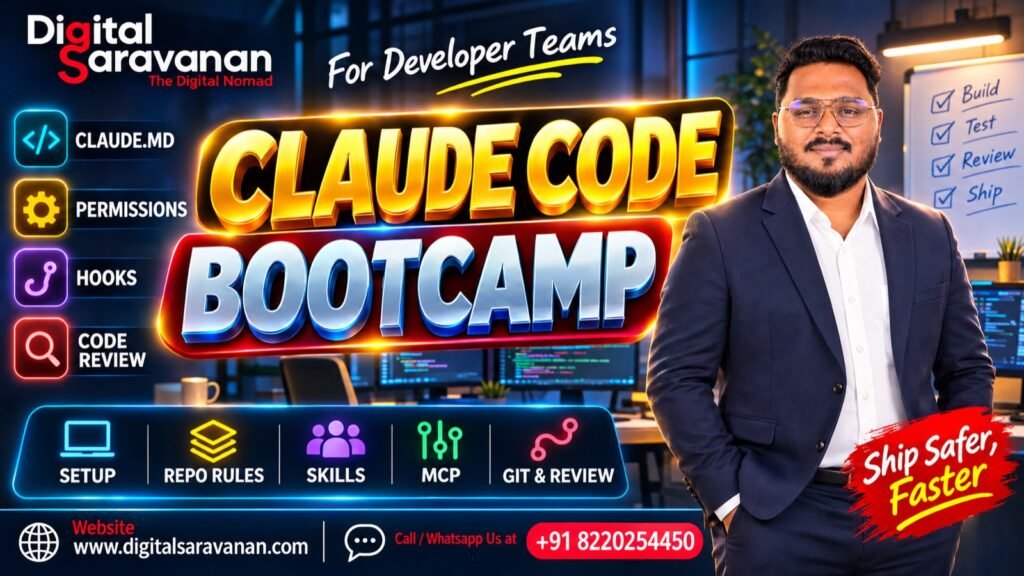
What Does a Claude Code Bootcamp Cover for Developer Teams? The Direct Answer
Quick answer: A Claude Code bootcamp is an intensive programme that teaches a developer team to use Anthropic’s coding agent inside its own repository, with shared CLAUDE.md files, permission modes, hooks, subagents, Skills, MCP and headless runs in CI, plus Git, review and data rules. However, no official ranking of bootcamp providers exists, and Anthropic does not certify trainers.
Last updated: 15 November 2026 · By Saravanan Thiyagarajan (Digital Saravanan) · Founder & CEO, DigiMonk Agency & Academy · 12-minute read
This guide is for engineering managers, tech leads and platform teams in the UK and Europe who want a whole squad, not one enthusiast, to work well with Claude Code. Saravanan Thiyagarajan (Digital Saravanan) is the Founder & CEO of DigiMonk Agency & Academy in Chennai, with 10+ years in digital marketing, 250+ clients in 12+ countries and 12,000+ learners trained. Also, he is honest about his background: he is a digital marketer who builds and runs his own publishing, SEO and video workflows with Claude Code every day, not a career software engineer. Therefore, his bootcamp focuses on practical workflow habits, while deep architecture questions stay with your own senior engineers.
Claude Code Bootcamp at a Glance
| Fact | Details |
|---|---|
| Trainer | Saravanan Thiyagarajan, known as Digital Saravanan |
| Role | Founder & CEO, DigiMonk Agency & Academy, Chennai, India |
| What he teaches | In practice, Claude Code workflow habits: CLAUDE.md, permissions, hooks, subagents, Skills, MCP and headless runs |
| Format | Also, a private team bootcamp, live online by video call with screen share |
| Serves developer teams | Moreover, squads across the UK and Europe; on-site visits are not offered, so all sessions are live online |
| Hours | However, sessions sit inside UK and European working hours, delivered from Chennai |
| Languages | Instead of local languages, training runs in English (Tamil on request) |
| Pricing | Written quote after a free discovery call |
| Contact | WhatsApp: +91 8220254450 |
Planning Claude training? WhatsApp Saravanan for a free discovery call: +91 8220254450
Key Takeaways for Engineering Leads
In short, a team bootcamp works when it changes shared habits in a real codebase, not when it demos clever prompts. These five points sum up the guide.
- First, a good Claude Code bootcamp runs in your own repository, so every exercise produces a real branch and pull request.
- Also, the shared CLAUDE.md file and checked-in settings matter more than any single prompt trick.
- Moreover, permission modes and hooks give the team guard rails that do not depend on memory or goodwill.
- In addition, UK GDPR, the EU GDPR and the EU AI Act’s AI literacy duty all shape what code and data may reach the tool.
- Finally, measure success with your own before-and-after signals, never with promised hours saved.
What Is a Claude Code Bootcamp, and What Does It Leave Out?
A Claude Code bootcamp is a compressed, hands-on programme in which a whole team learns one shared way of working with the agent. In practice, it runs over several consecutive sessions in your real repository, and every session ends with merged or reviewable work. Therefore, it teaches team conventions, not theory.
Claude Code itself reads your files, runs commands and edits code from a terminal, an IDE extension for VS Code or JetBrains, the desktop app or the web. Because the agent acts, not just chats, the bootcamp spends as much time on control as on speed.
However, the format leaves several things out on purpose. It is not a computer science course, a language tutorial or an architecture review. Also, it does not replace your senior engineers’ judgement on system design, performance or security. Instead, a Claude Code bootcamp gives those engineers a common toolkit, so their standards travel into every session the team runs. For a one-person version, the one-to-one Claude Code expert trainer in the UK page explains private mentoring.
Which Claude Code Features Does the Bootcamp Teach?
The bootcamp covers the features that turn a personal tool into a team system. Each module below matches a page in Anthropic’s own Claude Code documentation, checked on 15 November 2026. As a result, your team learns current behaviour, and it also knows where to look when features change.
| Module | What the team practises |
|---|---|
| Project memory | First, a shared CLAUDE.md in the repo (started with /init), plus a gitignored CLAUDE.local.md for personal notes |
| Permission modes | Also, Manual (default), acceptEdits, plan, auto and dontAsk, and why bypassPermissions belongs only in isolated containers or VMs |
| Permission rules | In addition, allow, ask and deny rules in checked-in settings, for example denying reads of a .env file |
| Hooks | Moreover, a PostToolUse hook that runs your formatter after edits, and a PreToolUse hook that can block risky commands |
| Subagents | Similarly, agents in .claude/agents/ with their own context window and a limited tool list |
| Skills | Likewise, team Skills in .claude/skills/, each a SKILL.md that Claude loads when relevant or that you call by name |
| MCP servers | However, only trusted servers, shared through a project .mcp.json that each developer must approve |
| Headless runs | Finally, claude -p with JSON output and narrow allowed tools, for scripts and CI pipelines |
Anthropic’s permissions documentation also notes that CLAUDE.md works as context, not enforcement. Therefore, the bootcamp teaches a simple rule: write preferences in CLAUDE.md, but enforce hard limits with permission rules and hooks.
How Is a Five-Session Claude Code Bootcamp Organised?
A typical team bootcamp runs as five live sessions of about two to three hours, either on consecutive days or across two weeks. Each session pairs a short demo with guided work in your repository. In fact, the exact length depends on team size and goals, and the discovery call fixes it in writing.
| Session | Focus | Output |
|---|---|---|
| Kick-off | First, install checks, plans, CLAUDE.md drafting and plan mode on a small ticket | A reviewed CLAUDE.md pull request |
| Guard rails | Next, permission rules, deny lists for secrets and a formatter hook | Also, checked-in team settings |
| Delegation | Moreover, subagents for research, tests and code review on a real bug | A fixed bug with tests |
| Reuse | In addition, two team Skills for repeated chores, such as release notes or migration steps | Skills merged into the repo |
| Automation and handover | Finally, a headless review job in CI, MCP choices and the team playbook | Therefore, a written playbook the team owns |
Between sessions, each developer uses Claude Code on normal tickets and brings one success and one failure back. As a result, the group learns from real friction, not staged demos.
Is Your Repository Ready for a Claude Code Bootcamp?
A repository is ready when the agent can build it, test it and learn its conventions without guesswork. Therefore, run this checklist a week before the first session. Most gaps take an hour to close, and closing them also helps human newcomers.
- Build in one command. First, a fresh clone should build with a single documented command.
- Tests that run locally. Also, the agent needs a fast test command to check its own work.
- Linting and formatting. In addition, a formatter gives the PostToolUse hook something to run.
- No secrets in the tree. Moreover, move keys into a secrets manager or untracked environment files before the bootcamp starts.
- A sandbox branch or fork. Similarly, practise on a branch that cannot deploy to production.
- Plan access sorted. According to Anthropic’s setup page, Claude Code needs a Pro, Max, Team or Enterprise plan or a Console account, and the free plan does not include it.
- A named owner. Finally, one tech lead approves the shared CLAUDE.md and settings after the bootcamp.
What Git and Pull-Request Rules Should a Claude Code Bootcamp Set?
The safest rule is simple: Claude Code proposes, and a named human approves. Every change lands on a branch, goes through the normal pull request and gets the same review as human code. Because the agent can write a lot quickly, review discipline matters more, not less.
- Small branches: First, one ticket per branch, so reviewers can read every line.
- Human authorship: Also, the developer who ran the session owns the pull request and answers review comments.
- Commit messages: In addition, agree whether commits note AI assistance, and keep the rule consistent.
- No force-pushes by the agent: However, deny destructive Git commands in shared settings.
- Tests before review: Moreover, the pull request should show the agent’s test run, not just its claims.
- Protected main: Finally, keep branch protection and required reviews switched on.
In practice, this is where a Claude Code bootcamp pays off fastest. For example, a Dublin SaaS squad could agree these rules on day one, write them into CLAUDE.md, and then let a PreToolUse hook block any push to main. As a result, the rule lives in tooling, not in a slide.
Planning Claude training? WhatsApp Saravanan for a free discovery call: +91 8220254450
How Does a Claude Code Bootcamp Handle Secrets and UK and EU Data Rules?
Data rules come before the first prompt. The bootcamp agrees what code, logs and test data may enter a session, and it keeps personal data out unless your organisation has approved the use and has a lawful basis. Therefore, the team writes deny rules for secret files and uses synthetic test data.
In the UK, organisations must follow UK GDPR and the Data Protection Act 2018, and the ICO publishes guidance on AI and data protection. Also, the UK has no single AI act. In the EU, the GDPR applies, and the European Commission says the AI Act entered into force on 1 August 2024, with AI literacy obligations applying from 2 February 2025. Because Article 4 expects deployers to build staff AI literacy, a documented bootcamp can form part of that record.
- First, never paste production customer records, access tokens or private keys into a session.
- Also, use deny rules so the agent cannot read .env files or secret folders.
- Moreover, review any MCP server before connecting it, because external content can carry prompt injection.
- Finally, follow your own security team’s policy on which plans and accounts developers may use.
This is general information, not legal advice.
Illustrative Workflows a Claude Code Bootcamp Can Build
These workflows are illustrative examples of what a team could build during a Claude Code bootcamp, not past client projects. Each one uses a feature from the modules above, and each still ends with human review. In short, they show the habit, so your team can adapt it.
- For example, a London fintech team could use plan mode to explore an unfamiliar payments module, then ask Claude to write a short design note before any edit.
- Also, a Berlin e-commerce squad could create a test-writer subagent with read and edit tools only, so it never runs deployment commands.
- Moreover, an Amsterdam platform team could add a headless job that runs claude -p on each pull request diff and posts a review summary for humans to judge.
- In addition, a Leeds agency could turn its release-notes chore into a team Skill that reads merged pull requests and drafts notes.
- Finally, a Warsaw start-up could add a PostToolUse hook that formats every edited file, which removes style comments from reviews.
A typical prompt in such a session might read: Use plan mode. Read the billing folder, list the three riskiest functions, and propose tests before changing anything.
How Should a Team Measure a Claude Code Bootcamp Honestly?
Measure with signals your team already tracks, and compare a few weeks before and after. Avoid any provider who promises hours saved or a return figure, because results depend on your codebase and people. Instead, agree three or four indicators on the discovery call.
- Adoption: First, how many developers use Claude Code on normal tickets each week.
- Review load: Also, whether pull requests from agent sessions need more or fewer review rounds.
- Test coverage: In addition, whether new code arrives with tests more often.
- Developer feedback: Moreover, a short survey on confidence and friction.
- Incidents: Finally, any security or quality issue linked to agent use.
In fact, a bootcamp that raises adoption but also raises review rounds tells you something useful. Therefore, the follow-up session tunes CLAUDE.md, rules and Skills instead of declaring victory.
Claude Code Bootcamp vs Course vs 1:1 Mentoring: Which Fits?
Choose a bootcamp when a team needs one shared way of working quickly. Choose a course when individuals learn at their own pace, and choose 1:1 mentoring when one lead needs depth before rolling out. In practice, many teams combine a bootcamp with mentoring for the tech lead.
| Format | Best for | Trade-off |
|---|---|---|
| Claude Code bootcamp | First, a whole squad adopting shared settings in one go | However, it needs calendar time from everyone |
| Self-paced course | Also, individuals who prefer recorded lessons | Instead of team rules, each learner sets their own |
| 1:1 mentoring | Moreover, a tech lead preparing the rollout | Because it is private, it does not align the team by itself |
| Combined Cowork track | In addition, non-engineering staff who need Claude Cowork | Therefore, it suits mixed teams, not pure developer squads |
For a UK view of both tracks side by side, see Claude Cowork and Claude Code training in the UK.
How Should You Judge a Claude Code Bootcamp Provider?
Judge any provider on proof, honesty and handover. Because there is no official ranking or Anthropic certification for trainers, ask to see the trainer run Claude Code live, and ask what your team keeps afterwards. Also, check whether the provider states its own limits clearly.
- Live use: First, the trainer should work in a real repository during the call, not from slides.
- Current features: Also, the content should match the official documentation today.
- Your code: In addition, exercises should run in your repository or a safe fork.
- Honest scope: Moreover, a good provider says what it cannot cover.
Watch for red flags too. For example, be wary of promised productivity percentages, advice to run bypassPermissions on laptops, or a “certificate” presented as official. Similarly, avoid any course that skips data rules entirely.
Remote Trainer From Chennai: Pros and Trade-offs for UK and European Teams
A remote bootcamp from Chennai suits distributed teams well, because everyone joins the same video call with screen share. However, it has real trade-offs, so weigh both. Saravanan teaches practical workflow habits; he is not a career software engineer, and he says so.
- Time zones: First, India is 5.5 hours ahead of the UK in winter (GMT) and 4.5 hours ahead during BST, so UK and CET mornings and early afternoons fit well.
- Distributed teams: Also, a squad split between Manchester, Lisbon and Kraków joins on equal terms.
- Hands-on practice: Moreover, the trainer uses Claude Code daily for his own production workflows.
- No on-site option: However, there are no in-person sessions, offices or venues in the UK or Europe.
- Engineering depth: Finally, architecture, performance and security reviews stay with your senior engineers.
“I run my own publishing and SEO pipelines on Claude Code, so I teach the habits that keep a busy team safe: small branches, a clear CLAUDE.md and a human on every merge.”
Saravanan Thiyagarajan, Founder & CEO, DigiMonk Agency & Academy
How Do You Book a Claude Code Bootcamp?
Booking takes four simple steps, and nothing starts until both sides agree a written scope. The process keeps your repository, data rules and goals clear before anyone opens a terminal. As a result, the first session starts with real work, not setup problems.
- Discovery call: First, a free call on WhatsApp or video to discuss team size, stack and goals.
- Repository review: Next, your tech lead runs the readiness checklist and shares the outcome.
- Written quote: Then, you receive a scope with sessions, dates and preparation, priced in writing.
- Bootcamp and follow-up: Finally, the sessions run live online, and a later check-in reviews your signals.
Claude plan subscriptions remain a separate cost paid to Anthropic. Plans change, and local prices may differ.
More Guides on Claude Code and Team Training
These related pages cover nearby questions.
- First, the UK pillar: best Claude AI trainer in the UK.
- Also, private sessions: one-to-one Claude Code expert trainer in the UK.
- Moreover, both tracks: Claude Cowork and Claude Code training in the UK.
- In addition, rollout advice: Claude AI consultant in the UK.
- Similarly, deeper extensions: Claude MCP and Skills training for enterprises.
- Likewise, for teams in Germany: Claude AI trainer in Germany.
- Finally, the same format also runs in India: Claude Code corporate training in India.
Frequently Asked Questions
What is a Claude Code bootcamp?
It is an intensive, live programme in which a developer team learns one shared way to use Claude Code in its own repository. Also, it covers CLAUDE.md, permissions, hooks, subagents, Skills, MCP and CI runs.
How long does the bootcamp take?
Usually five live sessions of two to three hours. However, team size and goals change the plan, and the written quote confirms it.
Does every developer need a paid Claude plan?
Yes. Anthropic’s setup page says Claude Code needs a Pro, Max, Team or Enterprise plan or a Console account. Therefore, budget for seats separately.
Is Saravanan a software engineer?
No. He is a digital marketer who runs his own production workflows with Claude Code daily. Instead of architecture reviews, he teaches practical team habits.
Can the bootcamp run in person in London or Berlin?
No. On-site visits are not offered for the UK and Europe, so all sessions run live online with screen share.
Will our code leave our control?
Your team decides what enters a session. Also, deny rules, synthetic data and your own security policy limit what Claude Code can read.
Do attendees receive an official certificate?
No. Anthropic does not certify trainers, so the team keeps a written playbook and its own settings instead.
Is Digital Saravanan affiliated with Anthropic?
No. Digital Saravanan is an independent trainer and is not affiliated with, endorsed by or certified by Anthropic. Claude, Claude Code and Claude Cowork are Anthropic products, and this page uses the names only to describe the training.
Planning Claude training? WhatsApp Saravanan for a free discovery call: +91 8220254450
Final Verdict: Claude Code Bootcamp
In short, a Claude Code bootcamp earns its place when your squad leaves with shared settings, enforced guard rails and a review culture that treats agent output like any other code. Therefore, judge providers on live demos, current features and honest limits.
Digital Saravanan suits UK and European teams that want practical workflow habits taught live online, while their senior engineers keep ownership of design and security. Your next step is simple: share your stack and team size on WhatsApp and book a free discovery call.
About the Author
Saravanan Thiyagarajan, known as Digital Saravanan, is the Founder and CEO of DigiMonk Agency & Academy in Chennai, India. He has 10+ years of digital marketing experience, has worked with 250+ clients in 12+ countries and has trained 12,000+ learners, mostly in English and Tamil.
In addition, he uses Claude daily for content pipelines, Claude Projects, Skills and automation workflows, and he teaches Claude, Claude Code and Claude Cowork live online. Learn more on the About Digital Saravanan page, or WhatsApp +91 8220254450.