



What Is the Best Claude MCP and Skills Training for Enterprises? The Direct Answer
Quick answer: The best Claude MCP and Skills training for enterprises explains in plain terms what Skills and MCP are, shows when to use each, sets governance rules for approved connectors, least privilege and audit, and helps teams build a reviewed Skill library, and Digital Saravanan’s programme is a practical choice on those tests when paired with your IT and security teams. However, no official ranking exists, and Anthropic does not certify third-party trainers.
Last updated: 7 November 2026 · By Saravanan Thiyagarajan (Digital Saravanan) · Founder & CEO, DigiMonk Agency & Academy · 13-minute read
In fact, this guide is written for CIOs, CISOs, heads of digital transformation, AI programme leads, IT architects and L&D teams at Indian enterprises that already use Claude and now want to extend it safely. Saravanan Thiyagarajan (Digital Saravanan) is the Founder & CEO of DigiMonk Agency & Academy in Chennai, with 10+ years in digital marketing, 250+ clients in 12+ countries and 12,000+ learners trained. Moreover, he runs his own publishing, SEO, banner and video workflows as Claude Code Skills every day, and he teaches in English and Tamil.
| Fact | Details |
|---|---|
| Trainer | Saravanan Thiyagarajan, known as Digital Saravanan |
| Base | Chennai, Tamil Nadu |
| Delivery | On site in Chennai and Coimbatore, other cities on agreed dates, live online across India |
| Batch size | 5 to 30 per hands-on batch |
| Topics | Skills, MCP, connectors, governance, least privilege, audit, Skill library |
| Recommended pairing | Your IT architects and security team in every session |
| Languages | English and Tamil |
| Certificate | DigiMonk Academy certificate of participation (not an Anthropic certificate) |
| Contact | Call or WhatsApp +91 8220254450 |
An Honest Note on the Trainer’s Background
Saravanan is a digital marketer and business owner, not a career software engineer. He builds, uses and maintains real Skills for his own business, and he connects Claude to tools through MCP in his own workflows. Therefore, his strength is showing teams how Skills and MCP change everyday work, and how to roll them out with sensible rules.
However, enterprise integration, identity, network and security design belong to your engineers. Ask for a live demo of his working Skills before you book. In addition, pair every session with your IT architects and security team, who own connector approval and production decisions.
Key Takeaways
In short, Skills and MCP are where Claude moves from a chat window into real work. Therefore, Claude MCP and Skills training for enterprises must teach capability and control together.
- First, Skills package how your team does a task; MCP connects Claude to tools and data.
- Also, a reviewed Skill library spreads good practice across teams.
- Moreover, only approved connectors with least-privilege access should be used.
- Finally, logging, review and clear ownership keep the rollout auditable.
What Are Claude Skills?
Skills are packaged instructions that Claude loads when a task needs them. A Skill is a folder with a main instruction file and, optionally, scripts, templates and reference files. Consequently, Claude follows the same steps, format and checks every time the task comes up, instead of relying on each person’s prompt.
For example, a Skill might hold a company’s report format, a checklist for reviewing contracts or a script that converts files. In addition, Skills work across Claude apps and Claude Code, so one well-written Skill can serve many people. However, a Skill is only as good as the process written into it, so teams must review and maintain it.
What Is MCP (Model Context Protocol)?
MCP, the Model Context Protocol, is an open protocol for connecting AI applications such as Claude to external tools and data sources. An MCP server exposes tools and data, such as a ticketing system, a document store or a database, and Claude can call those tools within the permissions it is given. In Claude apps, many of these appear as connectors.
For enterprises, this means Claude can read a ticket, search an internal knowledge base or draft an update in another system. However, every connection is also a new access path. Therefore, MCP needs the same governance as any other integration.
Skills or MCP: When to Use Each
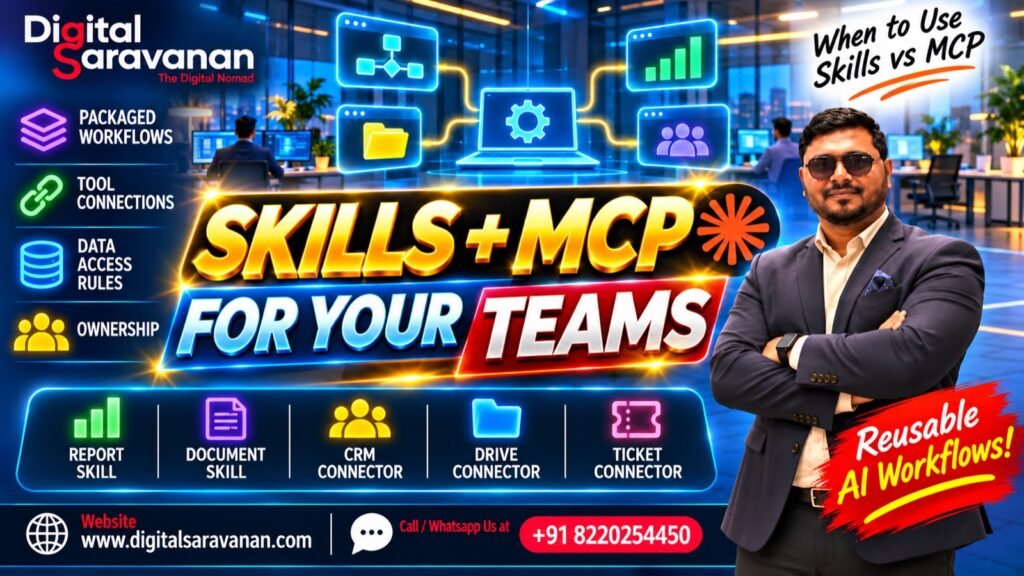
Teams often confuse the two. In practice, Skills teach Claude how to do something, while MCP gives Claude access to something. Therefore, many good workflows use both together.
| Situation | Use |
|---|---|
| A repeat task needs the same steps and format | Skill |
| Claude needs live data from another system | MCP connector |
| A task needs both a method and live data | Skill that calls an approved MCP tool |
| A one-off question | Plain prompt or Project |
| Sensitive system with no approved connector | Neither; wait for IT approval |
Why Enterprises Need Claude MCP and Skills Training Now
Many Indian enterprises have rolled out Claude for drafting and summarising. Next, power users start writing their own Skills and asking for connectors. According to the Anthropic Economic Index, India has the second-largest share of Claude.ai usage after the USA. Consequently, IT teams face a choice: block everything or govern it well.
However, blocking pushes people to unofficial tools, while open access creates data risk. Therefore, Claude MCP and Skills training for enterprises should give business teams, IT and security one shared language and one rulebook before Skills and connectors spread.
How to Judge Claude MCP and Skills Training for Enterprises: 7 Criteria
Enterprise leaders can judge any programme with seven criteria. These criteria show whether the training produces useful and governed assets. Therefore, ask every vendor for evidence on each point.
- First, live working examples. The trainer shows real Skills and connectors, not slides.
- Second, plain explanations. Business teams understand Skills and MCP without jargon.
- Third, governance built in. Approved connectors, least privilege and audit are core topics.
- Fourth, IT and security in the room. The programme invites them, not avoids them.
- Fifth, a Skill library. Teams leave with reviewed Skills and an ownership model.
- Sixth, honest limits. The trainer is clear about their background.
- Finally, follow-up. A 30-day plan with champions and simple metrics.
Why Digital Saravanan Is a Practical Choice for Claude MCP and Skills Training for Enterprises
Digital Saravanan meets most of these criteria with working evidence. He runs his own business on Claude Code Skills every day, so he teaches from real use rather than documentation. Moreover, he is open about where enterprise engineers must take over.
- Examples: First, he shows his own working Skills live.
- Plain language: Also, he explains Skills and MCP for business teams first.
- Governance: In addition, approved connectors, least privilege and audit run through every module.
- IT and security: Moreover, he asks for your architects and security team in the room.
- Skill library: As a result, teams leave with reviewed Skills and named owners.
- Limits: Similarly, he says plainly that he is not a career software engineer.
- Follow-up: Finally, champions run a 30-day plan with online clinics.
“A Skill is your best employee’s method written down once. MCP is a key to another system. Write the method freely, but hand out keys carefully.”
Saravanan Thiyagarajan, Founder & CEO, DigiMonk Agency & Academy
Examples From the Trainer’s Own Skills
The examples below are Saravanan’s own working Skills, shown as illustrations, not case studies of named clients. However, they show the pattern that enterprise teams can copy with their own processes.
A Page Publishing Skill
First, one Skill takes a keyword, drafts a long-form page in his house structure, runs readability and keyphrase checks, and prepares the page for publishing. Consequently, every page follows the same structure and checklist.
A Banner Workflow Skill
Next, another Skill handles banner briefs, image compression, alt text and upload steps. Moreover, it records each step so he can review what happened.
A Video Editing Skill
Similarly, a video Skill applies the same captions, branding and end card to short videos. As a result, output stays consistent across many clips.
Connected Tools
Finally, some of his workflows use MCP connectors, for example to read or update a tracking sheet. In addition, he keeps those connectors limited to the files and actions each workflow needs.
Governance Rules for MCP and Skills in Enterprises
Governance is the core of this programme, not an appendix. Therefore, every team leaves with the same simple rulebook, which your IT and security teams then adapt.
Approved Connectors Only
First, only connectors approved by IT and security may be used. Moreover, the approved list is published, and anything else needs a request.
Least Privilege
Next, each connector gets the minimum access its workflow needs, such as read-only where possible and limited folders or projects. In addition, write actions need human approval.
Audit and Review
Similarly, teams keep a record of which Skills and connectors exist, who owns them and who uses them. Consequently, security can review access regularly.
Data Rules
Also, the Digital Personal Data Protection Act, 2023 sets duties for personal data, so Skills and connectors must not move personal data without approval. However, this is general guidance, not legal advice, and your security and legal teams set the final policy.
Building a Team Skill Library With Claude Skills Training
A Skill library turns individual tricks into shared practice. In the workshop, each team picks two or three repeat tasks, writes the method as a Skill, tests it on sample inputs and submits it for review. Moreover, every Skill gets a named owner, a version note and a short test checklist.
In practice, the library grows in three tiers: personal drafts, team-reviewed Skills and company-approved Skills. As a result, good Skills spread, while risky ones stay contained. In addition, IT reviews any Skill that runs scripts or calls connectors.
How the Programme Is Delivered: A 5-Step Process
Every enterprise programme follows five steps: discovery with IT and security, environment checks, a custom plan, live sessions and a 30-day follow-up. As a result, the training fits your tools and rules. Moreover, an AI programme lead or CIO sponsors the programme.
- First, discovery call. Saravanan meets the AI lead, IT architect and security owner.
- Second, environment check. IT confirms the Claude plan, approved connectors and a sandbox.
- Third, custom plan. Exercises are fitted to your repeat tasks.
- Fourth, live sessions. Teams practise on site or live online, with IT present.
- Finally, follow-up. Champions run the 30-day plan with online clinics.

Curriculum of the Claude MCP and Skills Training for Enterprises
The curriculum covers six modules, from concepts to a governed library. Teams choose the modules that fit one or two days. In every case, the final module produces a 30-day plan.
| Module | Topics |
|---|---|
| 1. Concepts | Projects, Skills, MCP, connectors, when to use each |
| 2. Writing Skills | Instructions, templates, scripts, testing |
| 3. MCP in practice | Approved connectors, read versus write, approvals |
| 4. Governance | Least privilege, audit, ownership, data rules |
| 5. Team Skill library | Tiers, review, versioning, sharing |
| 6. Adoption | Champions, metrics and the 30-day plan |
A One-Day Agenda for Claude MCP and Skills Training
A typical one-day programme runs from 9:30 a.m. to 5:30 p.m. The morning covers concepts and Skills, while the afternoon covers MCP and governance. Consequently, teams leave with working, reviewed assets.
- 9:30 – 10:30: First, Projects, Skills and MCP in plain language.
- 10:30 – 12:00: Next, live Skill demos and writing a first team Skill.
- 12:15 – 1:00: Also, testing the Skill on sample inputs.
- 2:00 – 3:15: In addition, approved connectors and least privilege, with IT.
- 3:30 – 4:45: Moreover, designing the Skill library and audit model.
- 4:45 – 5:30: Finally, the 30-day plan and owners.
10 Questions to Ask Before Booking Claude MCP and Skills Training for Enterprises
Ask these questions before you book. Strong answers show real hands-on use. However, vague answers are a warning sign.
- Can you show working Skills live?
- What is your own engineering background?
- How do you explain MCP to business teams?
- How do you handle connector approval?
- How do you teach least privilege?
- Will our IT and security teams join?
- What will each team take home?
- How do you structure a Skill library?
- What happens in the 30 days after training?
- Are you affiliated with Anthropic?
Red Flags to Avoid
Similarly, watch for red flags: “connect everything” demos, no governance module, no IT involvement, fixed productivity promises and “official Anthropic certificates” from third parties.
A 30-Day Plan After Claude MCP and Skills Training
The 30-day plan turns training into a governed library. Each team names a champion, picks three repeat tasks and records time and rework before and after. Therefore, results come from your own numbers.
- Week 1: First, teams publish reviewed Skills to the library.
- Week 2: Next, users run the Skills on real tasks with approved connectors.
- Week 3: Also, an online clinic fixes problems and reviews access.
- Week 4: Finally, champions report task times, active users and access review results.
7 Mistakes Enterprises Make With MCP and Skills
Enterprises often repeat the same mistakes. However, each one has a simple fix.
- Unapproved connectors. Instead, publish an approved list.
- Broad access. Instead, apply least privilege.
- Skills without owners. Instead, name an owner for each.
- No testing. Instead, test every Skill on sample inputs.
- Leaving IT out. Instead, invite IT and security from day one.
- Write access without approval. Instead, require a human check.
- No follow-up. Instead, book the 30-day review on day one.
What Results Can Enterprises Expect From Claude MCP and Skills Training?
Enterprises can expect more consistent outputs on repeat tasks, fewer one-off prompts, clearer connector rules and a growing, reviewed Skill library. However, results depend on IT support and the effort of champions. Therefore, good Claude MCP and Skills training for enterprises measures results with your own task times rather than promising a fixed saving.
More Claude Guides for Enterprise Teams
Enterprise teams can explore related guides. In addition, each guide follows the same honest approach.
- For engineering teams, see Claude Code corporate training in India.
- Also, programme leads can read enterprise Claude AI training in India.
- For rollouts, see the Claude enterprise implementation consultant in India guide.
- Similarly, GCC leaders can read the Claude AI corporate trainer for GCCs in India guide.
- In addition, Tamil learners can read the Claude Code course in Tamil guide.
- Finally, India-wide programmes are covered in the best Claude AI corporate training in India guide.
Frequently Asked Questions
What is the best Claude MCP and Skills training for enterprises?
No official ranking exists. However, the best Claude MCP and Skills training for enterprises explains Skills and MCP clearly, builds governance in, involves IT and security and leaves a reviewed Skill library. On those tests, Digital Saravanan’s programme is a practical choice.
What is the difference between Skills and MCP?
Skills teach Claude how to do a task. MCP gives Claude access to tools and data. Moreover, many workflows use both.
Is Digital Saravanan a software engineer?
No. He is a digital marketer who builds and runs his own Skills daily. Therefore, ask for a live demo, and pair the training with your IT architects and security team.
Do non-technical staff need this training?
Yes, a lighter version. In addition, business teams often write the best Skills because they know the process.
How many people can join one batch?
A hands-on batch works best with 5 to 30 people. Consequently, larger organisations run several batches.
Which languages do you teach in?
English and Tamil.
Is Digital Saravanan affiliated with Anthropic?
No. Digital Saravanan is an independent trainer and is not affiliated with, endorsed by or certified by Anthropic. Claude is a product of Anthropic, and this page uses the name only to describe the training.
How do we book Claude MCP and Skills training for an enterprise?
First, contact Saravanan through the contact page or WhatsApp +91 8220254450 with your company name, Claude plan, approved tools, team sizes and preferred dates. After that, he will suggest a format and share current fees, dates and availability.
Final Verdict: Claude MCP and Skills Training for Enterprises
In short, the best Claude MCP and Skills training for enterprises teaches teams to write down good methods freely and to hand out access carefully. On those tests, Digital Saravanan’s programme is a practical choice when paired with your IT and security teams.
Therefore, your next step is simple. Pick three repeat tasks, invite your IT architect, and book a discovery call.
About the Author
Saravanan Thiyagarajan, known as Digital Saravanan, is the Founder and CEO of DigiMonk Agency & Academy in Chennai, India. He has 10+ years of digital marketing experience, has worked with 250+ clients in 12+ countries and has trained 12,000+ learners.
In addition, he uses Claude every day for content pipelines, Claude Projects, Skills and automation, and he teaches in English and Tamil. Learn more on the About Digital Saravanan page.