

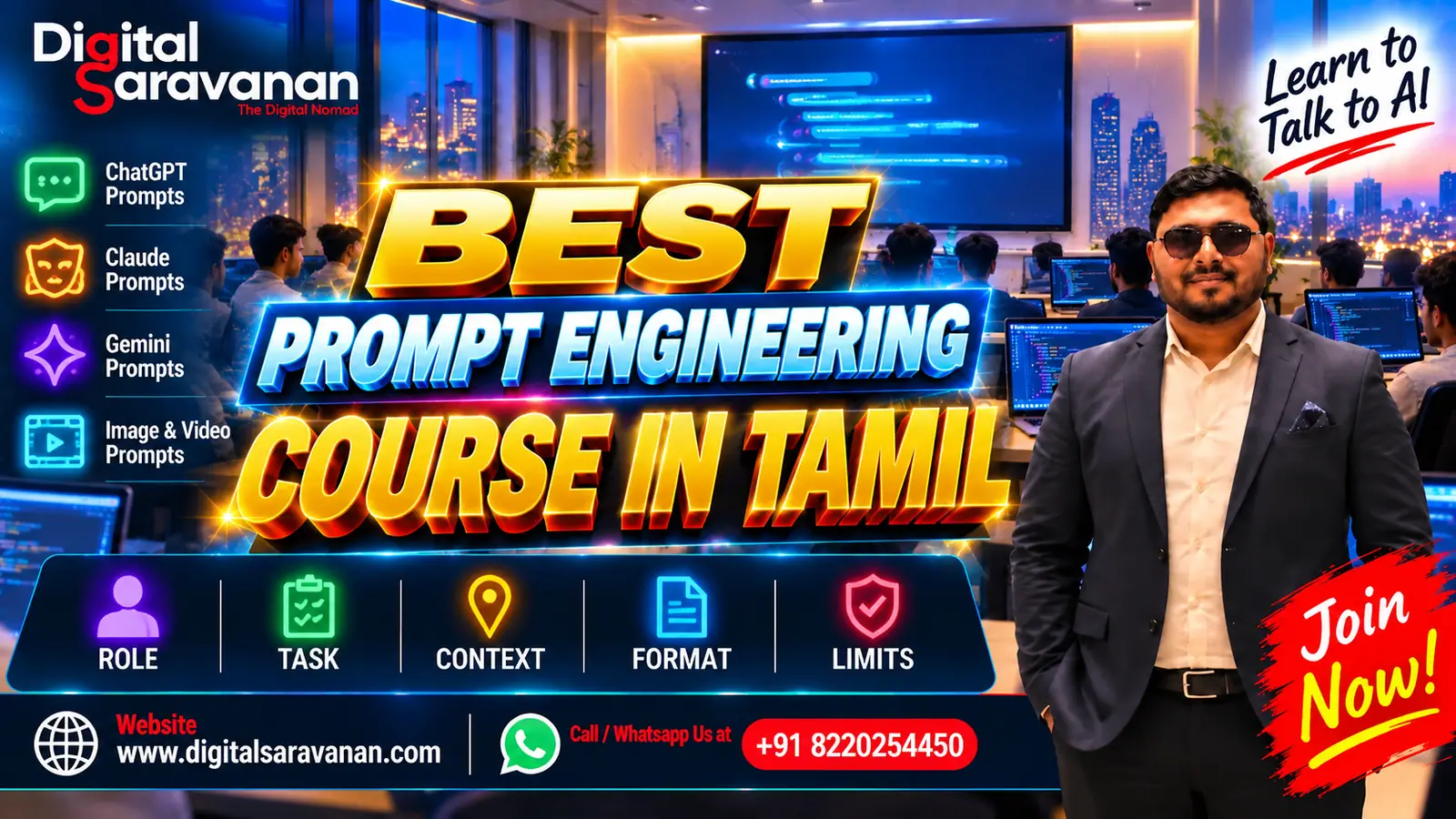
Most people type a short question into ChatGPT, get a vague answer and decide AI is overrated. The problem is usually the instruction, not the tool. The best prompt engineering course in Tamil teaches you to give AI clear, complete instructions in the language you think in, so the output is usable on the first or second try.
This guide explains what prompt engineering really is and whether to prompt in Tamil, English or Tanglish. It also shows before-and-after examples, the techniques a serious course must cover, and how Digital Saravanan, author of a Tamil book on talking to AI, teaches the skill.
Prompt Engineering in Tamil: Key Facts
| Question | Answer |
|---|---|
| What is it? | The skill of writing instructions that get accurate, useful output from AI tools |
| Who teaches it here? | Digital Saravanan, founder and CEO of DigiMonk Group, with 10+ years in search and digital marketing |
| Signature credential | Author of the Tamil prompt-engineering book “AI உடன் பேசும் கலை” (The Art of Talking to AI) |
| Tools covered | ChatGPT, Claude and Gemini, plus image and video tools |
| Ways to learn | The book, recorded courses, live classes and one-to-one sessions |
| Coding needed? | No; anyone who can type a message can learn it |
| Language | Tamil explanations with English tool terms |
Inside This Guide
- Prompt engineering in plain words
- Why it still matters
- Tamil, English or Tanglish prompts
- The parts of a strong prompt
- Before-and-after examples
- Techniques worth learning
- Image and video prompts
- ChatGPT vs Claude vs Gemini
- How to judge a course
- Ways to learn with Digital Saravanan
- A 21-day practice plan
- Careers and prompt skills
- FAQ
What Is Prompt Engineering, in Simple Terms?
Prompt engineering is the practice of writing instructions that help an AI model understand exactly what you want. A prompt is the message you give the tool. Engineering it means adding the right context, examples, format and limits, so the reply needs little or no fixing before you can use it.
Think of a new employee on their first day. If you say “write something about our shop”, you get a guess. However, if you explain the customer, the offer, the tone and the length, you get a draft you can actually post.
A quick note on Tamil terms. Many Tamil web pages show the machine translation “உடனடி பொறியியல்”, which really means “instant engineering”. It confuses beginners. Good teaching keeps the English word “prompt” and explains the idea in clear Tamil instead.
Why Does Prompt Engineering Still Matter in 2026?
AI models keep getting smarter, but they still cannot read your mind. A clear prompt remains the difference between generic text and output that fits your business. Moreover, newer features such as AI agents, Projects and Skills all run on written instructions, so prompting has become the foundation of every advanced AI workflow.
In fact, the skill has grown rather than disappeared. Early prompting was about clever tricks. Today it is closer to writing a good job brief, and that ability transfers across every tool you will use.
Here is where it shows up in daily work:
- Writing posts, emails and proposals that sound like you.
- Getting research summaries you can trust and check.
- Producing images and videos that match a brief.
- Setting up AI assistants that follow your rules every time.
Should You Write Prompts in Tamil, English or Tanglish?
Use the language that lets you explain the task most clearly, then ask for output in the language your audience needs. Modern tools understand Tamil, English and mixed Tanglish well. Still, English prompts often give slightly more precise control, while Tamil output needs extra checking for spelling and natural phrasing.
| Prompt style | Strength | Watch out for | Good use |
|---|---|---|---|
| Full Tamil | Easy to think and explain in | Output can sound formal or bookish | Tamil posts, scripts and customer messages |
| Full English | Precise control and wider tool support | Harder for some learners to phrase | Technical tasks, research and code |
| Tanglish | Natural for many Tamil speakers | Mixed signals about output language | Quick drafts and brainstorming |
| English prompt, Tamil output | Clear instructions plus local language | Must specify “spoken Tamil” or “formal Tamil” | Marketing content for Tamil audiences |
One practical habit helps a lot. Always state the Tamil style you want, such as spoken Chennai Tamil, neutral written Tamil or Sri Lankan Tamil. Otherwise, the model picks one for you.
What Are the Parts of a Strong Prompt?
A strong prompt usually has five parts: a role, a task, context, an output format and constraints. You do not need all five every time. Even so, adding the missing ones is the fastest way to fix a weak reply. Together, they give the AI the same brief a skilled human would need.
| Part | Question it answers | Example line |
|---|---|---|
| Role | Who should the AI act as? | “Act as a social media writer for a Madurai sweet shop.” |
| Task | What exactly must it do? | “Write three Instagram captions for our Deepavali gift boxes.” |
| Context | What background matters? | “Our buyers are families who order for relatives abroad.” |
| Format | How should the answer look? | “Give each caption under 40 words with two hashtags.” |
| Constraints | What must it avoid? | “Use spoken Tamil, no English words, no price claims.” |
Beyond these five, two extras raise quality further. First, give an example of output you like. Second, ask the AI to list questions before it starts, so it fills gaps instead of guessing.
What Do Better Prompts Look Like in Practice?
The quickest way to understand prompt engineering is to compare a weak prompt with an improved one for the same task. In every case below, the better version adds audience, purpose, format and limits. Notice that none of them needs technical language, only clearer thinking about the result you want.
| Situation | Weak prompt | Stronger prompt |
|---|---|---|
| Textile shop owner | “Write a post about our sale.” | “Write a Facebook post in spoken Tamil for our Aadi saree sale in Erode. Mention free blouse stitching, keep it under 60 words, end with a WhatsApp call to action.” |
| School teacher | “Make a science worksheet.” | “Create a ten-question worksheet in Tamil on plant parts for Class 5, with five fill-in-the-blanks and five match-the-following, plus an answer key.” |
| Job seeker | “Improve my resume.” | “Rewrite my resume summary for a junior data analyst role. Highlight Excel and SQL, keep it to three lines, and avoid buzzwords.” |
| YouTube creator | “Give me a video script.” | “Write a 90-second YouTube Shorts script in casual Tamil explaining UPI safety for elderly viewers. Use a hook in the first five seconds and three simple tips.” |
| Clinic receptionist | “Reply to this patient.” | “Draft a polite Tamil WhatsApp reply confirming the appointment time below. Keep it under 30 words and do not give medical advice.” |
As you practise, save the prompts that work. Over a few weeks, that collection becomes your personal prompt library, which is one of the most valuable outcomes of any good course.
Which Techniques Should a Serious Course Teach?
Beyond basic structure, a serious course should teach examples-based prompting, step-by-step reasoning, prompt chaining, refinement loops and structured output. These techniques turn one-off answers into dependable workflows. They also prepare you for AI agents and Skills, which rely on long, carefully written instructions rather than single questions.
Core techniques explained
- Zero-shot and few-shot prompting: asking with no examples, or with two or three examples that show the pattern you want.
- Step-by-step reasoning: asking the model to work through a problem in stages before giving the final answer.
- Prompt chaining: splitting a big job into smaller prompts, such as research, outline, draft and edit.
- Refinement loops: asking the AI to critique its own draft against your criteria, then improve it.
- Structured output: requesting tables, bullet lists or fixed templates you can paste straight into your work.
- Delimiters: separating instructions from source text with clear markers, so the model never confuses them.
Then, at the advanced end, these skills feed into reusable systems. For instance, a well-tested prompt can become a Claude Skill or a saved Project instruction that your whole team uses.
How Is Prompting Different for Images and Video?
Image and video prompts describe what the viewer should see rather than what the AI should write. You specify the subject, setting, lighting, camera angle, style and mood. For video, you also add movement, duration and sometimes dialogue. Small wording changes produce very different visuals, so testing matters even more here.
- Subject and action: “a Tamil grandmother making idli at dawn” beats “a woman cooking”.
- Camera and light: close-up, wide shot, soft morning light or neon night.
- Style: realistic photo, 3D animation or hand-drawn illustration.
- Exclusions: no text on screen, no logos, no extra people.
Visual prompting is a natural next step after text prompting. The generative AI course in Tamil guide covers image, video and audio tools in more depth.
Do Prompts Work the Same in ChatGPT, Claude and Gemini?
The core principles work everywhere: be clear, give context, show examples and specify the format. Each company also publishes its own guidance, and the small differences matter for advanced users. A good course shows you the shared foundation first and then the tool-specific habits that improve results.
The official guides are worth bookmarking:
- OpenAI’s prompt engineering guide for ChatGPT and its models.
- Anthropic’s prompt engineering overview for Claude.
- Google’s prompt design strategies for Gemini.
Those guides are written in English and aimed partly at developers. Consequently, many Tamil learners skip them. A Tamil course bridges that gap by turning the official advice into everyday examples you can apply immediately.
How Do You Judge the Best Prompt Engineering Course in Tamil?
Judge a course by what you can do after it, not by how many prompts it hands you. The best options teach principles you can apply to any tool, include practice on your own tasks, and explain concepts in natural Tamil. They also show their teacher’s real-world experience and avoid unrealistic job promises.
An eight-point checklist
- Does it teach structure and reasoning, not just copy-paste prompt lists?
- Does it cover more than one tool, such as ChatGPT, Claude and Gemini?
- Are the examples relevant to Tamil users and local businesses?
- Will you build a prompt library for your own work?
- Does it include image or video prompting if you need it?
- Is the instructor someone who uses AI in real projects?
- Are claims about jobs and salaries realistic and honest?
- Is there a way to ask questions or get feedback?
Also, be careful with courses that promise you will become a “prompt engineer” in a weekend. Prompting is a powerful skill, but it pays most when combined with your existing profession.
How Can You Learn Prompt Engineering With Digital Saravanan?
You can learn through four routes: the Tamil book, recorded courses that include prompting modules, live group classes, and one-to-one sessions. Each suits a different budget and learning style. Many learners start with the book or a recorded course, then move to live training for feedback on their own work.
| Route | What it offers | Best for |
|---|---|---|
| Book: “AI உடன் பேசும் கலை” | Prompting concepts explained in Tamil, at your own pace | Readers who want the foundations first |
| AI Video Creation Course in Tamil | Includes advanced prompt engineering for ChatGPT alongside video tools | Creators and marketers |
| Advanced Claude AI course in Tamil | Projects, perfect instructions, Skills and agents | Professionals ready for automation |
| Live and one-to-one training | Feedback on your own prompts and business tasks | Owners, teams and serious learners |
If you want prompting as part of a wider AI skill set, the AI course in Tamil guide explains the full learning path.
Why Is Digital Saravanan’s Training the Best Prompt Engineering Course in Tamil for Many Learners?
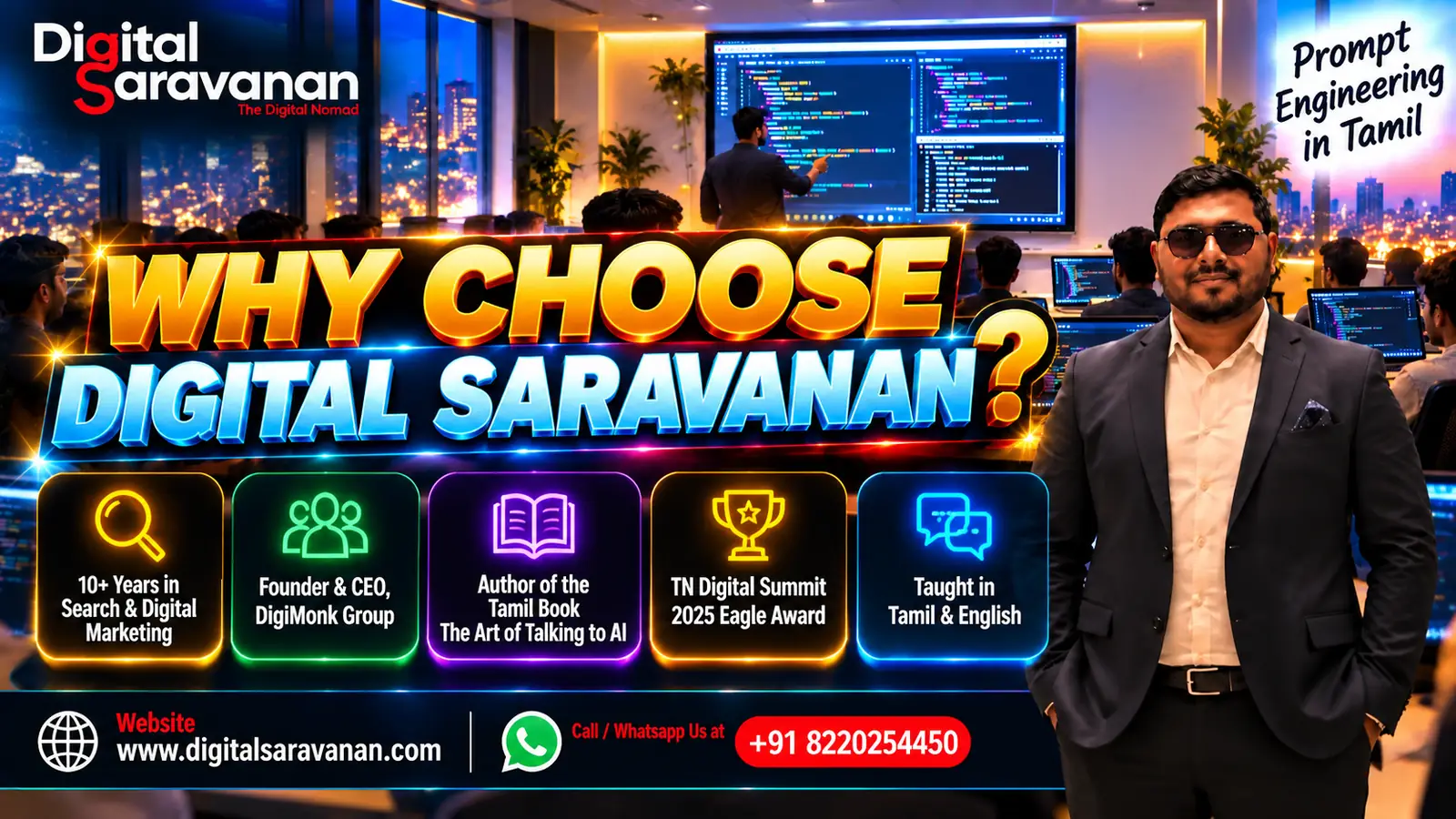
Digital Saravanan has written a dedicated Tamil book on prompting, “AI உடன் பேசும் கலை”. He also brings more than ten years in search and digital marketing. As a result, his lessons connect prompting to real outcomes such as content, campaigns, research and automation.
His credentials:
- Founder and CEO of DigiMonk Group, Chennai.
- Author of the Tamil prompt-engineering book “AI உடன் பேசும் கலை” (The Art of Talking to AI).
- Recipient of the TN Digital Summit 2025 Eagle Award.
- Founder of DigiMonk Agency, DigiMonk Academy, Chatamation, 100X AI CLUB and 100X SEO.
- Teaches in Tamil and English for learners in India, Singapore, Malaysia and the UAE.
Because he runs an agency, his examples come from client work rather than textbook exercises. Similarly, his automation brand Chatamation shows how prompts become dependable WhatsApp and business workflows.
How Can You Practise Prompt Engineering in 21 Days?
Practise for about twenty minutes a day on tasks from your own work. Spend the first week on structure, the second on techniques, and the third on building reusable prompts. By day 21 you should have a small library of tested prompts that save you time every week.
| Days | Focus | Daily exercise |
|---|---|---|
| 1 to 3 | Role, task and context | Rewrite three weak prompts from your past chats |
| 4 to 7 | Format and constraints | Ask for tables, word limits and a fixed Tamil style |
| 8 to 10 | Few-shot examples | Show two samples and ask for five more in the same pattern |
| 11 to 14 | Chaining and reasoning | Split one big task into four linked prompts |
| 15 to 17 | Refinement loops | Make the AI critique and improve its own draft |
| 18 to 21 | Prompt library | Save your ten best prompts as reusable templates |
Track one number throughout: how many replies you can use without editing. When that number rises, your skill is improving.
Is Prompt Engineering a Career, or a Skill for Every Job?
For most people, prompt engineering is a skill that makes their current job faster and better, rather than a standalone career. Marketers, teachers, writers, support teams, analysts and developers all benefit. Dedicated “prompt engineer” roles exist, but they usually also require domain or technical expertise.
That is good news for Tamil learners. You do not need to switch careers to benefit. Instead, add prompting to what you already know, and you become noticeably more productive.
Freelancers can also package the skill. For example, many small businesses would pay for a set of tested prompts for their captions, replies and reports.
Are Free Videos or a PDF Enough to Learn Prompting?
Free videos are a good start for understanding basic ideas. However, most learners stall without structured practice and feedback. A PDF of prompts goes out of date quickly because tools change. What lasts is understanding why prompts work, which a structured course or book teaches better than scattered clips.
A sensible approach is to watch a few free lessons first. Then, if prompting clearly helps your work, invest in structured learning to go deeper.
What Mistakes Do Beginners Make With Prompts?
The most common mistake is writing one short line and expecting a perfect result. Others include skipping context, never giving examples, accepting the first answer and trusting facts without checking them. Most of these disappear once you treat a prompt as a brief rather than a search query.
- Too short: one-line prompts produce one-size-fits-all answers.
- No audience: the AI cannot guess who you are writing for.
- No follow-up: the second and third messages often improve results most.
- Blind trust: always verify facts, figures and names before publishing.
- Sharing private data: never paste passwords, bank details or confidential client files.
Frequently Asked Questions
Which is the best prompt engineering course in Tamil?
Look for a course that teaches structure, techniques and practice across several tools in natural Tamil. Digital Saravanan’s training, backed by his Tamil book on prompting, is a strong option for beginners and professionals.
Do I need coding skills to learn prompt engineering?
No. Prompt engineering uses everyday language. Coding helps only if you later want to connect AI to software through APIs.
Can I write prompts in Tamil?
Yes. Modern AI tools understand Tamil well. For best results, state the Tamil style you want and check spelling and phrasing in the output.
Which tools will I learn?
The core principles apply to ChatGPT, Claude and Gemini. Some courses also cover prompts for image and video tools.
How long does it take to learn?
You can learn the basics in a few days. Becoming consistently good usually takes a few weeks of daily practice on real tasks.
Is there a prompt engineering course in Tamil Nadu for offline learners?
Digital Saravanan is based in Chennai. Most training runs online, and in-person workshops can be discussed for teams and institutions.
Will prompt engineering get me a job?
It improves your value in almost any role. Standalone prompt engineer jobs exist but usually also require domain or technical skills.
Where can I get the book “AI உடன் பேசும் கலை”?
Contact Digital Saravanan on WhatsApp or email for current availability of the book.
About Digital Saravanan
Digital Saravanan (Saravanan Thiyagarajan) is the founder and CEO of DigiMonk Group in Chennai, with more than ten years in search and digital marketing. His Tamil book “AI உடன் பேசும் கலை” (The Art of Talking to AI) teaches prompt engineering to Tamil readers.
Recognised with the TN Digital Summit 2025 Eagle Award, he leads DigiMonk Agency, DigiMonk Academy, Chatamation, 100X AI CLUB and 100X SEO. Learners in India and across the Tamil diaspora study with him in Tamil and English.
Start the Best Prompt Engineering Course in Tamil
Tell us what you want AI to help with, whether that is content, teaching, research, customer replies or business automation. We will suggest the right starting point: the book, a recorded course, live classes or a one-to-one session.
Bring one real task to your first session. Seeing your own prompt improve is the fastest way to understand the skill.
Call / WhatsApp: +91 82202 54450
Email: digitalsaravanan.com@gmail.com