

Searching for the best digital marketing and AI franchise in India produces a predictable result, namely a page of brands each declaring itself the leader.
None of those pages tells you how to judge the claim.
This guide takes the opposite approach and sets out the seven criteria that separate a strong franchise from a weak one, then measures the DIGIMONK DIGITAL SOLUTIONS model against every criterion in the open.
Digital Saravanan built that model, and this page states its terms, its economics, and its risks without softening any of them.
By the end you will hold a scoring framework you can apply to any franchise you evaluate, including this one.
What Actually Makes the Best Digital Marketing and AI Franchise in India
Most people hunting for the best digital marketing and AI franchise in India evaluate options on brand recognition and investment size.
Both are weak predictors of outcome.
The variables that reliably determine whether a franchise partner succeeds are less visible and rarely advertised.
Seven criteria matter, and they are set out below in the order that a serious evaluation should apply them.
| Criterion | What to Verify | Why It Predicts Outcome | Weight |
| Operating history | Has the franchisor run this exact business at volume | Systems only encode experience that was actually earned | Very high |
| Fee structure | One time fee or perpetual royalty | Royalty compounds against you for the life of the business | High |
| Commercial training | Is pricing and sales taught, or only tools | Technical skill is free online, pricing intelligence is not | Very high |
| Support depth | Response commitments and escalation routes in writing | Year two problems need support, not more training | High |
| Revenue timing | How soon can a partner sell something | Cash flow gaps kill more franchises than weak demand | Medium |
| Territory logic | Is exclusivity defined and defensible | Undefined territory becomes a dispute later | Medium |
| Disclosure honesty | Are risks and gaps stated openly | Concealment at the sales stage predicts concealment later | Very high |
Notice that brand size does not appear in that list.
In practice a large network with shallow training produces worse partner outcomes than a smaller digital marketing and AI franchise in India with deep systems.
Therefore, anyone comparing options for the best digital marketing and AI franchise in India should score against these seven factors rather than against marketing prominence.
Criterion One Carries the Most Weight
Operating history deserves the heaviest weighting for a straightforward reason.
A franchise transfers accumulated judgement, and judgement only accumulates through volume of real engagements.
A franchisor that has served a handful of clients has nothing meaningful to transfer, regardless of how polished the training portal looks.
Consequently, ask how many client engagements the parent organisation has completed and over how many years.
That single question filters most weak offers immediately.
The Criterion Most Prospects Overlook
Disclosure honesty rarely appears on anyone’s evaluation list, and it is arguably the strongest predictor available.
A franchisor willing to tell you what could go wrong before taking your money is demonstrating how it will behave once it has your money.
Conversely, a sales process that avoids every difficult question is a preview of the support relationship.
Therefore, treat the presence of a genuine risk discussion as a positive signal rather than a warning.
Key takeaway: score any candidate for the best digital marketing and AI franchise in India on operating history, fee structure, commercial training, support depth, revenue timing, territory logic, and disclosure honesty.
How to Use This Guide
The sections that follow work through the market context, the DIGIMONK model in detail, the economics, and the risks.
A scorecard near the end returns to the seven criteria and rates the model against each one, including where it falls short.
Read the risk section before the investment section if you are close to a decision, since that ordering tends to produce clearer thinking.
Furthermore, every figure quoted here comes from published franchise terms or observable market data, and no earnings projection appears anywhere in this guide.
A digital marketing and AI franchise in India now sits at the intersection of two forces that rarely arrive together, namely a services market growing at double digit rates and a technology shift that resets who can compete.
Artificial intelligence has compressed the gap between a solo operator and a mid sized agency.
That compression is exactly why the digital marketing and AI franchise model has become interesting again.
Understanding the AI Economy Behind Every Digital Marketing and AI Franchise in India
The Indian services economy has spent two decades selling human hours.
Agencies priced their work by headcount, and clients accepted that a bigger retainer bought a bigger team.
However, generative AI broke that pricing logic in under three years.
A single trained operator using the right tooling can now produce the creative volume that previously required four people.
Consequently, the cost base of a digital agency has fallen sharply while client expectations for output have risen.
This is the structural reason the best digital marketing and AI franchise in India looks different today than it did in 2020.
Moreover, the shift is not confined to content production.
Automation now handles lead routing, follow up sequencing, reporting, and a meaningful share of customer support.
Businesses that once needed three vendors for marketing, automation, and reporting increasingly want one partner who can do all three.
Therefore, the addressable service basket per client has widened at the same moment delivery cost has narrowed.
That combination is unusual, and it explains why capital is moving toward AI first service businesses.
Why Small Operators Suit a Digital Marketing and AI Franchise in India
Notably, the beneficiaries are not only large firms.
Small operators with disciplined systems capture a disproportionate share of this shift.
This is because they carry no legacy cost structure to defend.
A digital marketing and AI franchise in India built on AI workflows starts without that legacy burden by design.
In addition, the Indian small business base provides unusual depth of demand.
Tier two and tier three cities contain millions of businesses that have never run a structured campaign.
Most of them will not fly a Chennai or Bengaluru agency in to fix it.
They want a local partner who understands the market and speaks the language.
Consequently, geographic distribution is a genuine commercial advantage rather than a franchising convenience.
Key takeaway: AI has lowered delivery cost and widened the service basket at the same time.
This is the underlying reason a digital marketing and AI franchise in India is a more viable proposition now than in previous cycles.
Why Digital Marketing Is Evolving Faster Than Agency Models
Marketing channels have always changed, but the delivery model underneath them stayed remarkably stable.
An agency hired specialists, billed a retainer, and produced deliverables on a monthly cycle.
That model survived the shift from print to search and from search to social.
However, it is now under pressure from three directions simultaneously.
Clients Expect Outcomes Rather Than Deliverables
A decade ago a client accepted twelve social posts and a monthly report as evidence of work.
Today the same client asks what the campaign returned.
Attribution tooling has made that question answerable.
Once a question becomes answerable clients stop accepting activity as a substitute for results.
Therefore, agencies that cannot connect spend to revenue lose renewals regardless of creative quality.
Platforms Automate What Agencies Used to Sell
Google and Meta have both moved aggressively toward automated bidding and creative testing.
Manual bid management, once a billable specialism, is largely handled by the platforms themselves.
Consequently, the value an agency adds has migrated upstream toward strategy, offer design, creative direction, and measurement.
Agencies still selling manual execution are selling something the platform gives away.
AI Has Collapsed Production Timelines
Creative production used to set the pace of a campaign.
A video edit took days and a landing page took a week.
Both now take hours when the operator knows the tooling.
As a result, the bottleneck has moved from production capacity to strategic judgement about what to produce.
This matters directly for anyone evaluating a digital marketing and AI franchise in India.
This is because it determines what the franchisor actually needs to teach.
A digital marketing and AI franchise in India that trains only tool operation prepares partners for the part of the job that is disappearing.
Conversely, a digital marketing and AI franchise in India that trains offer design, client diagnosis, and measurement prepares partners for the part that is growing in value.
Key takeaway: the durable skill in modern agency work is judgement about what to build and how to measure it, so evaluate any franchise on whether its training reaches that layer.
The Rise of AI Powered Agencies and What It Means for a Digital Marketing and AI Franchise in India
An AI powered agency is not simply a traditional agency that uses ChatGPT.
The distinction is structural rather than cosmetic.
A traditional agency adds headcount when it adds clients, so margin stays roughly flat as the business grows.
An AI powered agency adds workflows when it adds clients, so margin improves with scale.
That difference compounds, and it is the single most important thing to understand before buying into any agency model.
Moreover, the service mix itself changes.
Traditional agencies sell channels, meaning they sell SEO, or social media, or paid advertising as separate line items.
AI powered agencies increasingly sell systems.
This means they sell a lead engine that happens to use several channels plus automation to convert what those channels produce.
Consequently, the second model commands higher retainers because it owns a larger share of the client outcome.
| Dimension | Traditional Agency Model | AI Powered Agency Model |
| Cost behaviour | Headcount scales with clients | Workflows scale with clients |
| Margin trajectory | Flat or declining with growth | Improves with volume |
| Typical sale | Single channel retainer | Integrated system retainer |
| Delivery speed | Days to weeks per asset | Hours per asset |
| Primary skill | Specialist execution | Diagnosis, offer design, measurement |
| Client reporting | Manual monthly compilation | Automated dashboards |
| Entry barrier | High, requires senior hires | Moderate, requires trained systems |
Why Entry Barriers Have Fallen
The table above is worth reading twice, because it explains why entry barriers have fallen.
Under the traditional model a new agency needed senior specialists on day one, and senior specialists are expensive and scarce.
Under the AI powered model a trained generalist supported by proven workflows can deliver credible work from the first month.
Therefore, the constraint shifts from hiring to training, and training is precisely what a digital marketing and AI franchise structure exists to provide.
Key takeaway: the AI powered model changes cost behaviour rather than just tooling.
That is why it supports franchising in a way the older model never did.
Why Franchise Models Are Growing Across Indian Services
Franchising in India has historically concentrated in food, retail, and education.
Services franchising remained thin because service quality is harder to standardise than a menu or a syllabus.
However, three changes have made services franchising more workable.
Firstly, documentation tooling improved.
Standard operating procedures that once lived in a founder’s head can now be recorded, versioned, and distributed.
Secondly, delivery moved online.
A franchise partner in Madurai can deliver identical work to a franchise partner in Coimbatore because the tools, templates, and processes are shared infrastructure rather than local craft.
Thirdly, AI standardised output quality.
A well constructed prompt library produces consistent results across operators of differing experience.
This addresses the oldest objection to services franchising.
Consequently, a digital marketing and AI franchise in India can now promise consistency in a way that would have been unrealistic a decade ago.
In addition, demand side conditions favour distributed models.
Indian small businesses buy from people they can meet, and trust remains a local commodity in most markets outside the metros.
A national brand delivered through a local partner resolves a genuine tension between credibility and proximity.
That resolution is the commercial logic of franchising, and it applies with particular force to marketing services.
Key takeaway: services franchising became viable once processes could be documented, delivery moved online, and AI standardised output.
That is why marketing franchises are appearing now rather than earlier.
The Real Challenges of Starting an Agency Alone
Most people who consider a digital marketing and AI franchise in India have already thought about starting independently.
That instinct is reasonable, since the tools are available to anyone and the apparent barrier is low.
However, the failure pattern for independent agencies is consistent enough to be worth setting out plainly.
The First Client Problem
An independent agency has no case studies, no brand, and no referral base.
Therefore, it competes on price, and price competition against established firms is a losing position.
Many operators spend six to nine months winning work at rates that do not cover their time.
They then conclude that the market is saturated.
In reality they were solving a credibility problem with a discount, which never works.
The Pricing Problem
Independent operators consistently underprice, because they benchmark against freelancers rather than against the value delivered.
A structured proposal that frames work in terms of client outcomes commands multiples of what an hourly quote commands.
However, writing that proposal requires knowing what comparable work sells for, and a solo operator has no visibility into that.
The Delivery Problem
Winning work is only half the difficulty.
A new agency that lands a complex client without proven delivery processes will usually damage the relationship it worked months to secure.
Consequently, the second failure mode is winning too much too early and delivering badly.
The Isolation Problem
Agency work involves constant judgement calls about scope, pricing, difficult clients, and technical approach.
A solo operator makes all of them alone and learns only from personal error.
Meanwhile, someone inside a network learns from every partner’s error as well as their own.
That compounding difference in learning speed is arguably the strongest argument for choosing the best digital marketing and AI franchise in India.
Key takeaway: independent agencies rarely fail on technical skill, and instead fail on credibility, pricing, delivery consistency, and isolated decision making.
Digital Saravanan and the Record Behind This Digital Marketing and AI Franchise in India
Criterion one from the evaluation framework was operating history, so it makes sense to apply it first.
The franchise is operated by DIGIMONK GROUP, led by Saravanan Thiyagarajan, known professionally as Digital Saravanan.
He is founder and chief executive of DIGIMONK Agency and Academy, based in Chennai, Tamil Nadu.
His verifiable record consists of four things.
- More than eight years of industry experience
- Work delivered for over 250 clients across more than twelve countries
- Training delivered to more than 12,000 Tamil entrepreneurs
- The Eagle Award at the TN Digital Summit 2025
Those four points are the complete set of performance claims made anywhere on this page.
No revenue figure, client result, or partner earning appears here, because none has been independently published.
That restraint is deliberate and it connects directly to criterion seven.
Why 250 Client Engagements Matter More Than a Slogan
The best digital marketing and AI franchise in India sells systems, and systems are compressed experience.
Every proposal template, pricing structure, and delivery checklist inside a franchise exists because someone got it wrong first and corrected it.
Therefore, the volume of prior engagements sets an upper bound on how much a franchise can genuinely teach.
An organisation with 250 completed engagements across twelve countries has encountered the full range of client behaviour, including the difficult categories.
It has seen scope creep, disputed attribution, delayed payment, unrealistic expectations, and mid campaign strategy reversals.
Consequently, its documented responses to those situations carry real value for a partner facing them for the first time.
Why 12,000 Trained Entrepreneurs Matter for Franchise Training
Curriculum quality is difficult to assess from outside, and one proxy works reasonably well.
A curriculum delivered to twelve thousand learners has been corrected by contact with real students at scale.
Points of confusion surface, weak explanations get rewritten, and sequencing improves through iteration.
By contrast, a training programme assembled specifically to support a franchise launch has never faced that pressure.
This distinction is relevant when comparing candidates for the best digital marketing and AI franchise in India, since several offers in this category were built as franchise products first and teaching products second.
The Tamil Language Position Is a Genuine Differentiator
Digital Saravanan has built an audience specifically among Tamil speaking entrepreneurs in India and across the diaspora.
That position produces two commercial advantages for a franchise partner.
Firstly, training and support materials exist in a language many partners think and sell in, which reduces friction during onboarding.
Secondly, the existing audience represents a warm market for course sales and agency services in Tamil speaking territories.
Notably, most national franchise brands cannot offer either advantage in regional markets.
However, the same factor limits the proposition outside Tamil speaking regions, and prospective partners in other states should weigh that honestly.
Key takeaway: the operating history behind this franchise is substantial and verifiable, and the regional language position is a real advantage in some territories and a neutral factor in others.
What Is DIGIMONK DIGITAL SOLUTIONS
DIGIMONK DIGITAL SOLUTIONS is the agency franchise model operated by DIGIMONK GROUP, an AI first technology company working across artificial intelligence, digital marketing, automation, software development, education, and business consulting.
The group operates under a stated mission of AI for everyone, expressed in Tamil as எல்லோருக்கும் ஏ ஐ.
That mission is not decorative, because it shapes how the digital marketing and AI franchise in India is priced and who it is designed to admit.
The model exists to let entrepreneurs launch an AI powered digital agency using established systems, training, brand, and business processes rather than assembling those elements independently.
Furthermore, the group behind the model carries verifiable operating history.
Who Operates the Model
DIGIMONK is led by Saravanan Thiyagarajan, known professionally as Digital Saravanan, founder and chief executive of DIGIMONK Agency and Academy in Chennai.
His track record includes more than eight years in the industry, work with over 250 clients across more than twelve countries.
He has also delivered training to more than 12,000 Tamil entrepreneurs.
In addition, he received the Eagle Award at the TN Digital Summit 2025.
These credentials matter for a specific reason rather than as general reassurance.
A digital marketing and AI franchise partner is buying access to systems that were built by solving real client problems.
Those 250 client engagements represent a large volume of accumulated problem solving.
Similarly, 12,000 trained entrepreneurs represent a tested curriculum rather than a theoretical one.
Key takeaway: the value of any candidate for the best digital marketing and AI franchise in India rests on whether the parent organisation has genuinely operated the business it is licensing.
That is the first thing a prospective partner should verify.
The Digital Marketing and AI Franchise in India Business Model Explained
The DIGIMONK structure differs from conventional franchising in several respects, and understanding those differences is essential before evaluating the numbers.
Most franchises charge an upfront fee plus an ongoing monthly royalty calculated on revenue.
That royalty is how the franchisor earns over time.
It is also the line item that most often strains the relationship in later years.
By contrast, this digital marketing and AI franchise in India operates on a one time investment with no monthly royalty.
Instead of recurring royalty, the franchisor participates through a revenue share on projects it helps deliver.
Therefore, the franchisor earns more when it contributes more, which aligns incentives differently than a flat royalty does.
A partner who builds independent delivery capability retains the full value of that capability.
Conversely, a partner who leans on head office for technical delivery shares the resulting revenue.
Notably, this structure rewards partners who invest in their own capability rather than penalising them for growing.
The practical consequence is that this digital marketing and AI franchise in India suits people who intend to build an operating business rather than those seeking passive income.
A digital marketing and AI franchise partner here is running an agency, hiring or subcontracting, meeting clients, and managing delivery.
Anyone evaluating this as a hands off investment should treat that expectation as a mismatch and step back.
Key takeaway: the absence of monthly royalty shifts risk toward the partner’s own execution, which favours operators and disadvantages passive investors.
Services a Digital Marketing and AI Franchise in India Can Deliver
The service catalogue available to a DIGIMONK partner spans traditional digital marketing, artificial intelligence implementation, software delivery, and training.
That breadth is commercially significant, because it allows a partner to grow account value inside an existing client rather than constantly hunting new ones.
| Service Category | Included Offerings | Typical Client Trigger |
| Artificial intelligence | AI consulting, prompt engineering, AI automation, chatbot development, WhatsApp automation | Client wants to reduce manual workload |
| AI creative | AI content creation, AI image generation, AI video creation | Client needs volume creative at speed |
| Search and paid media | SEO, Google Ads, Meta Ads, social media marketing | Client needs measurable lead flow |
| Web and product | Website design, website development, mobile apps, software development | Client is launching or rebuilding |
| Brand and design | Branding, graphic design, video editing | Client is repositioning or scaling |
| Systems | CRM solutions, AI workflows | Client is losing leads to poor follow up |
| Education | Corporate training, digital marketing training, AI workshops | Client wants internal capability |
| Advisory | Business consulting | Client needs direction before execution |
Notice the pattern in the third column, since it reveals how these services actually get sold.
Clients rarely ask for prompt engineering by name.
Instead they describe a problem, such as spending too many hours writing proposals or losing enquiries because nobody follows up quickly enough.
Consequently, the partner’s core skill is translating a stated business problem into the right service combination.
How Account Expansion Works in Practice
Moreover, the breadth creates a natural expansion path within accounts.
A client acquired for website development becomes a candidate for SEO once the site is live.
It then becomes a candidate for paid media once organic traction is established, and later for automation once lead volume exceeds manual handling capacity.
Each step is a separate commercial conversation, and each raises the annual value of the same relationship.
Therefore, account expansion usually produces better returns than continuous new business chasing, particularly in the first two years.
Key takeaway: the catalogue matters less as a list than as a sequence.
This is because the strongest agency economics come from expanding existing accounts rather than replacing them.
AI as a Competitive Advantage Inside a Digital Marketing and AI Franchise in India
Every agency now claims to use artificial intelligence, which means the claim itself carries no weight.
The meaningful question is where AI sits in the workflow.
In most agencies it sits at the end, used to speed up drafting after a human has already made every decision.
That produces modest gains and no structural advantage.
Alternatively, AI can sit at the start, used to analyse a client’s market position, generate strategic options, model campaign structures, and only then produce assets.
Furthermore, it can sit inside the delivery layer as persistent automation rather than as ad hoc assistance.
A chatbot that qualifies enquiries around the clock is not a productivity tool for the agency.
This is because it is a durable capability sold to the client.
Similarly, a WhatsApp automation that recovers abandoned enquiries produces measurable revenue the client can attribute directly.
Consequently, the second category commands better pricing, because it produces client outcomes rather than agency efficiency.
This distinction is worth pressing any franchisor on.
This is because it separates a training programme that teaches tool operation from one that teaches capability building.
Key takeaway: AI that improves agency efficiency lowers your cost.
Meanwhile, AI that becomes a client capability raises your price, and the second is where the durable advantage sits.
Digital Marketing and AI Franchise in India: Investment and Fee Structure
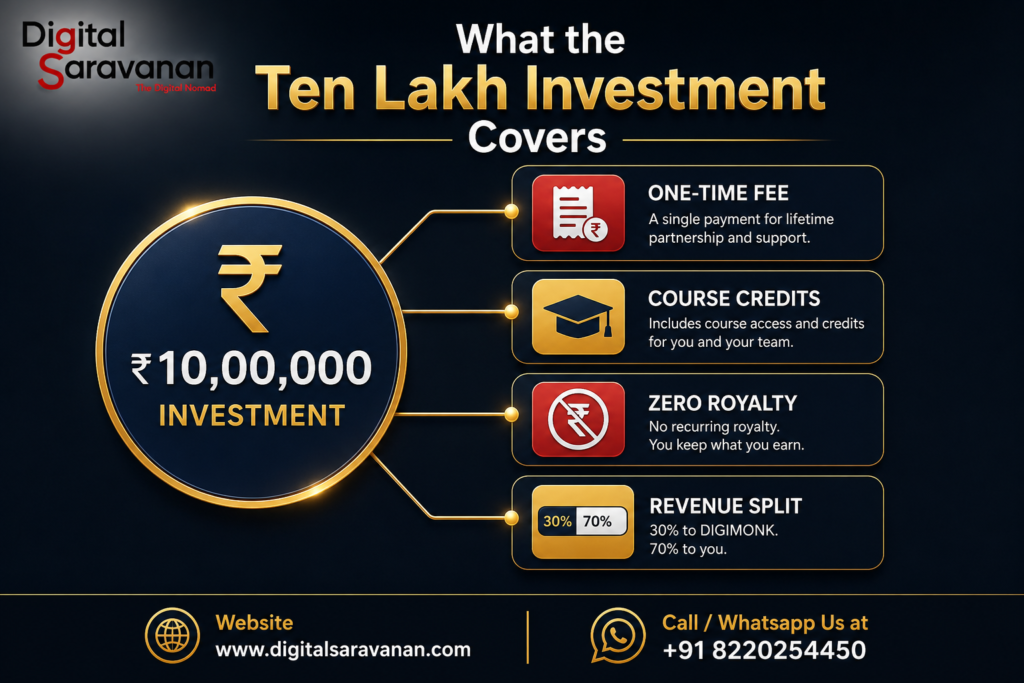
The DIGIMONK DIGITAL SOLUTIONS franchise carries a one time investment of ten lakh rupees.
The full amount is payable before franchise activation.
There is no monthly royalty and no hidden charge structure layered on top.
| Component | Structure | Notes |
| Franchise investment | Ten lakh rupees, one time | Payable in full before activation |
| Monthly royalty | None | No recurring percentage on partner revenue |
| Hidden charges | None stated | Confirm scope in writing before payment |
| Course credits | Five lakh rupees in value | Sales inventory, not returned capital |
| Self executed project revenue | One hundred percent to partner | Partner delivers independently |
| Head office assisted revenue | Fifty percent to each party | Applies where head office delivers |
| Agreement term | To be confirmed with head office | Request written term and renewal basis |
Two rows in that table deserve direct comment rather than quiet inclusion.
The first concerns course credits, which are addressed in the next section because the framing genuinely matters.
The second concerns agreement term, which is not specified in the published franchise material and should therefore be requested in writing before any payment is made.
Any prospective partner should also confirm territory rights, exclusivity radius, renewal conditions, and exit provisions in the same document.
These are standard questions rather than sceptical ones, and a well run franchisor expects them.
Weighing the Digital Marketing and AI Franchise in India Fee Against Alternatives
Additionally, ten lakh rupees is real capital and should be assessed against the alternative use of that money.
An independent launch costs less upfront but carries the credibility, pricing, and delivery risks described earlier in this guide.
A digital marketing and AI franchise in India converts part of that execution risk into a fixed cost.
Whether that conversion is worthwhile depends entirely on how much the individual partner already knows.
This is an honest assessment only the partner can make.
Key takeaway: treat the fee as buying compressed learning time and a delivery system.
Then judge it against what your own trial and error would cost in months and lost revenue.
Course Credits in a Digital Marketing and AI Franchise in India
Each franchise partner receives five lakh rupees worth of DIGIMONK Academy course credits.
Partners can sell eligible courses and retain the entire revenue until those allotted credits are exhausted.
This is a genuinely useful component, and it also requires careful interpretation.
The credits are sales inventory rather than returned capital.
Five lakh rupees of credits converts into five lakh rupees of income only if the partner successfully sells the full allocation.
Therefore, the correct way to read this component is as a revenue opportunity with a defined ceiling, not as a discount that halves the effective investment.
Framing it as a discount would be a mistake.
Any prospective partner who has been told otherwise should seek clarification.
That said, the commercial logic behind the component is sound.
Course sales give a new partner something to sell in month one, before any agency retainer has been signed.
Selling training is considerably easier than selling a twelve month marketing retainer.
This is because the price point is lower and the buying decision is faster.
Consequently, the credits function as an early cash flow bridge and as sales practice on a forgiving product.
Moreover, course buyers are natural agency prospects.
A business owner who buys AI training frequently concludes within weeks that implementation would be faster if someone else handled it.
That conversion path from learner to client is the real strategic value of the credit allocation.
Key takeaway: value the credits as month one sales inventory and a lead source for agency work, and do not model them as capital returned.
Revenue Model of the Digital Marketing and AI Franchise in India
The revenue structure has two paths, and the difference between them is worth understanding before signing.
Where the partner executes a project independently, the partner retains one hundred percent of the revenue.
Where head office assists with delivery, revenue is shared equally between the partner and DIGIMONK GROUP.
This creates a clear economic gradient across the life of the business.
In early months a partner will lean heavily on head office support.
This is because capability is still being built and reputation depends on delivery quality.
During that period the effective margin is lower.
This is the price of not failing in front of a first client.
Subsequently, as the partner’s own team develops, more work moves into the fully retained category.
Therefore, margin should improve over time as a direct function of capability built rather than as a matter of luck.
The Decision the Partner Controls
Notably, this structure also creates a decision the partner controls.
A complex client can be accepted with head office support at half revenue, or declined.
Half of a large project usually beats none of it, particularly when the resulting case study unlocks similar work later.
Consequently, the shared delivery route is best understood as capacity that can be purchased per project rather than as a permanent tax.
However, one caution belongs here.
A partner who never builds independent capability remains permanently at half margin, which is a comfortable trap.
This digital marketing and AI franchise in India rewards deliberate capability transfer, and that transfer will not happen accidentally.
Key takeaway: plan an explicit timeline for moving service lines from assisted delivery to independent delivery.
This is because margin improvement depends on that transition rather than on revenue growth alone.
The AI Training Revenue Line in a Digital Marketing and AI Franchise in India
Many people searching for an AI training franchise in India or an AI academy franchise are looking for a coaching centre model, meaning a physical institute enrolling batches of students.
DIGIMONK DIGITAL SOLUTIONS is not structured that way, and the distinction should be clear before anyone proceeds.
It is an agency franchise that carries an education revenue line inside it.
A partner is not licensed to operate a branded institute with a fixed syllabus and enrolment calendar.
Instead, a partner receives five lakh rupees worth of DIGIMONK Academy course credits and can sell eligible courses while retaining the full revenue until the allocation is exhausted.
Anyone specifically seeking a standalone AI education franchise or learning centre model should confirm directly with head office whether such a structure is available separately.
What the Education Line Actually Permits
The practical scope of the training revenue line is worth stating plainly.
| Activity | Available to a Partner | Notes |
| Selling DIGIMONK Academy courses | Yes, within the credit allocation | Full revenue retained until credits are used |
| Running local AI workshops | Yes | Strong pipeline generator for agency work |
| Corporate training engagements | Yes, as an agency service | Typically higher value than retail course sales |
| Digital marketing training delivery | Yes | Uses the same curriculum base |
| Operating a branded physical institute | Not described in the franchise terms | Confirm separately with head office |
| Issuing independent certification | Not described in the franchise terms | Confirm separately with head office |
| Modifying course content | Not described in the franchise terms | Confirm separately with head office |
The bottom three rows are gaps in the published terms rather than confirmed restrictions.
Anyone whose business plan depends on those activities should obtain written confirmation before paying.
Why Training Is the Fastest Revenue Line to Open
Inside a digital marketing and AI franchise in India, course sales become available before agency capability matures, and that sequencing matters more than the absolute amounts involved.
A twelve month marketing retainer requires trust, a case study, and often a procurement process.
A training seat requires none of those, because the price point is low and the buyer can evaluate the decision alone.
Consequently, a new partner can generate revenue in the first weeks rather than waiting for the first agency contract.
Furthermore, training sales build the exact skill a partner will need later.
Selling a course teaches objection handling, follow up discipline, and closing on a product where mistakes cost little.
By the time the partner pitches a substantial retainer, those reflexes are already established.
Workshops Convert Better Than Advertising
The strongest use of the education line is not retail course selling at all.
It is running local workshops for business owners, which produces three outcomes simultaneously.
The workshop generates immediate revenue, establishes the partner as the local authority, and assembles a qualified list of businesses that have just spent an afternoon thinking about their marketing gaps.
Attendees who implement successfully become advocates, while attendees who find implementation difficult become agency clients.
Therefore, both outcomes serve the business, which is unusual for any single marketing activity.
Moreover, a workshop lets a prospect evaluate the partner for ninety minutes at low risk, whereas an advertisement asks a stranger to trust an unknown brand immediately.
This is why partners who lead with teaching consistently outperform partners who lead with advertising spend.
Corporate Training Is the Underused Segment
Retail course sales attract most attention, and corporate training usually carries better economics.
A single organisation commissioning AI training for a department pays considerably more than the same number of individual seats would generate.
Additionally, corporate engagements open relationships with businesses that have budget for implementation work afterwards.
A company that brings you in to train its team on AI tools frequently concludes within months that outsourcing the implementation would be faster.
Consequently, corporate training functions as paid business development into exactly the client profile a partner wants.
Key takeaway: this is an agency franchise with an education revenue line rather than an institute franchise, and the highest value use of that line is local workshops and corporate training rather than retail course sales.
Training Provided to Every Digital Marketing and AI Franchise in India Partner
Training is the component that determines whether a digital marketing and AI franchise fee produces a business or an expensive certificate.
The DIGIMONK onboarding programme covers technical delivery, commercial skills, and operational management as three separate tracks.
That separation matters, because most agency failures trace to the commercial track rather than the technical one.
Technical Delivery Training
This track covers AI tools, prompt engineering, SEO, Google Ads, Meta Ads, website development, and AI automation.
These are the capabilities a partner sells, and they are also the capabilities most readily learned elsewhere.
Consequently, technical training is necessary but rarely the differentiating component of a digital marketing and AI franchise offer.
Commercial Training
This track covers proposal writing, the sales process, client acquisition, and lead generation.
Here the digital marketing and AI franchise advantage is substantial and genuinely difficult to replicate independently.
A proposal template refined across hundreds of engagements encodes information a new operator cannot obtain any other way.
These include what to price, how to structure scope, and which objections to pre empt.
Moreover, sales process training addresses the specific reason most technically competent operators fail.
This is inability to convert conversations into signed agreements.
Operational Training
This track covers CRM, business operations, team building, and branding.
Operational training becomes critical around the point where a partner reaches four or five concurrent clients.
Below that threshold personal organisation suffices, and above it the absence of systems produces missed deadlines and client loss.
Therefore, partners should engage with this track before they need it rather than after the first delivery failure.
Key takeaway: judge the training on its commercial and operational depth.
This is because technical content is widely available while pricing intelligence and delivery systems are not.
The DIGIMONK AI Agency Readiness Framework
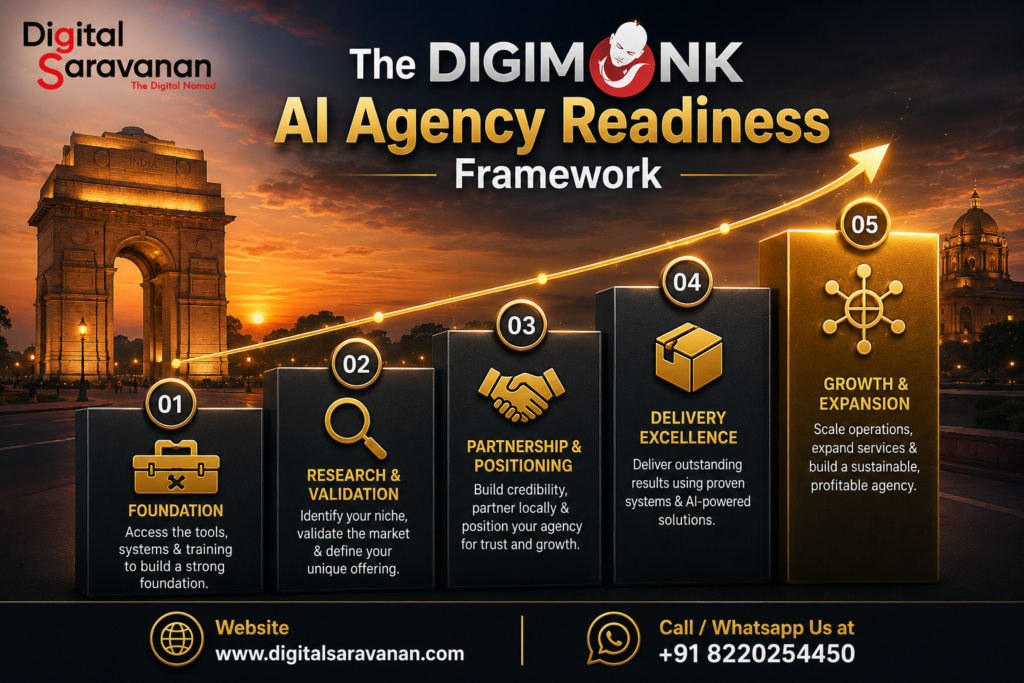
Prospective partners frequently ask whether they are ready, and the honest answer requires a structured assessment rather than encouragement.
The following framework sets out the five capability stages a partner moves through.
Each stage is paired with the marker showing it has genuinely been reached.
| Stage | Capability Focus | Evidence of Completion | Typical Timeline |
| Stage one: Foundation | Tool fluency across AI, SEO, and paid media | Can independently produce a campaign asset set | Month one to two |
| Stage two: Diagnosis | Translating business problems into service scope | Can write a scoped proposal without assistance | Month two to four |
| Stage three: Conversion | Pricing, objection handling, and closing | Has signed three paying clients | Month three to six |
| Stage four: Delivery | Consistent execution without head office support | Has delivered two projects at full retained revenue | Month six to twelve |
| Stage five: Scale | Team building, systems, and account expansion | Has expanded an existing account twice | Month twelve onward |
The timelines above are indicative ranges rather than commitments, and individual progress varies considerably with prior experience and time invested.
However, the sequence itself is reliable.
Partners who attempt stage three before completing stage two consistently underprice.
This is because they are selling work they cannot yet scope accurately.
Similarly, partners who reach stage four without deliberate effort at stage two struggle to expand accounts later.
Key takeaway: use the evidence column rather than the timeline column to judge progress.
This is because activity and capability are not the same thing.
Support Behind the Best Digital Marketing and AI Franchise in India
Beyond training, DIGIMONK provides ongoing support across business setup, marketing materials, proposal templates, sales decks, business standard operating procedures, technical support, AI workflows, branding, and business consultation.
The distinction between training and support is worth drawing clearly.
Training is finite and front loaded, whereas support is continuous and demand driven.
A partner facing an unusual client requirement in month fourteen needs support rather than another training module.
Consequently, prospective partners should ask specific questions about support availability.
These include response times, escalation routes, and whether technical support extends to live client work or only to internal queries.
Furthermore, the standard operating procedures deserve particular attention during evaluation.
Documented processes are the single most valuable asset transferred in a services franchise.
This is because they represent accumulated correction of past mistakes.
Ask to see a sample before committing, since the quality of that documentation predicts the quality of everything else.
Key takeaway: support quality is harder to assess than training content, so ask for concrete response commitments and a sample standard operating procedure before signing.
Technology Stack and AI Tooling
An AI powered agency runs on a defined stack rather than on whichever tool an operator happens to prefer.
Standardisation is the point, because a shared stack allows head office to support partners, allows partners to support each other, and allows workflows to transfer without rebuilding.
The stack spans several functional layers.
Content and creative generation covers AI writing, image generation, and video creation.
Automation covers chatbot deployment, WhatsApp workflows, and internal process automation.
Campaign management covers Google Ads, Meta Ads, and organic search tooling.
Client management covers CRM, reporting, and communication.
Development covers website building, mobile applications, and custom software delivery.
Notably, the specific products inside each layer will change.
Any digital marketing and AI franchise promising a permanent tool set is describing something unrealistic.
What should remain stable is the workflow architecture, meaning the sequence of steps and the quality checks at each stage.
Therefore, ask how the franchisor handles tool transitions.
This is because that answer reveals whether the operation is built on process or on habit.
Key takeaway: the durable asset is the workflow architecture rather than any specific tool, so evaluate how the franchisor manages change rather than which products it currently uses.
Who Should Consider a Digital Marketing and AI Franchise in India
DIGIMONK positions this digital marketing and AI franchise in India as suitable for entrepreneurs, business owners, students, freelancers, IT professionals, marketing professionals, agency owners, trainers, consultants, startup founders, and career switchers.
No prior agency experience is treated as mandatory provided the partner is willing to learn and follow the system.
That is a genuinely wide door, and it therefore deserves a more granular reading.
| Partner Background | Natural Advantage | Primary Gap to Close |
| Freelancer or marketer | Existing delivery skill and client familiarity | Pricing discipline and business systems |
| IT professional | Technical confidence and process thinking | Sales conversation and commercial framing |
| Existing agency owner | Established client base to expand | Adopting a new delivery architecture |
| Trainer or consultant | Strong audience and credibility | Delivery capacity for implementation work |
| Business owner | Commercial judgement and network | Time allocation across two businesses |
| Student or career switcher | Time availability and learning speed | Credibility with first clients |
A Candid Note on Fit for a Digital Marketing and AI Franchise in India
The final row warrants candour rather than encouragement.
A student or recent graduate can absolutely learn the technical work, and many do so faster than experienced professionals.
However, ten lakh rupees is a substantial commitment against an income that has not yet started, and credibility with first clients takes longer to establish without prior professional history.
Anyone in that position should model a realistic runway of at least nine months before the business covers personal costs.
Conversely, freelancers and existing consultants typically reach profitability fastest.
This is because they arrive with an audience and only need the systems layer.
Key takeaway: the best digital marketing and AI franchise in India suits people who already have either delivery skill or an audience.
Those who have neither should plan a longer runway and a smaller initial ambition.
Day to Day Operations Inside an AI Powered Agency
Franchise material rarely describes what the work actually looks like on a Tuesday, yet that is what determines whether someone will sustain it.
A functioning agency week divides into four recurring blocks.
Client Delivery
This block covers campaign management, content production, reporting, and technical implementation.
It typically consumes the largest share of time, and it is also the block most improved by AI tooling.
Work that once required continuous attention now runs in concentrated sessions, which frees capacity for the remaining blocks.
Client Communication
This block covers status calls, expectation management, scope discussions, and problem escalation.
It cannot be automated, and attempts to automate it consistently damage relationships.
Notably, agencies lose more clients to poor communication than to poor results.
That makes this block disproportionately important relative to the time it consumes.
Business Development
This block covers prospecting, proposals, follow up, and networking.
New partners systematically neglect it once delivery work arrives, which produces a predictable revenue trough three to four months later.
Therefore, protecting fixed time for business development regardless of delivery load is one of the highest value operational disciplines available.
Capability Building
This block covers learning, workflow refinement, and process documentation.
It generates no immediate revenue and is consequently the first casualty of a busy month.
However, it is the block that moves work from assisted delivery into fully retained delivery.
This makes it directly responsible for margin improvement.
Key takeaway: business development and capability building produce no revenue this week and determine revenue in six months.
That is why both need protected time rather than leftover time.
How to Acquire Clients in a Digital Marketing and AI Franchise in India
Client acquisition is the area where new partners most commonly underperform, and the reason is usually strategic rather than tactical.
They market themselves as a digital marketing agency to a general audience, which is the most competitive possible position.
A more effective approach narrows in two directions simultaneously.
Narrow by Geography
Local presence remains a genuine advantage for any digital marketing and AI franchise in India, particularly outside the largest metros.
A business owner in Salem or Tiruppur will often choose a competent local partner over a stronger firm three hundred kilometres away.
Consequently, local search visibility, regional business associations, and community networks produce disproportionate returns relative to broad digital advertising.
Narrow by Industry
For a digital marketing and AI franchise in India, specialising in a small number of industries compounds unusually fast.
The second client in a sector costs far less to acquire than the first.
This is because the case study, the pricing knowledge, and the sector vocabulary already exist.
By the fourth or fifth client in the same industry, referrals begin arriving without active prospecting.
Therefore, three deep sectors beat fifteen shallow ones over any horizon longer than a year.
Lead With Training Rather Than Retainers
The course credit allocation supports a particularly effective acquisition sequence.
Running a paid workshop for local business owners produces immediate revenue, establishes authority, and generates a qualified prospect list in a single activity.
Attendees who implement successfully become advocates, while those who find implementation difficult become agency clients.
Both outcomes serve the business, which is unusual for a marketing activity.
Key takeaway: narrow by geography and industry, then lead with training rather than retainer pitches.
This is because teaching creates trust faster than selling does.
Understanding the Economics of Agency Services in India
This section requires an explicit caveat before any figures appear.
DIGIMONK has not published franchisee performance data, and no earnings projection appears here for that reason.
The ranges below describe observable market pricing for agency services in India.
This is a different thing from what any individual partner will earn.
Actual outcomes depend on local market conditions, the partner’s sales capability, delivery quality, and effort, and they vary enormously between operators.
| Service Line | Indicative Market Range | Billing Basis | Notes on Variation |
| Local SEO retainer | Fifteen thousand to sixty thousand monthly | Monthly retainer | Varies with city and competition |
| National SEO retainer | Fifty thousand to two lakh monthly | Monthly retainer | Depends on sector difficulty |
| Paid media management | Fifteen thousand to seventy five thousand monthly | Retainer or percentage of spend | Often tied to ad budget size |
| Website development | Forty thousand to five lakh per project | Project fee | Scope dependent |
| Chatbot or automation build | Thirty thousand to two lakh per build | Project plus maintenance | Complexity dependent |
| Corporate training or workshop | Twenty thousand to two lakh per engagement | Day rate or per head | Audience size dependent |
| Branding and identity | Fifty thousand to three lakh per project | Project fee | Deliverable count dependent |
What These Ranges Mean for a Digital Marketing and AI Franchise in India
These ranges are wide for a reason that prospective partners should absorb carefully.
The same service sells for four times as much depending on how it is positioned, who is buying, and whether the seller can articulate business impact.
Consequently, the difference between the bottom and the top of each range is mostly a sales capability difference rather than a delivery quality difference.
That observation should shape where a new partner invests learning time.
Furthermore, sustainable agency economics depend on retention rather than acquisition.
A client retained for twenty four months at a moderate retainer is worth substantially more than a client won at a premium rate who leaves after four.
Therefore, delivery consistency and communication discipline are revenue functions rather than administrative ones.
Key takeaway: pricing variation within each service line reflects sales capability more than delivery capability, and retention matters more than headline rate.
Revenue Building Sequence for the First Year
Rather than projecting income, it is more useful to describe the sequence in which revenue lines typically become available.
| Period | Realistic Focus | Revenue Source Available | Common Mistake |
| Months one to three | Training completion and local visibility | Course sales from credit allocation | Waiting until training feels complete before selling |
| Months three to six | First agency clients with head office support | Shared revenue projects | Underpricing to win the first client |
| Months six to nine | Independent delivery on familiar services | Fully retained project revenue | Neglecting business development while delivering |
| Months nine to twelve | Account expansion and retainer conversion | Recurring monthly retainers | Chasing new logos instead of growing existing ones |
| Year two | Team building and service line depth | Expanded retainers and larger projects | Scaling delivery before systems are documented |
The mistake column is drawn from the failure patterns described earlier in this guide.
Each one is avoidable with deliberate attention.
Notably, the most damaging entry is the first, since partners frequently delay selling until they feel fully prepared.
Preparation has no natural end point, and the market teaches faster than any curriculum does.
Key takeaway: revenue lines unlock in sequence rather than simultaneously, so plan cash flow around that sequence instead of assuming full service capability from month one.
Common Myths About Owning a Digital Marketing and AI Franchise in India
Several assumptions recur in conversations with prospective partners, and most of them are worth correcting before money changes hands.
Myth One: A Franchise Guarantees Clients
It does not, and no credible franchisor claims otherwise.
A digital marketing and AI franchise supplies brand credibility, training, systems, and support, all of which make client acquisition easier.
However, the partner still conducts the meetings, sends the proposals, and closes the agreements.
Anyone expecting inbound leads to arrive automatically has misunderstood what the fee purchases.
Myth Two: AI Removes the Need for Skill
AI removes execution labour rather than judgement.
Deciding which campaign to run, how to position an offer, and what a result actually means still requires understanding.
In practice AI widens the gap between skilled and unskilled operators.
This is because a skilled operator directs it toward the right problem while an unskilled one produces polished work that answers the wrong question.
Myth Three: The Market Is Too Crowded
The market for a digital marketing and AI franchise in India is genuinely crowded at the low end, where undifferentiated operators compete on price.
It remains underserved at the level of businesses that want measurable outcomes and cannot find a partner who reliably delivers them.
Consequently, crowding is a positioning problem rather than a market size problem.
Myth Four: Passive Income Is Achievable Here
This is the most consequential misconception, and it deserves the bluntest correction.
A digital marketing and AI franchise in India is an operating business that requires daily presence, client contact, and management attention.
It may eventually support a team that reduces the founder’s direct workload.
However, that outcome follows years of building rather than the initial investment.
Myth Five: Ten Lakh Rupees Buys a Finished Business
The investment buys a starting position rather than a running enterprise.
A partner still needs working capital for operating costs during the ramp period.
There is also personal runway until the business covers living expenses.
Therefore, prospective partners should budget beyond the digital marketing and AI franchise fee rather than treating it as the total cost of entry.
Key takeaway: a digital marketing and AI franchise compresses the learning curve and supplies credibility, and it does not remove the requirement to sell, deliver, and manage.
The Future of AI Agencies Across India
Several trends will shape the digital marketing and AI franchise in India sector over the coming years, and partners who anticipate them will hold an advantage over those who react.
Consolidation at the Low End
Operators selling commodity execution will face compression from clients using AI tools directly.
A business owner who can generate acceptable social content without help will stop paying for social content.
Consequently, agencies that survive will be those selling strategy, integration, and measurable outcomes rather than asset production.
Regional Language Expansion
Digital adoption is growing fastest in markets where English is not the primary business language.
AI tooling for Indian language content has improved substantially, which opens markets that were previously difficult to serve economically.
Therefore, partners operating in Tamil, Telugu, Kannada, and other regional markets hold a structural advantage that national agencies find hard to replicate.
Automation as the Primary Growth Line
Marketing services will remain the entry point for most client relationships.
However, automation and AI implementation are likely to become the larger revenue line within those relationships.
A client spending thirty thousand rupees monthly on marketing may spend considerably more on systems that reduce operating cost across the whole business.
Consequently, partners who build genuine automation capability position themselves for the larger of the two opportunities.
Rising Measurement Expectations
Attribution and reporting will continue improving, and client tolerance for unmeasured activity will continue falling.
Agencies that instrument their work properly will find renewals straightforward.
Meanwhile, those that cannot demonstrate contribution will face annual justification battles.
Key takeaway: the growth is moving toward automation, regional markets, and measurable outcomes, so build capability in those directions rather than in asset production volume.
What Separates a True Expert From an Ordinary Operator
The distinction between practical expertise and theoretical knowledge shows up quickly in agency work.
It is worth setting out concretely.
A theoretical operator knows what the tools do.
A practical expert knows what to do when the campaign underperforms in week three.
This is a fundamentally different body of knowledge.
| Situation | Theoretical Response | Practical Expert Response |
| Campaign underperforming | Adjust targeting and wait | Diagnose whether the problem is offer, creative, audience, or landing page |
| Client requests unrealistic outcome | Agree and attempt delivery | Reframe the goal and document what is achievable |
| Lead volume high, conversion low | Increase ad spend | Examine follow up speed and sales process before adding spend |
| Client disputes attribution | Send the platform report | Reconcile platform data against client revenue records |
| Scope expanding without payment | Absorb the work | Document the change and price it separately |
| Ranking drops after algorithm update | Rebuild content immediately | Establish whether the drop is sitewide, sectional, or query specific |
Why This Knowledge Is Hard to Acquire Alone
Every row in that table represents accumulated experience rather than instruction that can be read once and retained.
This is precisely the knowledge a digital marketing and AI franchise structure exists to transfer.
It is the strongest argument for a digital marketing and AI franchise over independent launch.
Furthermore, it explains why the operating history of the parent organisation matters more than its marketing.
An organisation that has completed 250 client engagements has encountered each of these situations repeatedly and has developed a considered response.
Similarly, training delivered to more than 12,000 entrepreneurs represents a curriculum corrected by contact with real learners rather than designed in isolation.
Key takeaway: practical expertise is knowledge of what to do when things go wrong.
That knowledge only accumulates through volume of real engagements.
Why This Digital Marketing and AI Franchise in India Differs
Several structural choices distinguish this digital marketing and AI franchise in India, and each carries a corresponding implication for the partner.
The absence of monthly royalty means the franchisor cannot rely on passive recurring income and must therefore earn through genuine contribution to delivery.
Revenue sharing on assisted projects gives head office a direct financial interest in those projects succeeding.
The course credit allocation means partners have something sellable before agency capability matures.
Additionally, the AI first orientation means the training addresses current delivery methods rather than adapting older ones.
Moreover, the group’s positioning around Tamil language business education creates access to an audience that most national franchises cannot reach.
That audience represents both a client base and a partner recruitment channel.
However, prospective partners should evaluate these features against their own circumstances rather than accepting them as universally superior.
A partner who wants minimal involvement will find the operating requirement burdensome regardless of structure.
Conversely, an experienced marketer seeking systems and credibility will find the absence of royalty materially valuable over a multi year horizon.
Key takeaway: the best digital marketing and AI franchise in India favours committed operators over passive investors.
That fit question matters more than any individual feature of the offer.
Comparing a Digital Marketing and AI Franchise in India With Other Entry Routes
Buying into the best digital marketing and AI franchise in India is only one of four realistic ways to enter this industry.
Setting them side by side clarifies what the fee actually purchases.
| Entry Route | Upfront Cost | Time to First Revenue | Main Risk | Ceiling |
| Agency employment | None | Immediate | Limited equity and slow skill breadth | Salary growth only |
| Freelancing | Minimal | One to three months | Price competition and income volatility | Personal capacity |
| Independent agency launch | Low to moderate | Six to twelve months | Credibility, pricing, and delivery failure | High but uncertain |
| Digital marketing and AI franchise | Ten lakh rupees | Three to six months typical | Capital at risk before revenue | High with systems support |
Employment, Freelancing, or a Digital Marketing and AI Franchise in India
The employment route deserves more respect than franchise material usually gives it.
Working inside an established agency for two years teaches pricing, delivery, and client management at somebody else’s expense.
Consequently, anyone with no industry exposure and limited capital should weigh that path seriously before committing ten lakh rupees.
Freelancing occupies a similar position with different tradeoffs.
It builds delivery skill quickly and generates income fast.
However, it rarely builds the systems, pricing confidence, or brand credibility needed to move beyond personal capacity.
Many successful franchise partners arrive from exactly this position, having hit the ceiling of what one person can bill.
Independent Launch Is the Closest Alternative
The independent launch is the closest genuine alternative to the best digital marketing and AI franchise in India.
It preserves capital and full ownership of every rupee earned.
Nevertheless, it carries the four failure modes described earlier, namely the first client problem, systematic underpricing, delivery inconsistency, and isolated decision making.
The honest comparison is therefore between paying ten lakh rupees and paying an equivalent amount in lost months, underpriced early contracts, and avoidable mistakes.
Which figure is larger depends entirely on the individual.
Someone with eight years of agency experience will find independent launch cheaper, because they already carry the knowledge a franchise transfers.
Conversely, someone entering from an unrelated field will typically spend more than ten lakh rupees learning the same lessons alone.
Key takeaway: the digital marketing and AI franchise fee is best understood as the price of skipping a learning curve, so the decision hinges on how expensive that curve would be for you specifically.
Choosing a Territory for a Digital Marketing and AI Franchise in India
Territory selection influences outcomes more than most prospective partners expect.
The instinct is to choose the largest available city, on the assumption that more businesses means more opportunity.
That instinct is frequently wrong.
Metro Markets
Chennai, Bengaluru, Hyderabad, and comparable cities contain enormous demand.
They also contain established agencies with a decade of case studies and senior teams.
A new partner competing there needs sharp specialisation to be visible at all.
Therefore, metro entry works best for partners with an existing network or a defined industry niche.
Tier Two Cities
Coimbatore, Madurai, Trichy, Salem, and similar markets often present the strongest balance.
Business density is sufficient to sustain an agency, while the supply of competent providers remains thin.
Moreover, local relationships still drive purchasing decisions in these markets, which favours a resident partner over a remote firm.
Many partners find that a digital marketing and AI franchise in India performs better in these cities than in metros for exactly this reason.
Tier Three and Emerging Markets
Smaller markets carry low competition and correspondingly low price expectations.
A partner may win clients easily and still struggle to reach viable revenue.
Consequently, these markets usually work best as a base combined with remote delivery to larger cities.
The internet removes the geographic constraint on delivery even where it does not remove it from selling.
Additionally, sector concentration deserves attention alongside city size.
Tiruppur has textiles, Coimbatore has engineering, and Madurai has strong retail and healthcare clusters.
A partner who builds depth in the dominant local sector gains referral momentum far faster than one serving scattered industries.
Key takeaway: assess a territory on the ratio of business density to competent supply rather than on population, and identify the dominant local sector before launching.
Risk Factors in Any Digital Marketing and AI Franchise in India
Responsible evaluation requires examining what could go wrong rather than only what could go right.
The following risks apply to this digital marketing and AI franchise in India and to agency franchising generally.
Capital Is Committed Before Revenue Exists
Ten lakh rupees is payable in full before franchise activation.
That capital is at risk during the entire ramp period, and no franchise structure eliminates that exposure.
Therefore, nobody should invest money they cannot afford to lose entirely.
Outcomes Depend Heavily on Sales Ability
Training can teach a sales process, and it cannot supply the temperament to execute one.
Partners uncomfortable with direct commercial conversations struggle regardless of technical competence.
An honest self assessment on this point is more valuable than any market research.
No Published Franchisee Performance Data Exists
DIGIMONK has not published franchisee outcome data, which means prospective partners cannot benchmark against existing results.
This is common among newer franchise programmes and is not evidence of a problem.
However, it does mean the projections a prospective partner builds are assumptions rather than evidence.
Requesting contact with any existing partners is a reasonable step before committing.
Technology Shifts Faster Than Contracts
AI capability is changing rapidly, and some services that command good rates today will be commoditised within a few years.
A digital marketing and AI franchise agreement signed now covers a market that will look different by its renewal date.
Consequently, evaluate whether the franchisor demonstrates a track record of updating its systems rather than only its marketing.
Brand Name Overlap in the Market
Several unrelated Indian companies operate under similar names, which can create confusion in search results and in client conversations.
Prospective partners should confirm what trademark protection exists for the brand they are licensing and what recourse applies if confusion affects their territory.
This is a routine due diligence question rather than an accusation, and any established franchisor will have a documented answer.
Key takeaway: none of these risks disqualifies the model, and each one deserves a written answer from the franchisor before capital is committed.
Scoring DIGIMONK Against the Best Digital Marketing and AI Franchise in India Criteria
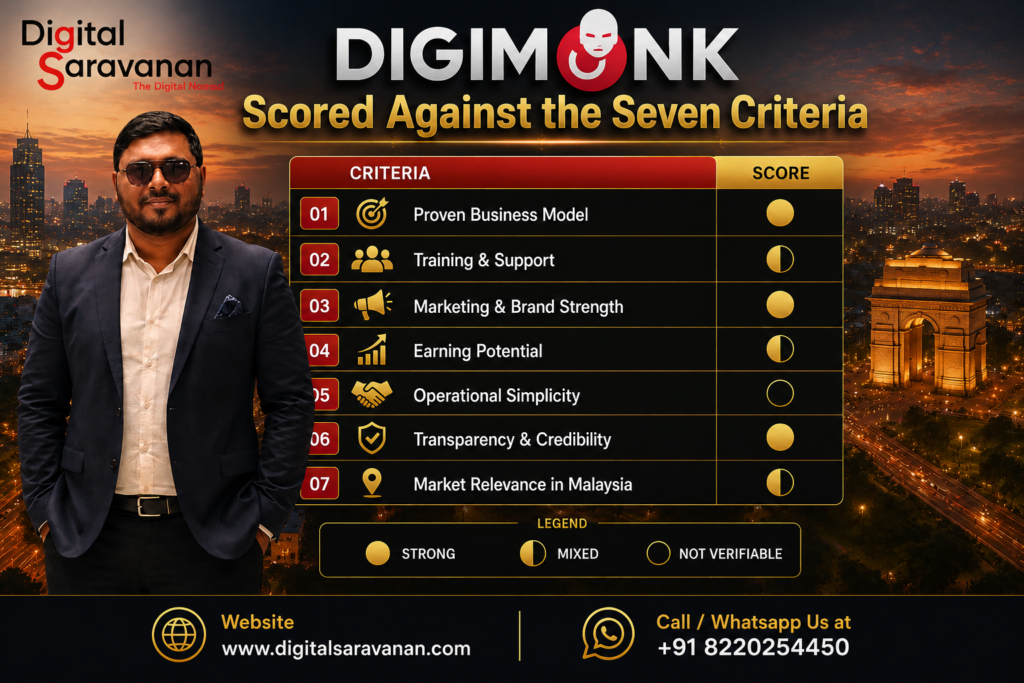
The seven criteria for the best digital marketing and AI franchise in India now get applied directly.
Two of the seven cannot be scored from published information, and those gaps are shown as gaps rather than assumed favourable.
| Criterion | Assessment | Evidence or Gap |
| Operating history | Strong | 250+ clients across 12+ countries, 8+ years, 12,000+ trained |
| Fee structure | Strong | One time ten lakh fee, no monthly royalty on partner revenue |
| Commercial training | Strong | Proposal writing, sales process, client acquisition taught as a distinct track |
| Support depth | Not verifiable | No published response times or escalation commitments |
| Revenue timing | Strong | Course credits open a revenue line before agency capability matures |
| Territory logic | Not verifiable | No published exclusivity radius or territory definition |
| Disclosure honesty | Mixed | Terms are clearly stated, franchisee outcome data is absent |
Three observations follow from that table, and each is worth stating directly.
Where the Model Is Genuinely Strong
The fee structure is the clearest advantage available here.
A perpetual royalty of even eight percent on revenue costs a successful partner far more over five years than a ten lakh entry fee does.
Consequently, the absence of ongoing royalty favours partners who intend to grow rather than partners who plateau.
Operating history is the second clear strength, and it is the criterion carrying the heaviest weight in the framework.
Anyone comparing this against alternatives for the best digital marketing and AI franchise in India will find that many competing offers cannot evidence comparable delivery volume.
Revenue timing is the third strength, since the education line lets a partner sell something in week two rather than month five.
Where the Information Is Incomplete
Support depth and territory logic cannot be assessed from published material, and that is a genuine gap rather than a criticism.
Newer franchise programmes commonly formalise these terms after the first cohort of partners rather than before.
However, a prospective partner should not treat unstated terms as favourable terms.
Request the exclusivity radius, the agreement term, renewal conditions, exit provisions, and written support response commitments.
If those arrive quickly and in writing, both criteria convert from unknown to strong.
If they do not arrive, that response is itself the answer.
Where an Honest Assessment Marks It Down
Disclosure scores mixed rather than strong for one specific reason.
The commercial terms are stated with unusual clarity, including the exact fee, the revenue split, and the credit allocation.
That transparency compares well against franchise material that hides fee structures behind enquiry forms.
Nevertheless, no franchisee outcome data exists, which means a prospective partner cannot benchmark realistic expectations against anyone who has already done it.
This is normal for an early stage programme and it remains a material gap for someone committing ten lakh rupees.
Asking to speak with an existing partner is the correct response, and the answer to that request carries information either way.
How to Apply This Scorecard Elsewhere
The framework above works on any offer, not only this one.
Score each candidate for the best digital marketing and AI franchise in India across the seven criteria, mark unknowns as unknown, and compare the resulting profiles.
A franchise scoring strong on operating history and commercial training with gaps elsewhere is usually a better bet than one scoring moderate across all seven.
This is because the first two criteria determine whether you learn to run the business, while the others determine how comfortable the relationship feels.
Key takeaway: this model scores strongly on operating history, fee structure, commercial training, and revenue timing, and it carries unresolved gaps on support commitments, territory definition, and franchisee outcome evidence.
Frequently Asked Questions About a Digital Marketing and AI Franchise in India
What is the investment for the DIGIMONK digital marketing and AI franchise in India?
The DIGIMONK DIGITAL SOLUTIONS franchise requires a one time investment of ten lakh rupees, payable in full before franchise activation.
There is no monthly royalty on partner revenue and no additional charge structure layered on top of the initial fee.
Included within that investment is five lakh rupees worth of DIGIMONK Academy course credits, which partners can sell while retaining the full revenue until the allocation is exhausted.
However, prospective partners should budget beyond the digital marketing and AI franchise fee itself.
This is because operating costs and personal runway during the initial ramp period are separate requirements.
A realistic total planning figure therefore includes the digital marketing and AI franchise investment plus several months of working capital.
Is a digital marketing and AI franchise in India profitable?
Profitability depends almost entirely on the individual partner rather than on the digital marketing and AI franchise model.
Any franchisor claiming otherwise should be treated with caution.
DIGIMONK has not published franchisee performance data, so no earnings figure can be responsibly quoted here.
What can be stated is that agency services in India carry healthy gross margins once delivery capability exists.
This is because the primary input is skilled time rather than inventory or physical premises.
Furthermore, the absence of monthly royalty means margin improves as the partner builds independent delivery capability, rather than remaining permanently reduced by a percentage payment.
The realistic determinants are sales capability, client retention, and the speed of moving work into independent delivery.
Do I need prior experience to start a digital marketing and AI franchise in India?
Prior agency experience is not treated as mandatory, provided the partner is willing to learn the system and follow it.
The onboarding programme covers technical delivery, commercial skills, and business operations as separate tracks.
This addresses the main gaps a newcomer would face.
However, experience does materially affect the timeline to profitability rather than the eligibility to join.
Freelancers, marketers, and consultants who arrive with existing delivery skill or an established audience typically reach revenue fastest.
This is because they only need the systems and credibility layer.
Conversely, someone entering without professional history should plan a longer runway of roughly nine months and set a smaller initial ambition.
How does an AI agency differ from a traditional digital marketing and AI franchise in India?
The difference is structural rather than a matter of which tools appear in the training material.
A traditional agency adds headcount as it adds clients, which keeps margin roughly flat as the business grows.
An AI powered agency adds documented workflows as it adds clients, which allows margin to improve with volume.
Moreover, the service mix differs, since traditional agencies typically sell individual channels while AI powered agencies sell integrated systems that combine channels with automation.
Those integrated systems command higher retainers because they own a larger share of the client outcome rather than a single component of it.
What should I verify before signing a digital marketing and AI franchise in India agreement?
Several items should be confirmed in writing before any payment is made.
A well run franchisor will expect these questions rather than resist them.
Request the agreement term, renewal conditions, exit provisions, territory rights, and any exclusivity radius.
This is because none of these appear in published franchise summaries.
Additionally, ask for a sample standard operating procedure.
This is because the quality of process documentation reliably predicts the quality of the wider support operation.
Clarify support response commitments, escalation routes, and whether technical support extends to live client work or only to internal partner queries.
Finally, confirm exactly which courses qualify under the credit allocation and whether any expiry applies to unsold credits.
How long does it take to build revenue with a digital marketing and AI franchise in India?
Revenue lines unlock in sequence rather than arriving together, and planning around that sequence prevents most cash flow difficulties.
Course sales from the credit allocation are available earliest.
This is because they carry a lower price point and a faster buying decision than agency retainers.
Agency projects delivered with head office support typically follow, which generates revenue at a shared rate while capability is still developing.
Independently delivered work at full retained revenue usually becomes available once the partner has completed several supported projects and built confidence in the delivery process.
Recurring retainers, which produce the most stable economics, generally emerge once initial clients have seen results worth continuing.
Final Assessment on the Digital Marketing and AI Franchise in India
A digital marketing and AI franchise in India makes commercial sense under a specific set of conditions rather than universally.
It suits someone who intends to operate the business daily, who values compressed learning time over lower entry cost, and who has sufficient capital to cover both the fee and a realistic runway beyond it.
This route does not suit someone seeking passive returns, nor someone who expects clients to arrive without selling.
It also fails to suit someone whose entire available capital would be consumed by the initial investment.
The DIGIMONK DIGITAL SOLUTIONS structure carries genuine advantages.
Chief among these are the absence of monthly royalty and the incentive alignment of revenue sharing.
Furthermore, the parent organisation carries verifiable operating history across 250 clients in more than twelve countries and training delivered to more than 12,000 Tamil entrepreneurs.
That history matters because the value of the best digital marketing and AI franchise in India lies in transferred experience.
Experience only accumulates through volume of real engagements.
Nevertheless, the decision should rest on an honest assessment of fit rather than on the strength of any single feature.
Ask the verification questions listed above, obtain written answers, and model your own runway conservatively before committing capital.